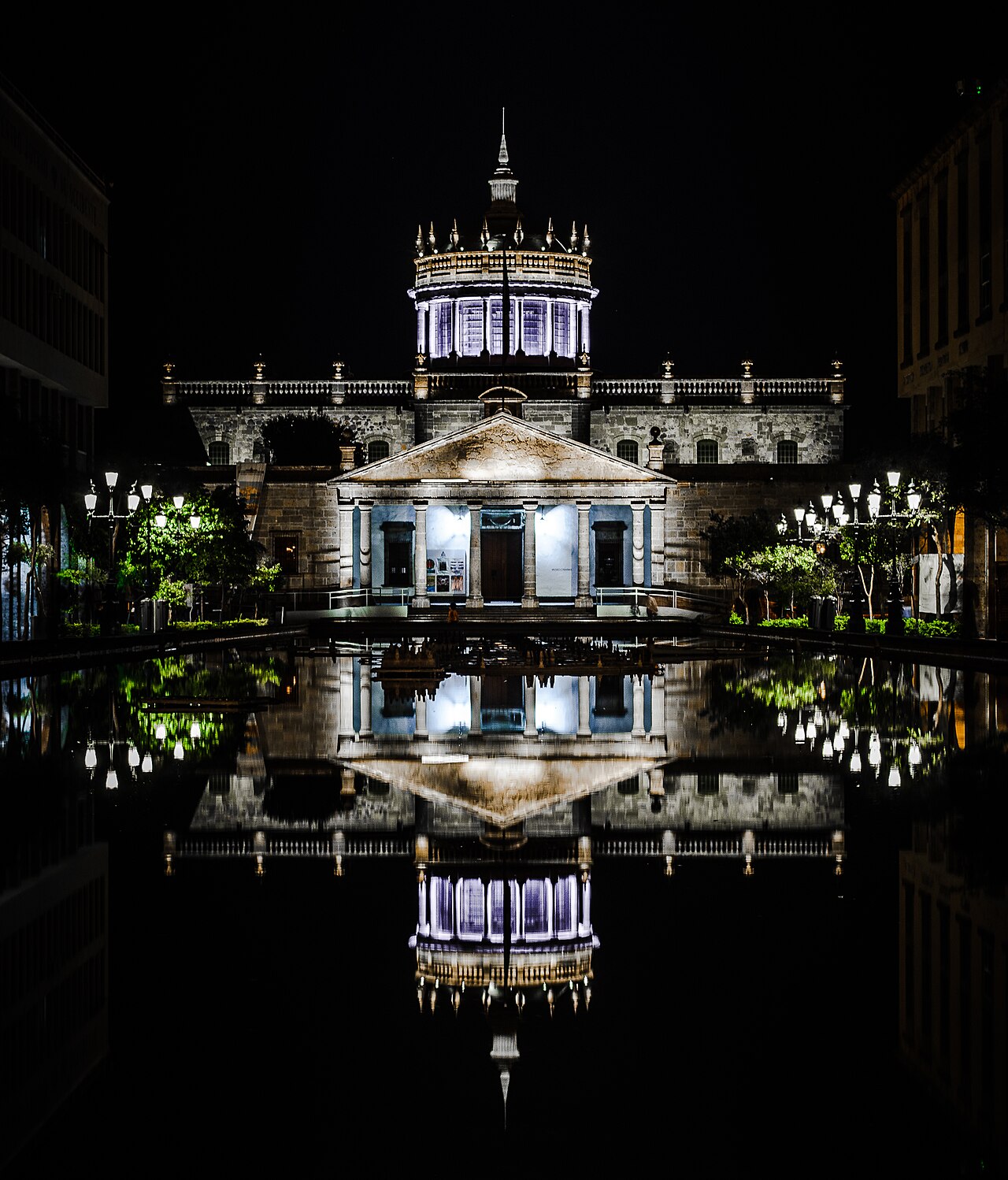
The Hospicio Cabañas opened in 1803 as the Casa de Caridad y Misericordia, a refuge for orphans, the elderly and the sick planned by Bishop Juan Cruz Ruiz de Cabañas, whose name it still carries. Building ran from 1805 to 1810 to a design by the architect Manuel Tolsá, and the result is less a palace than a small city under one roof: the complex has 23 patios, 106 rooms, 78 corridors and two chapels, almost all of it on a single level so that residents who could not climb stairs could still move freely. Over the next century it was damaged in the independence wars and used as a barracks, a prison and a hospice before restoration finished the great dome between 1828 and 1845. Today it houses the Museo Cabañas, run by the Jalisco state culture ministry, and it was inscribed as a UNESCO World Heritage Site in 1997. The reason most people come is the chapel. Between 1938 and 1939 José Clemente Orozco painted a cycle of murals across its walls and vault, and the central dome, with its figure of a man engulfed in fire, is often described as one of the masterpieces of Mexican muralism. The rest of the building holds rotating art exhibitions, a cinema and quiet arcaded courtyards that are a pleasure to wander even when the galleries are crowded.
Understanding the building makes the visit richer. The hospice was designed for care, not display, which is why the plan is so horizontal and so open: long corridors link patio after patio, each with its own light, planting and proportions. Walking the arcades gives you a feel for how colonial Mexico imagined charity, as an ordered, almost monastic community. The chapel at the centre is where the building turns from handsome to extraordinary.
Orozco painted here in the late 1930s, when he was at the height of his powers, and the murals tell a layered story of conquest, faith, violence and human resilience. The viewing arrangement matters: the murals are on the walls and above you, so give yourself time to stand still and look up, and ask whether the venue provides benches or mirrors to ease the strain on your neck.
Working the visit
The museum's own website gives the opening hours as Tuesday to Sunday, from ten in the morning to five in the evening, so plan around a Monday closure and allow the last hour for the chapel if you are short of time. The same page lists adult admission at a modest price in pesos, with discounts for students, seniors and teachers, and shows free entry on Tuesdays, which can mean queues, so go early or choose another day if you like a quiet room.
Temporary exhibitions change through the year and some may carry a separate fee, so look at the programme before you set out. The cinema inside shows films in a dedicated room, an easy addition on a hot afternoon.
Who it suits
Art and architecture lovers, history readers, couples who enjoy a slow cultural morning and anyone who wants to understand why Orozco matters. Children tend to enjoy the size of the place and the fire painting in the dome, although the galleries are better for older kids. The hospice sits at the eastern end of the pedestrian Plaza Tapatía, so you can walk to it from the cathedral in about fifteen to twenty minutes, taking in the fountains and sculpture on the way, and then return to the centre for lunch.
What to expect
The experience
A self-guided visit to a UNESCO-listed colonial hospice, with the Orozco chapel, rotating exhibitions, cinema and a long sequence of arcaded patios.
Best time
Weekday mornings soon after opening, when the chapel is quiet and the light in the patios is soft.
How long
Ninety minutes for the chapel and a quick tour of the patios, up to three hours if you add exhibitions.
Tips
Check the museum's website for the current hours and ticket prices, avoid Mondays when it is closed, and tilt your head back slowly in the chapel to see the dome.
Quick picks
- Best for
- Art and architecture lovers and first-timers who want one deep cultural stop.
- Families
- Older children enjoy the scale and the fire painting; younger ones may tire in the galleries, so keep the visit focused.
- Couples
- A quiet, atmospheric morning, followed by lunch near the Plaza Tapatía.
- Pair with
- The Plaza de Armas, the Guadalajara Cathedral and the Mercado San Juan de Dios on a single walking day.
- Time needed
- Allow two hours for a relaxed visit including the chapel.
Good questions
Why is the Hospicio Cabañas famous?+
It is a UNESCO World Heritage Site and home to a mural cycle painted by José Clemente Orozco in 1938 and 1939. The dome of the chapel, with its figure in flames, is one of the best-known works of Mexican muralism.
What are the opening hours?+
The museum's website gives Tuesday to Sunday, ten in the morning to five in the evening, and it is closed on Mondays. Hours can change for events, so check before you go.
Is there a free day?+
The museum's ticket page shows free entry on Tuesdays. Expect more visitors that day and arrive early.
How long should I allow?+
Plan on at least ninety minutes for the chapel and patios, and up to three hours if you want to see the exhibitions. A cinema on site can add time.
How far is it from the cathedral?+
It is roughly a fifteen to twenty minute walk east along the pedestrian Plaza Tapatía. Taxis and ride services are also quick for the short trip.