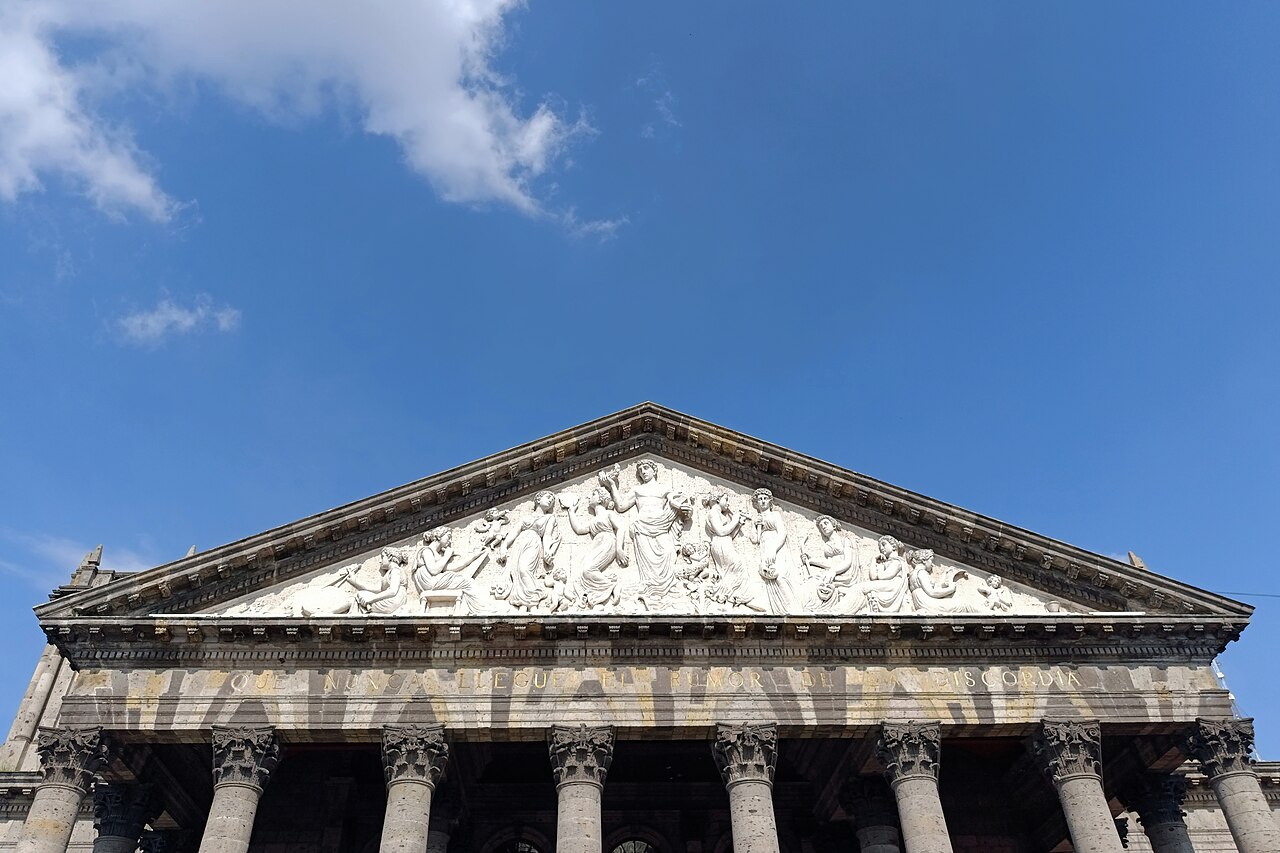
The Teatro Degollado is Guadalajara's grand stage and one of the best-preserved neoclassical theatres in Latin America. Work began in 1856 and the house opened in 1866 with a performance of Donizetti's Lucia di Lammermoor starring the soprano Ángela Peralta, so 2026 marked its 160th anniversary and the city has celebrated with exhibitions and a return to its opening opera. The façade is a columned portico crowned by a travertine high relief by Benito Castañeda, inspired by Apollo and the Muses, with a golden inscription expressing the hope that the sound of discord never reaches the hall. Inside, the horseshoe-shaped auditorium seats around 870 people and is draped in red velvet and gold leaf, with a layout said to echo La Scala in Milan. The ceiling mural depicts the fourth canto of Dante's Divine Comedy and was painted by three Jalisco artists, Jacobo Gálvez, Gerardo Suárez and Carlos Villaseñor. Behind the building a fountain and bronze sculptures by Rafael Zamarripa commemorate the city's founders. The theatre remains the home of the Jalisco Philharmonic Orchestra, so it is a working venue first and a sightseeing stop second.
The theatre stands on the edge of the cathedral plaza, at the start of the pedestrian Plaza Tapatía, which makes it a natural hinge in any walk through the centre. Its steps are a gathering place for locals and a good place to watch the city go by, and the portico is at its most dramatic when lit after dark.
Because it sits so close to the site of the first cathedral, the neighbourhood is also a good place to think about how Guadalajara grew, from a small colonial settlement to the cultural capital of western Mexico. The building has been restored over the years and is protected as a historic monument.
Working the visit
Public viewing of the interior is limited and the schedule varies by source and season. The city's tourism site mentions free weekday visits around midday, while the national tourism site describes weekday doors-open hours in the early afternoon, so treat any hours as a guide and confirm locally on the day. Rehearsals and technical work can close the hall without notice, which is a good reason to treat a look inside as a bonus rather than a plan.
The best way to see it is to attend a performance. Concerts by the Jalisco Philharmonic and visiting companies are advertised on the orchestra's pages and the theatre's own channels, and an evening in the hall is one of the most memorable things you can do in the city for a modest outlay.
Who it suits
Lovers of architecture, music and theatre, couples looking for a dressy night out, and anyone who likes a free viewpoint on civic life. Younger children may find the interior visit short, but the exterior and the nearby plazas are easy and open. Pair it with the cathedral and the Plaza de Armas on the same stroll, then walk east along the Plaza Tapatía toward the Hospicio Cabañas.
If you have a concert ticket, allow time for dinner nearby so that you arrive relaxed, and dress up a little to match the red-and-gold interior.
What to expect
The experience
A look at the neoclassical façade and, when open, the red-and-gold auditorium with its Dante ceiling, or an evening concert in the hall.
Best time
Weekday midday for a look inside, or an evening when a performance is scheduled and the portico is lit.
How long
Thirty to sixty minutes for the exterior and interior, or a full evening for a concert.
Tips
Confirm visiting hours locally since sources differ, check the philharmonic's programme for concerts and dress up a little for a performance.
Quick picks
- Best for
- Music, theatre and architecture fans who want to see how the city dressed itself in the nineteenth century.
- Families
- The exterior and plazas suit children; the interior is better for older kids who can sit still.
- Couples
- Book a concert and dine nearby before the show for a classic Guadalajara evening.
- Pair with
- The cathedral, the Plaza de Armas and the walk along the Plaza Tapatía to the Hospicio Cabañas.
- Time needed
- Allow an hour to include the plaza and a look inside.
Good questions
When did the Teatro Degollado open?+
It opened in 1866 with Donizetti's Lucia di Lammermoor, after construction began in 1856. In 2026 it marked its 160th anniversary.
Can I go inside without a ticket?+
Visits to the interior have been offered on certain weekdays, but hours differ between sources and rehearsals can close the hall. Confirm on the day or buy a concert seat.
Who performs there?+
It is the home of the Jalisco Philharmonic Orchestra and also hosts opera, dance and visiting companies. Check the programme before you travel.
What is the ceiling painting?+
The ceiling mural shows the fourth canto of Dante's Divine Comedy. It was painted by the Jalisco artists Jacobo Gálvez, Gerardo Suárez and Carlos Villaseñor.
Where is it?+
It sits on the edge of the cathedral plaza at the start of the Plaza Tapatía, in the heart of the historic centre. Several recommended hotels are two or three minutes away on foot.