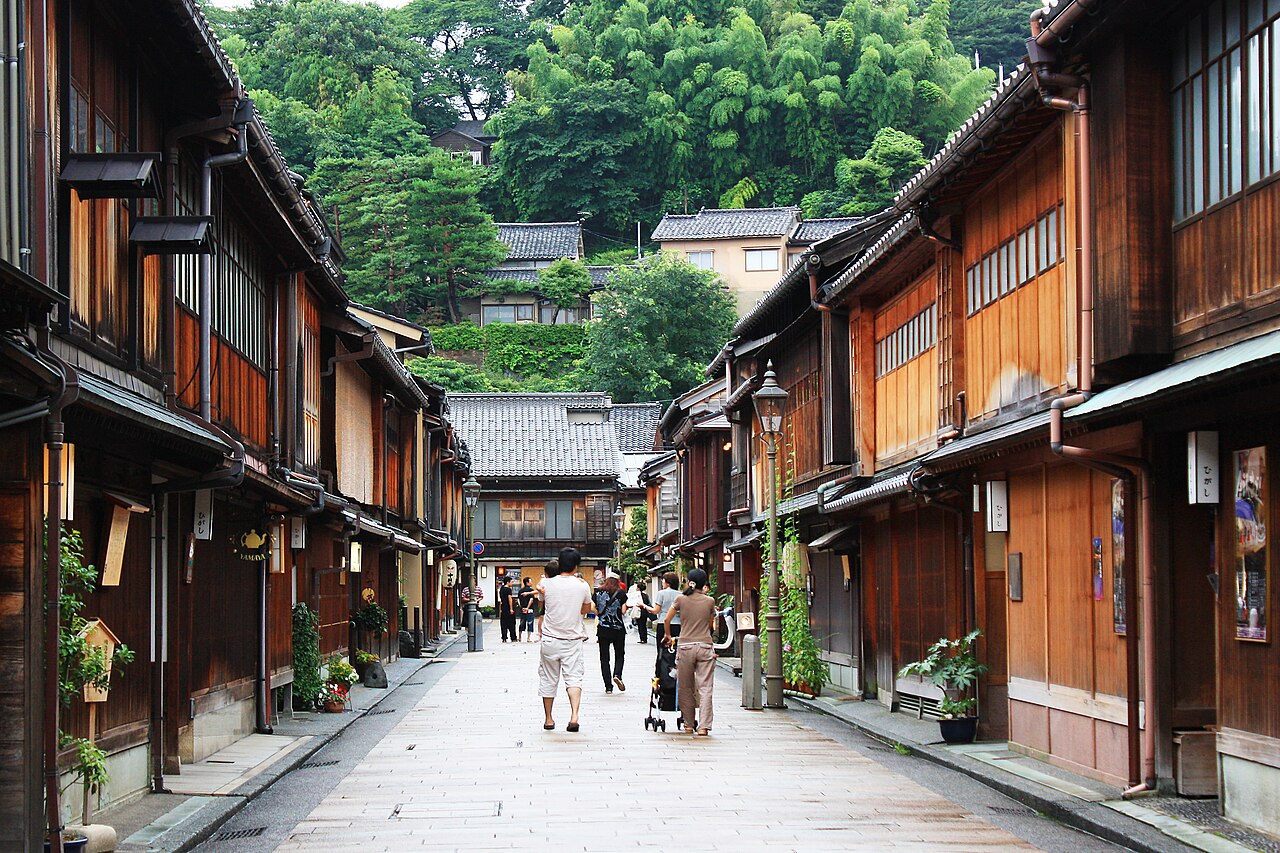
Nagamachi is where the Maeda lords' senior retainers lived, and a few streets keep the look of that era. Earthen walls topped with tile roofs line narrow lanes paved with stone, with a small canal running beside them and straw mats still hung over the walls in winter to protect the clay from frost and snow. The best building to enter is the Nomura House, the former home of the Nomura family, who held senior posts under the Maeda clan for generations. Its rooms have a coffered ceiling of Japanese cypress, sliding doors painted by the Maeda family's own artist and tea rooms facing a small garden. The garden is the highlight, with a stream threading between old stones and a bayberry tree said to be more than four hundred years old, and many visitors sit on the veranda with a bowl of tea and a sweet looking out over it. The quarter is peaceful compared with Higashi Chaya, and it is easy to walk in under an hour.
Reading the street
The clay walls are called tsuchibei, and the reeds or straw mats on top, put up in winter, are one of the quarter's signature seasonal sights. The canal was part of the old water network that supplied the samurai estates, and the lanes zig-zag by design, said to be so that an attacker could not see far. Nomura House's rooms show the contrasts of samurai life: formal reception rooms for visiting dignitaries, and private family quarters opening onto the garden.
Practical planning
The house keeps long daytime hours that shorten in the cooler half of the year, and it closes for a short period at year end and for the first days of January, so check the date. Admission costs a few hundred yen, with reduced prices for children. Shoes come off at the entrance and the rooms are traditional, so socks are a good idea in winter.
There is a tea room where you can sit with a bowl of tea and sweet in front of the garden, and it is worth the small extra cost. The house is about a five-minute walk from the Korinbo stop and a minute from a stop on the flat bus route.
Making a half day of it
Wander the quarter first, enter Nomura House mid-morning and pair it with the Myoryuji temple and the castle park, or take in the D.T. Suzuki Museum and the 21st Century Museum on the same side of the city. Walking tours of the district exist, but the streets are easy to explore alone with a map, and an hour is enough unless you are lingering over tea. Go early to catch the lanes empty, and enjoy the quiet light on the walls.
What to expect
The experience
A self-guided walk through earthen-walled lanes plus a visit to a preserved samurai house with tatami rooms, painted doors and a garden.
Best time
Early morning when the lanes are empty, or late afternoon before the house closes, which is earlier from October to March.
How long
About an hour for the lanes and the house, longer with tea.
Tips
Wear socks for the tatami, check the winter closing time and year-end closure, and take a bowl of tea in the garden room.
Quick picks
- Best for
- Travellers who want a quiet, authentic look at samurai-era homes without the crowds.
- Families
- Children enjoy the lanes and the ninja-style tricks nearby, though the house itself needs quiet voices.
- Couples
- Sit with matcha overlooking the garden and wander the canal-side lanes.
- Pair with
- Myoryuji, Kanazawa Castle Park and Omicho Market.
- Time needed
- Allow about ninety minutes.
Good questions
What is Nagamachi?+
It is the former district of the Maeda lords' retainers, known for earthen walls, stone-paved lanes and a small canal. A few streets and houses keep the atmosphere of the samurai era.
What is inside Nomura House?+
Tatami rooms, a coffered cypress ceiling, sliding doors with painted screens and a prized garden with an old bayberry tree. A tea room lets you sit facing the garden.
When is Nomura House closed?+
It closes in late December and on the first days of January, with shorter opening hours from October to March. Check the tourism board page for the current schedule.
Do I need a guide?+
No, the house has English information and the lanes are easy to walk. A guide helps if you want deeper history of the Maeda domain.
How do I get there?+
Walk about five minutes from the Korinbo bus stop or take the flat bus to the stop beside the house. It is also a walk of about fifteen minutes from Kenroku-en.