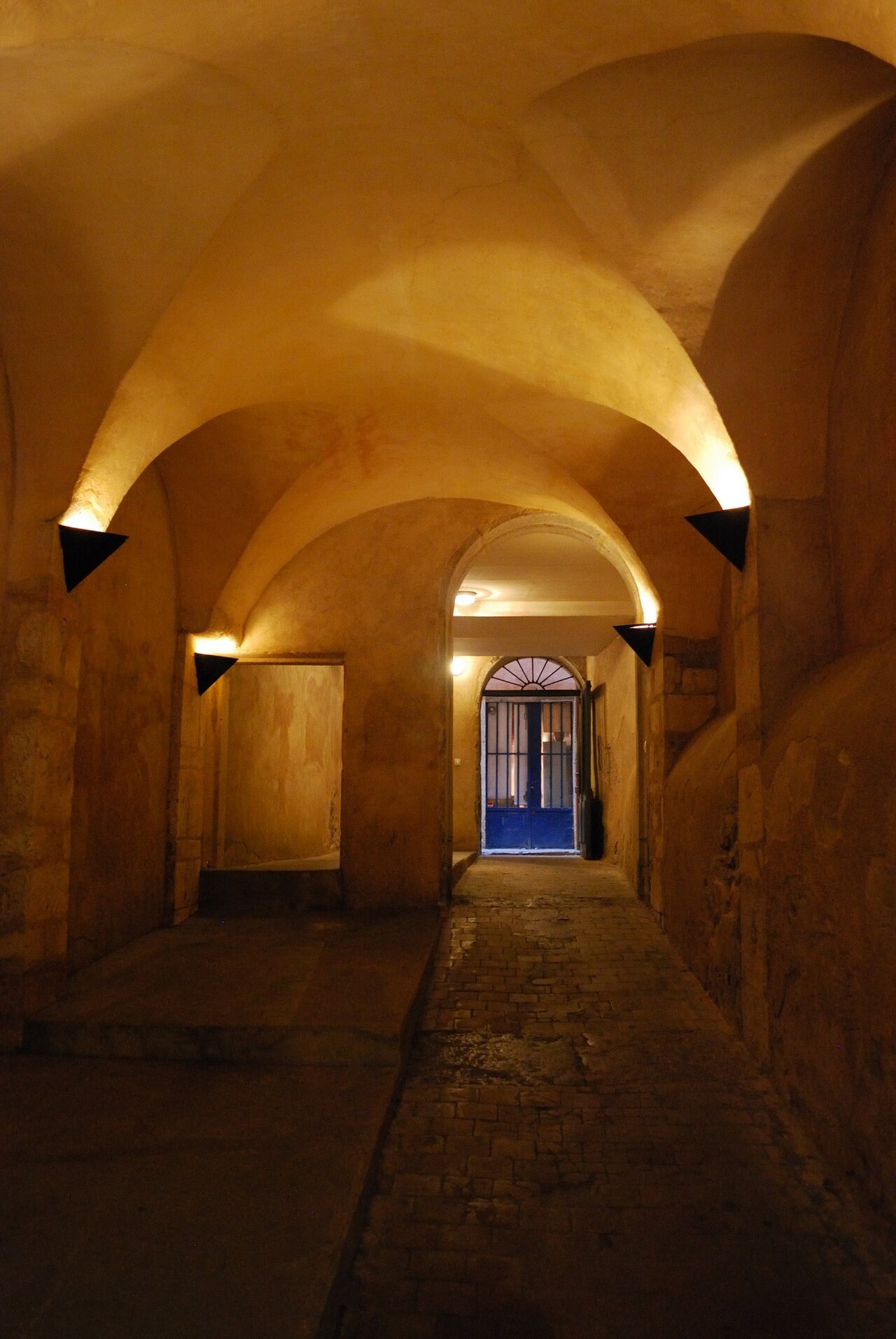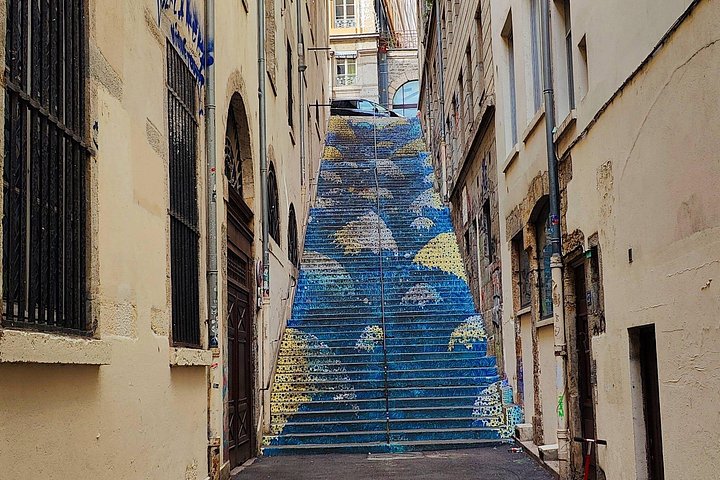
North of the Presqu’île, the slopes of the Croix-Rousse rise sharply above the city, and for nearly two centuries they were the factory floor of Lyon’s silk industry. The weavers, known as canuts, worked at huge Jacquard looms in tall-windowed apartments, and to carry their finished cloth downhill to the merchants without exposing it to rain they used traboules, covered passageways that cut through buildings and courtyards from one street to the next. The Croix-Rousse is the best place to understand how those secret passages worked, because here they were built for work, not for show. Steep staircases, unmarked doors and lofty ceilings still reveal a working past. Today the hill is a lively neighbourhood of independent shops, cafés, artists’ studios and families, with a village feel and a busy morning market along the plateau. Highlights include the Mur des Canuts, a vast trompe-l’oeil mural that depicts a street scene so convincingly that you can mistake it for a real one, and the Grande Côte and the staircases leading down towards the Saône and the Terreaux. A self-guided traboules route through the district makes a good second walk after Vieux Lyon.
How to visit
You can take metro line C, a rack railway that climbs the slope from Hôtel de Ville to the Croix-Rousse plateau, or walk up the steep stairs from Place des Terreaux. Walking up is hard work but rewarding. Many traboules are in private residential buildings that are open at set hours, so keep your voices low, follow the signs and close doors behind you. If you use a self-guided route, make sure you have the route on your phone before you set out.
What to expect
Allow two to three hours. The terrain is steep with a lot of steps, so wear sturdy shoes. The hill has fewer visitors than Vieux Lyon, so you may share a passage with only residents. The Maison des Canuts and silk workshops explain the weaving heritage, and you can see demonstrations of looms at some of them. Cafés on the plateau are good places for a break.
Making the most of it
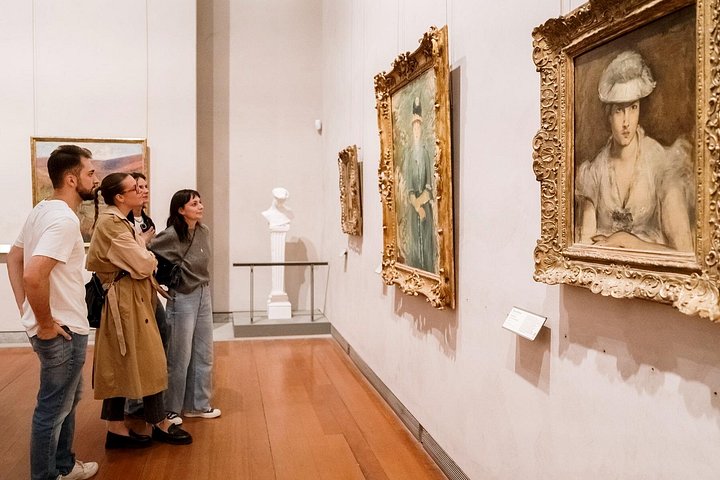
Go in the morning, when the market is lively and the light is soft. Start at the top, visit the mural and the market, and then drift downhill through the traboules to Place des Terreaux, finishing at the Musée des Beaux-Arts. If you are staying in a hotel on the Presqu’île or by the Rhône, the Croix-Rousse is an easy half-day walk from your door. Bring a layer for the breezy plateau and some water in summer.
A little history makes the walk richer: the Jacquard loom, invented in Lyon in the early 19th century, used punched cards to weave elaborate patterns and is often described as an ancestor of the computer. The canuts who operated these machines lived in tall buildings with high ceilings to fit the looms, and they rebelled in the 1830s over pay in uprisings that shaped French labour history.
The hill later had a role in the Resistance during the Second World War, when its passages helped people move unseen. Today the Maison des Canuts and several small silk workshops keep the craft alive, and are good places to see a loom working or to buy a scarf made from Lyon silk.
What to expect
The experience
A self-guided walk through the passageways, staircases and streets of the Croix-Rousse, the old silk weavers’ district.
Best time
Morning, when the plateau market is busy and the light is gentle.
How long
Two to three hours, with café stops.
Tips
Wear sturdy shoes for steep steps, be quiet in residential passages and download your route before you start.
Quick picks
- Best for
- Walkers and history lovers who want a local, less crowded side of Lyon.
- Families
- Older children enjoy the secret passages; the hills and steps are tiring for little legs.
- Couples
- A morning of wandering, coffee and views, then lunch in a neighbourhood bouchon.
- Pair with
- Musée des Beaux-Arts on Place des Terreaux and the Croix-Rousse market.
- Time needed
- Half a morning or afternoon.
Good questions
What is a traboule?+
A traboule is a covered passage through a building or courtyard linking two streets. In Lyon, silk workers used them to carry fabric downhill out of the rain.
How do I get to the Croix-Rousse?+
Take metro line C from Hôtel de Ville up the slope, or walk up the steps from Place des Terreaux. The walk is steep but short.
What is the Mur des Canuts?+
It is a giant trompe-l’oeil mural on the Croix-Rousse that shows a street scene, and it is a popular photo stop.
Are Croix-Rousse traboules open to the public?+
Some are open at set hours, but they are in residential buildings. Keep noise down and follow any posted rules.
How is it different from Vieux Lyon?+
The Croix-Rousse is a lived-in working neighbourhood with a village feel, while Vieux Lyon is a Renaissance old town with more visitors.