Long before the Renaissance, before the silk weavers and before the bouchons, Lyon was Lugdunum, founded in 43 BC and soon the capital of the Three Gauls. The most vivid trace of that world is on the slope of Fourvière hill, where two Roman theatres have been dug out of the earth: the Grand Théâtre, begun under Augustus and built to hold thousands of spectators in tiers cut into the hillside, and the smaller Odéon beside it, used for music and recitations. They are still used today, and in early summer the stone steps fill with audiences for the Nuits de Fourvière festival of music, theatre and dance, so you can sit where Romans once did and watch a modern performance. Beside the theatres, the Lugdunum Museum was built into the hillside in a low, partly underground concrete design from the 1970s, so that you walk down ramps through the collections with the ancient stage visible outside. Inside are inscriptions, sculpture, funerary monuments, glass and some of the finest Roman mosaics in France, along with the famous bronze Claudian Table, which preserves the speech the Emperor Claudius made to the Senate about admitting Gauls to office. A ticket to the archaeological site on the hill makes a good complement to the basilica nearby.
How to visit
The museum and theatres are on Fourvière hill, a few minutes downhill from the basilica and close to the funicular stations. Take a funicular from Vieux-Lyon station towards the Roman theatres stop or the basilica, or walk down from the basilica through the gardens. The museum is closed on Mondays and on 1 January, 1 May and 25 December, usually opens from late morning on weekdays and at ten at weekends, and closes in the early evening.
Entry is free for everyone on the first Sunday of each month. The open-air theatres keep longer hours, opening early in the morning and staying open into the evening in summer and a little earlier in winter. Check what your ticket covers before you go.
What to expect
Allow about two hours, one for the museum and one for the theatres and surrounding ruins, more if you are a classics fan. Slopes and steps make the site less easy for wheelchair users, although the museum itself is organised in a gentle spiral. Little ones enjoy the mosaics and the theatre steps, which are good places to sit and eat a picnic.
Making the most of it
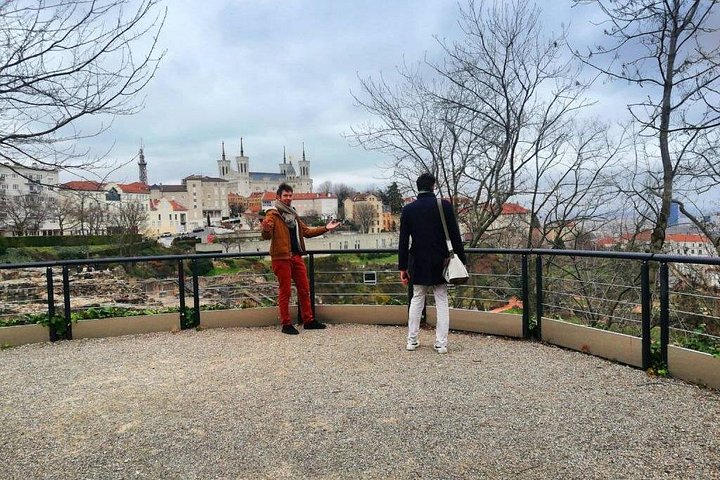
Start at the museum to understand what you are looking at, then walk out through the theatres and take in the view over the rooftops of Vieux Lyon. If you are in Lyon in June or July, check the Nuits de Fourvière programme and book an evening show in the Grand Théâtre. Combine the visit with the basilica above and a descent through the Rosaire gardens, and finish in the old town for lunch.
A little background helps
Lugdunum was founded as a Roman colony in 43 BC and became one of the most important cities of Gaul, the birthplace of the emperor Claudius and the seat of the imperial mint and of a great annual assembly of Gallic tribes. The hill you are standing on was the Roman forum and civic centre, which explains why so many traces survive beneath the modern streets.
Across the city, the Amphitheatre of the Three Gauls on the Croix-Rousse slope marks the spot where early Christians were martyred in AD 177. Seen together, these sites show Lyon as an imperial capital long before it became a city of food and silk.
What to expect
The experience
A self-guided visit to the open-air Roman theatres of Lugdunum and the Gallo-Roman museum built into Fourvière hill.
Best time
A weekday morning, combined with the basilica above, or a summer evening during the Nuits de Fourvière festival.
How long
About two hours for museum and theatres together.
Tips
The museum is closed on Mondays; wear shoes with grip for the stone steps and check what your ticket covers.
Quick picks
- Best for
- History lovers, and anyone who wants to stand in a Roman theatre with a view across Lyon.
- Families
- Children enjoy climbing the theatre steps and spotting animals and gods in the mosaics.
- Couples
- Take in a summer evening performance in the ancient theatre for something truly memorable.
- Pair with
- Fourvière Basilica, the Rosaire gardens and lunch in Vieux Lyon.
- Time needed
- Two hours.
Good questions
Where are the Roman theatres in Lyon?+
They are on the slope of Fourvière hill, just below the basilica. The museum is built into the same hillside beside them.
Is the Lugdunum museum open on Mondays?+
No, the museum is closed on Mondays and on 1 January, 1 May and 25 December. Entry is free on the first Sunday of each month.
Can you see a show in the Roman theatre?+
Yes, the Nuits de Fourvière festival uses the ancient theatres for concerts, theatre and dance in early summer. Book ahead for popular evenings.
How do I get there?+
Ride a funicular from Vieux-Lyon station up the hill, or walk down from the basilica through the gardens in about 10 minutes.
What is the Claudian Table?+
It is a Roman bronze tablet recording a speech by the Emperor Claudius about admitting Gauls to the Senate, found in Lyon and displayed in the museum.