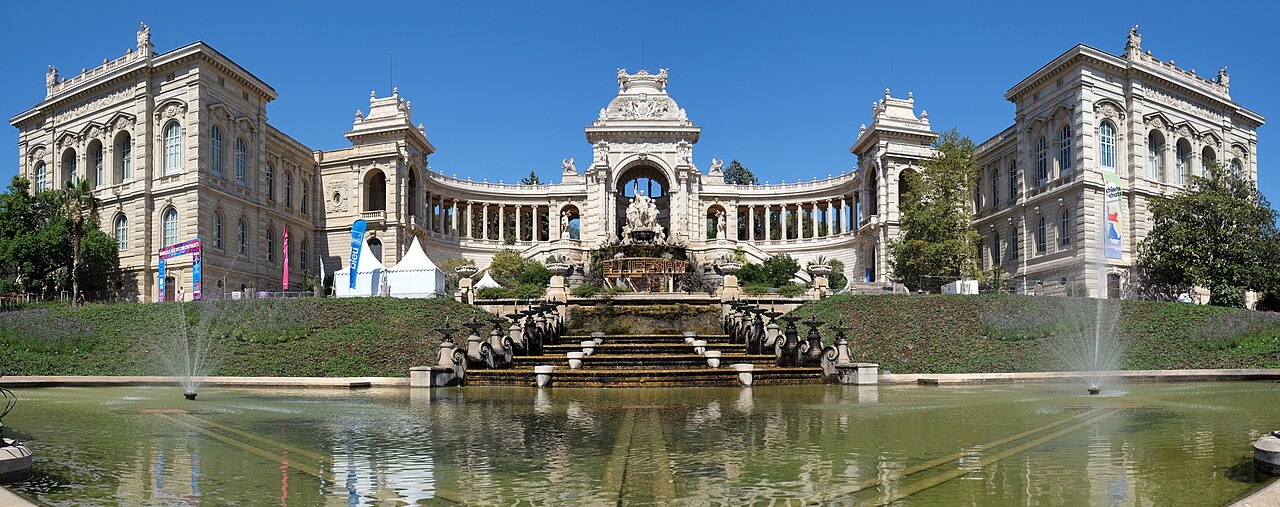
Marseille’s water came late. For centuries the city suffered shortages, and a cholera epidemic in 1835 sharpened the need for a solution. The answer was an 85-kilometre canal bringing water from the Durance river, a project that took about ten years under the engineer Franz Mayor de Montricher. When the water finally arrived, the city celebrated with a monument, and in 1869 the Palais Longchamp was inaugurated. The architect was Henry Espérandieu, the same man who designed Notre-Dame de la Garde, and the result is theatrical: a curved colonnade sweeping around a monumental fountain, with a central group by Jules Cavelier showing the Durance as a cart of vines and wheat pulled by Camargue bulls, and sculpted lions and tigers by Antoine Louis Barye standing guard at the entrance. It was never a palace in the royal sense; it is a celebration of water, and the cascade below it is the point. The two wings hold the Fine Arts Museum on the left and the Natural History Museum on the right, and inside the fine arts wing two large paintings by Puvis de Chavannes decorate the main staircase. Behind the monument lies a landscaped park, a breath of green in a dense city.
Getting there
The palace stands on Place Henri Dunant, on the Boulevard de Montricher, a short way north-east of the Canebière. A metro station is less than 500 metres away, and the walk up from the Vieux-Port takes around half an hour, so most visitors take the metro or a bus. It makes a rewarding detour on the way to or from the Noailles and Cours Julien areas, and it is a good first stop for travellers arriving at Saint-Charles station, which is a short ride away.
What to expect
The exterior and the park can be enjoyed freely and are the main reason to come. The best view is from the foot of the cascade, looking up at the colonnade, or from the top looking back across the city. The palace is open every day, but each museum keeps its own hours and ticket rules, so check what the Fine Arts Museum and the Natural History Museum are offering before you plan to go inside.
Allow about an hour for the monument and park, and longer if you want to visit one of the museums.
Making the most of it
Come in the late afternoon, when the stone turns golden and local families stroll through the park. Combine it with a visit to the Vieille Charité and the Noailles market streets for a day that stays off the usual harbour circuit. Keep an eye on the weather: on a rainy day the museums are a good refuge, while on a clear mistral day the air is crisp and the view from the colonnade is at its sharpest.
What to expect
The experience
A free look at a monumental 1869 fountain and colonnade, with a park behind it and two museums in its wings that run on their own hours and prices.
Best time
Late afternoon, when the stone glows and the park fills with local families.
How long
About an hour for the monument and park, longer with a museum visit.
Tips
Check each museum’s own opening hours and ticket rules before going inside, and take the metro rather than walking up from the port.
Quick picks
- Best for
- Travellers who like grand architecture and want to see a side of Marseille away from the harbour.
- Families
- The lions, the cascade and the shady park suit children well, and the Natural History Museum is a rainy-day option.
- Couples
- A golden-hour stroll through the park and up the cascade steps.
- Pair with
- The Vieille Charité, the Noailles market streets and the Cours Julien.
- Time needed
- One to two hours.
Good questions
What is the Palais Longchamp?+
It is a monumental fountain and colonnade inaugurated in 1869 to celebrate the arrival of water from the Durance river by a canal about 85 kilometres long.
Who designed the Palais Longchamp?+
Henry Espérandieu, who also designed Notre-Dame de la Garde. The sculptor Antoine Louis Barye made the lions and tigers, and Jules Cavelier made the central fountain.
Which museums are inside?+
The Fine Arts Museum occupies the left wing and the Natural History Museum the right wing. Each keeps its own hours and ticket rules.
How do I get there from the Vieux-Port?+
A metro station lies less than 500 metres away, and a bus or metro ride is quicker than the roughly half-hour walk.
Is the palace open every day?+
The palace is open every day, but check the individual museums for their opening days and hours.