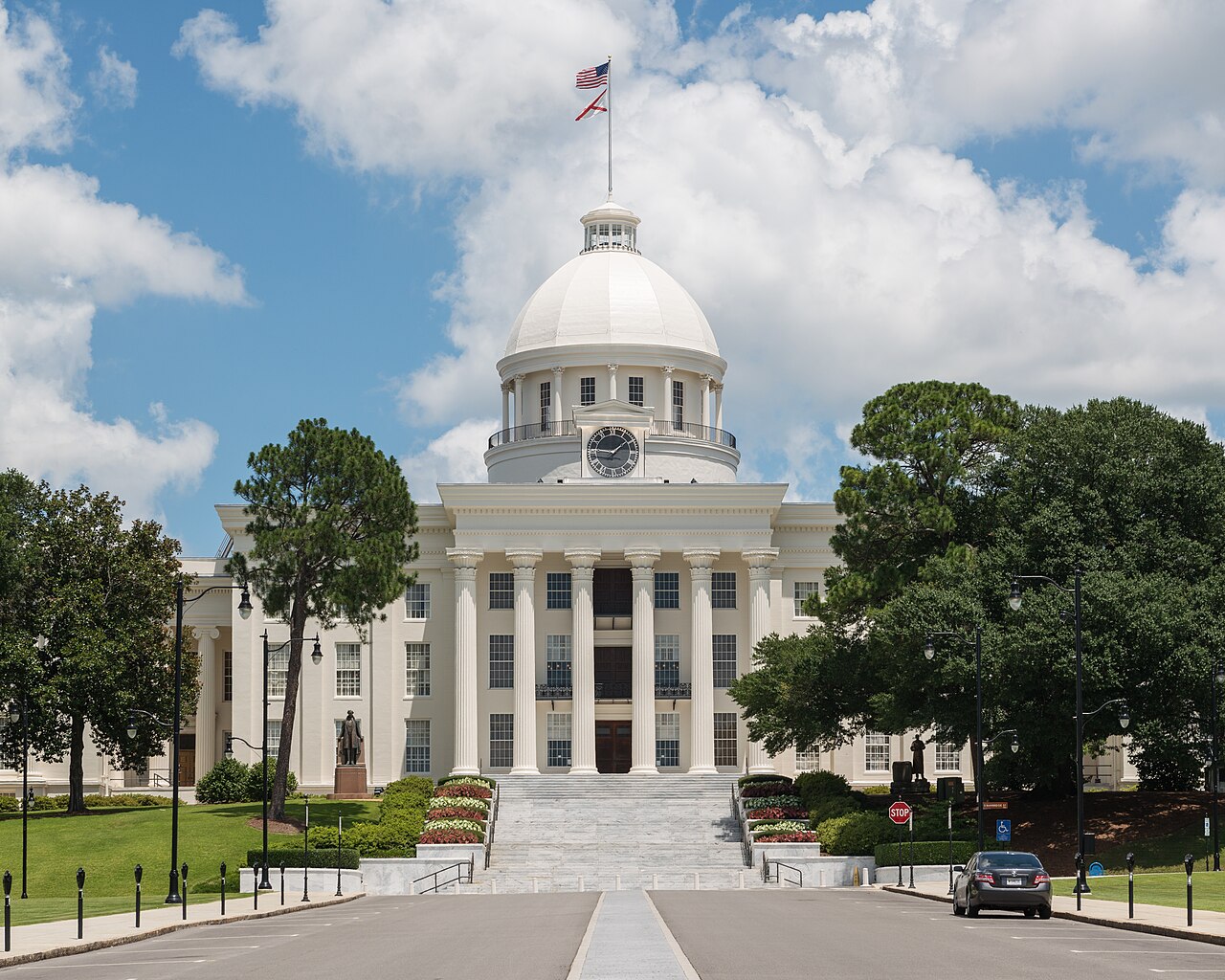
The Alabama State Capitol crowns Goat Hill at the top of Dexter Avenue and ties together two of the most consequential moments in American history. In February 1861, Jefferson Davis took the oath as president of the Confederate States on the front portico, and a brass star marks the spot today. Just over a century later, on March 25, 1965, thousands of marchers who had walked from Selma gathered on the same street and heard Dr. Martin Luther King Jr. speak from the Capitol steps. The building itself is a white Greek Revival landmark finished in the early 1850s, topped by a dome and filled with historical murals and a marble rotunda. It is a National Historic Landmark and still the seat of state government, yet visitors can walk in for free, tour the public spaces and take in how a single building can hold such contradictory chapters.
Inside, the rotunda murals by Roderick MacKenzie illustrate episodes from Alabama's history, and a double spiral staircase draws the eye upward. Self-guided tour materials, plus staff and signs, explain the legislative chambers and the former offices that have been restored. Guided tours are offered on weekdays by the state historical commission, and they are a good way to learn which rooms are open on the day you visit, since legislative sessions and events affect access. Security screening applies at entry, so carry only a small bag and allow a few extra minutes.
Outside, the grounds are full of monuments and markers, including statues from different eras that reflect competing memories of the state's past. The location at the head of Dexter Avenue also means that the view down the avenue toward Dexter Avenue King Memorial Baptist Church and Court Square is the most powerful in the city: the church and the Capitol face each other like characters in the same story. The Capitol is a short walk from the First White House of the Confederacy, which stands nearby and was the Davis family residence when Montgomery was the first Confederate capital, and from the Alabama Department of Archives and History.
Practical notes
The Capitol is free to enter, with weekday visiting hours and limited weekend access, so check the schedule before you go. Parking is available on nearby streets, but a downtown hotel makes the walk easy. The building is mostly accessible, with ramps and elevators, though older areas can have steps. The Capitol is included on the city multi-attraction pass for guided features, but regular admission to the public areas has been free.
Spring and early summer bring the pleasantest weather for walking the grounds. Take your time on the steps, because the angle of the avenue below, with the church at the bottom, helps explain why the 1965 marchers chose to end their journey right here.
If you have time, add a stop at the First White House of the Confederacy, a short walk away, which was moved to its current site in the twentieth century and preserves the rooms where the Davis family lived in 1861. Together with the Capitol, it tells the Confederate chapter of the city's history, while Dexter Avenue Church, the Rosa Parks Museum and the Legacy Museum tell the other. Seeing both sides within a few blocks is what makes Montgomery such a compelling and complicated city to visit.
What to expect
The experience
A self-guided or guided walk through the public areas of a historic working Capitol, plus the grounds.
Best time
Weekday mornings, when tours and staff are available.
How long
About an hour.
Tips
Expect security screening, check weekday hours and walk down Dexter Avenue afterward.
Quick picks
- Best for
- Anyone interested in the Confederacy and the civil rights movement in one place.
- Families
- Free and walkable, with plenty of space to roam on the grounds.
- Couples
- A scenic walk down Dexter Avenue.
- Pair with
- Dexter Avenue Church and the First White House of the Confederacy.
- Time needed
- One hour.
Good questions
What happened at the Capitol in 1861?+
Jefferson Davis took the oath as president of the Confederate States on the front portico in February 1861.
What happened there in 1965?+
The Selma to Montgomery marchers ended their route here on March 25, 1965, and Dr. King addressed the crowd.
Is it free?+
Entry to the public areas is free, though hours and tour availability vary.
Can I see inside?+
Yes, the rotunda and many public spaces are open on weekdays. Expect security screening.
What is nearby?+
Dexter Avenue Church, the First White House of the Confederacy, the Archives and History museum and Court Square are all within walking distance.