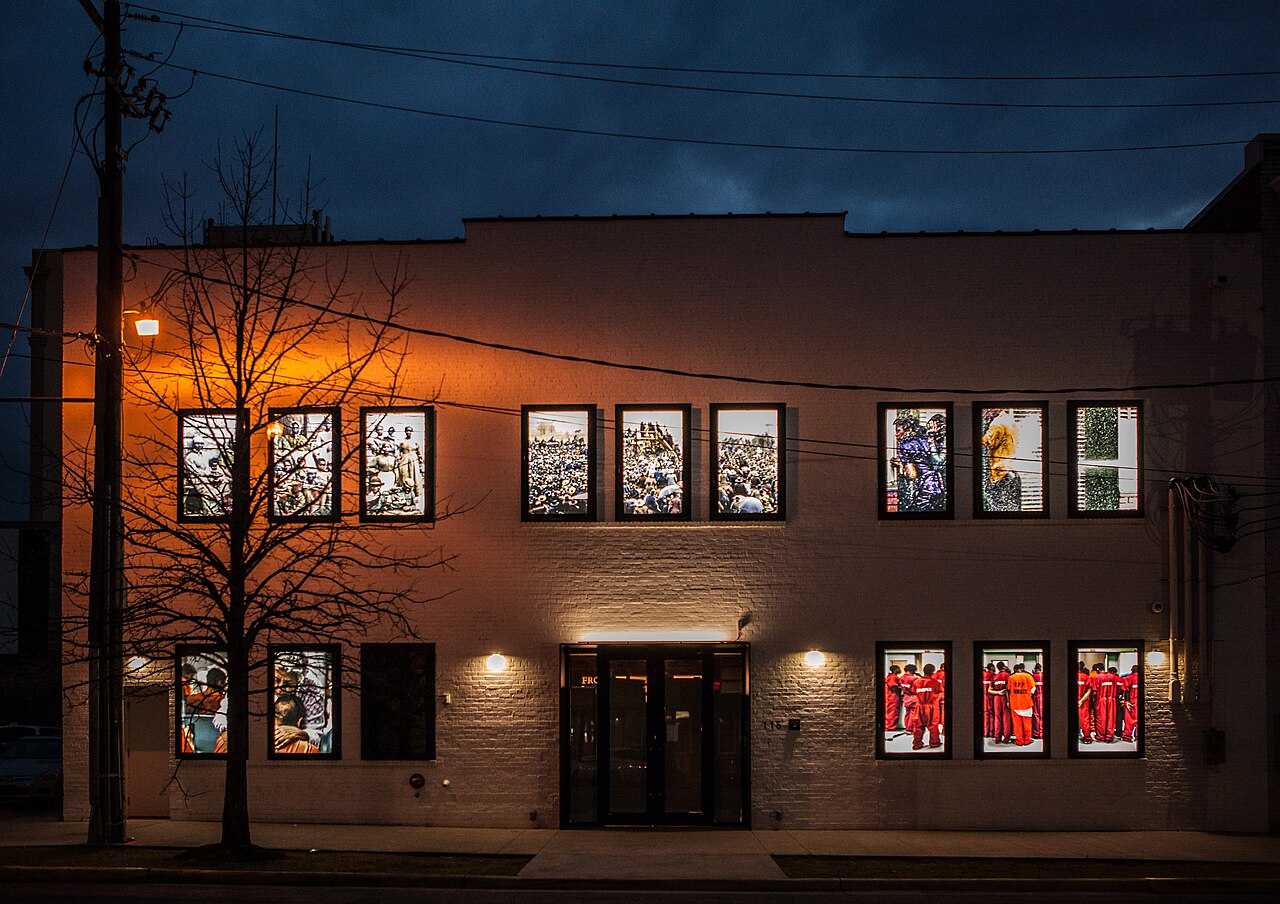
The Civil Rights Memorial Center, run by the Southern Poverty Law Center on Washington Avenue, is one of the quietest and most moving places in downtown Montgomery. Outside stands the Civil Rights Memorial, designed by Maya Lin and dedicated in 1989: a curved black granite wall with water flowing over it, and a round granite table over which water slowly moves, inscribed with the names and dates of forty-one men, women and children who died in the struggle for civil rights between 1954 and 1968. The design draws on a line from Dr. King's speeches, which is carved into the wall, about justice rolling down like waters. Inside the adjacent center, exhibits explain who the people on the memorial were, how they died and what their lives meant, along with a Wall of Tolerance where visitors can pledge to take a stand against hate. Together, the outdoor memorial and the indoor exhibits give a compact, human-scaled account of lives lost and lives still unfolding.
The memorial's power comes from its simplicity. The water is shallow and constant, and visitors instinctively touch it, run fingers over names and watch ripples spread. Many pause at the earliest names, such as Emmett Till, and at the later ones, including the four girls killed in Birmingham in 1963.
The names include martyrs often left out of history lessons, ordinary people such as farmers, students and veterans who were killed for registering voters or attending meetings. The brief timeline carved into the surface connects the deaths with the events of the movement, so you can see how each loss relates to the march of history.
Inside the center, the exhibits tell personal stories through photographs, letters and recordings. An interactive space invites visitors to take action on contemporary issues, and a room of names on the Wall of Tolerance shows how many people have committed to speaking out. The center is compact, taking about an hour, and works well as a pause between larger museums. It is included on the city multi-attraction pass, and it also appears on the self-guided Walk of Freedom route, which makes it easy to fold into a day on foot in downtown Montgomery.
A few practical suggestions
The memorial outside is accessible at most hours, while the indoor center keeps regular daytime hours with a closing day, so confirm before you go. Security screening is standard in the center. The courtyard has little shade, so sun protection and water are useful in summer. Photography is welcome around the memorial, though visitors are asked to be respectful.
If you are visiting with children, the center is a good place to start a conversation about courage and fairness, and staff can suggest age-appropriate ways to explore the displays. Pair this stop with the Rosa Parks Museum and Dexter Avenue Church for a morning that covers the major early chapters.
It also helps to know that the memorial sits within the same few blocks as the Capitol, the Rosa Parks Museum and Dexter Avenue Church, so it is rarely a stop that requires its own trip. Treat it as a short, silent rest in a day of dense history, and give yourself a minute to look at the names before reading any of the explanatory text. Many visitors say the effect of the moving water is stronger than any interpretation could be, and that the best way to experience the memorial is to stand and let it speak.
What to expect
The experience
An outdoor water memorial by Maya Lin plus a small indoor exhibit center.
Best time
Morning or late afternoon for softer light and fewer visitors.
How long
About an hour.
Tips
Check the center's opening days, bring water in summer and read the names slowly.
Quick picks
- Best for
- A compact, moving introduction to the movement's martyrs.
- Families
- Works well for children with some guidance.
- Couples
- A reflective pause between larger museums.
- Pair with
- The Rosa Parks Museum and Dexter Avenue Church.
- Time needed
- About an hour.
Good questions
Who designed the Civil Rights Memorial?+
Maya Lin, who also designed the Vietnam Veterans Memorial in Washington, DC. It was dedicated in 1989.
Whose names are on it?+
Forty-one people who died in the civil rights struggle between 1954 and 1968, with dates and brief events from the movement.
Is it free to see the memorial?+
The outdoor memorial is open to view. The indoor center keeps regular hours and may charge admission.
How long should I allow?+
About an hour for the memorial and the center.
Is it on the city pass?+
Yes, the Montgomery multi-attraction pass includes the center, and the Walk of Freedom route passes it.