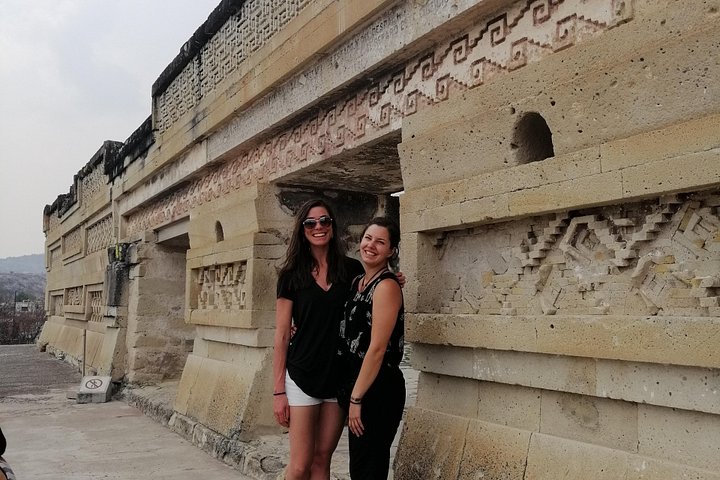
Mitla, about forty-five kilometres east of Oaxaca city, was the sacred centre of the Zapotec and later the Mixtec, and the name comes from a word for the place of the dead. Unlike Monte Albán, whose appeal is scale, Mitla is about detail. The palaces here are decorated with intricate mosaic panels called grecas, made of thousands of small cut stones fitted together without mortar in geometric patterns that look like woven textiles. The Hall of Columns, with its monolithic stone pillars, is the most imposing room, and a short walk away the Church of San Pablo was built by the Spanish on the foundations of a temple, using the older stones. A small cluster of buildings, the Group of the Columns, the Group of the Church and a few nearby structures, makes the site compact enough to see in an hour or two. It is open daily during the day, with an admission fee that is modest for foreign visitors and a last entry shortly before closing. It pairs naturally with Hierve el Agua, a mezcal stop and a craft market, and a half-day guided tour is an easy way to see it.
Reading the site
The fretwork patterns are thought to represent the sky, lightning and serpents, though interpretations vary and a guide will tell you what scholars currently suggest. The tombs under the Group of the Columns can be entered through a narrow passage, and the cruciform burial chamber gives a sense of how the Zapotec treated the dead. The colonial church sits right beside the pre-Hispanic buildings, a physical reminder of how cultures layered over each other.
Around the site
The town of Mitla is a centre for textiles, with stalls selling woven shawls and tablecloths, and many mezcal shops and tasting rooms are close by. Eating options range from simple comedores to restaurants serving regional dishes, and you can easily include Mitla in a day that takes in Hierve el Agua, the Tule Tree and a distillery. Visitors should expect to be offered goods by vendors and a polite no is usually enough.
Planning
Most visitors come on a half-day or full-day tour with a guide who explains the history, which adds a lot to a site with few signs. Independent travellers can reach Mitla by collective taxi or bus from the city, though a driver gives more flexibility. Wear a hat and sturdy shoes, bring water, and go in the morning for the best light on the stonework. Check the current hours before you travel in case schedules have changed.
What to expect
The experience
A guided or self-paced walk through the palace groups, the Hall of Columns, the tombs and the colonial church beside them.
Best time
Morning for the best light on the mosaic stonework and cooler air.
How long
An hour or two on site, plus travel from Oaxaca.
Tips
Go with a guide if you can, carry water and a hat, and expect polite sales offers from vendors outside.
Quick picks
- Best for
- Travellers who love fine craftsmanship and want a quieter alternative to Monte Albán.
- Families
- Older children enjoy the tombs and the stone patterns, though there is little shade.
- Couples
- Combine Mitla with a mezcal tasting and a textile stop for a relaxed day out.
- Pair with
- Hierve el Agua, a mezcal distillery and the Tule Tree.
- Time needed
- Half a day.
Good questions
How far is Mitla from Oaxaca?+
It is roughly forty-five kilometres east, around an hour's drive. Collective taxis, buses and tours all go there.
What is special about Mitla?+
Its walls are covered with geometric stone mosaics made without mortar, a style unique in Mexico. The site also sits beside a colonial church built on older foundations.
Is it open every day?+
The site is generally open during the day, with last entry shortly before closing. Check the current hours before you go.
Do I need a guide?+
A guide is helpful because there is little signage and the symbolism is easier to grasp with explanation. Many tours include one.
What can I combine it with?+
Hierve el Agua, the Tule Tree, a mezcal distillery and Teotitlán del Valle are the usual companions on a day trip.