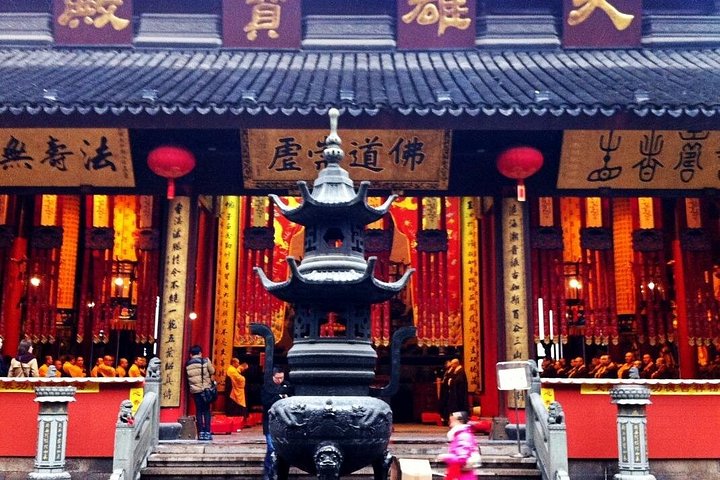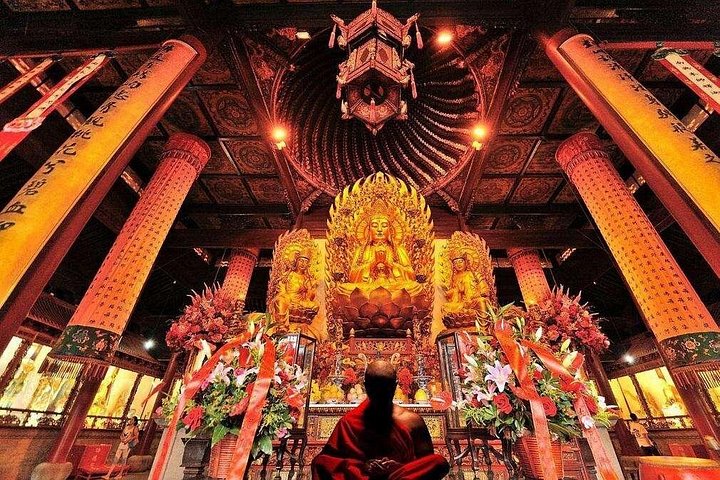
Longhua Temple is the largest ancient temple complex in Shanghai, and by tradition the oldest, with a history said to reach back to the third century. The buildings visitors see today date mostly from later rebuildings, in the style of the Song dynasty, and they follow the classic plan of a Chan Buddhist temple: a long north-south axis with the Hall of Heavenly Kings, the Grand Hall and the Three Sages Hall set one behind another. The temple stands in the southwest of the city, in the Xuhui district, and its red walls, upturned eaves and incense smoke are a world away from the glass towers of Pudong. It is a working temple with resident monks, and the courtyards are busy with local worshippers on festival days. The most recognisable feature is the Longhua Pagoda beside the temple, a seven-storey octagonal tower with deep eaves that rises over the neighbouring buildings and has long been a landmark of the southern city. Inside the temple, the bell tower holds a large bronze bell that is rung on New Year's Eve, when crowds gather to hear the strikes that welcome the year. In spring, the temple fair that surrounds the grounds brings stalls, snacks, folk performers and visitors from across the city, and it is one of the best seasonal events in Shanghai for anyone interested in local customs. The temple also has a vegetarian dining room that is popular at lunchtime.
Compared with the Jade Buddha Temple, Longhua feels larger, older and less staged. The courtyards are wide, the layout is easier to read, and there are fewer tour groups, particularly on weekday mornings. Walk the main axis from the gate, pause in the Hall of Heavenly Kings to look at the guardian figures, then climb the steps to the Grand Hall, where the principal Buddha images sit behind clouds of incense.
The Three Sages Hall and the Abbot's Hall are further back, and the bell and drum towers give a sense of the temple's daily rhythm, with monks chanting at set hours and visitors tracing the paths.
Working the visit
The temple charges a modest admission, and you can usually enter the main halls freely during opening hours. Go in the morning for the calmest atmosphere, or time your visit for a festival day if you enjoy crowds and colour. Dress modestly, keep your voice low, and follow the lead of worshippers when it comes to photography and the use of incense.
A short guided walking tour is available if you want the history and the symbolism explained, and it pairs well with a visit to the neighbouring pagoda and the nearby Longhua Martyrs Cemetery, which is a large memorial park with a very different mood.
Practical notes
The nearest metro stations are on lines 11 and 12 in the Longhua area, and from the station the temple is a short walk. The area is residential and local, with a few small restaurants and a good vegetarian lunch at the temple itself. Because the temple is in the southwest, it works best as a morning activity paired with a visit to the West Bund riverside or a trip to the nearby art museums, which are some of the city's best.
Check the opening hours and any festival closures before you go, bring small change for incense and allow about an hour and a half for the whole visit. Rain can make the stone steps slippery, so wear shoes with grip.
What to expect
The experience
A guided walking tour of the temple complex and its pagoda, with explanations of the halls, the bell and the customs of worshippers.
Best time
Weekday mornings for calm; the spring temple fair and New Year's Eve for atmosphere and crowds.
How long
About two hours for a guided walk, or an hour and a half on your own.
Tips
Dress modestly, wear shoes with grip on the stone steps and bring small change for incense and the vegetarian lunch.
Quick picks
- Best for
- Travellers who want an older, less crowded temple and a glimpse of local religious life.
- Families
- Open courtyards and a pagoda to look at make it manageable for children, though they will need to stay quiet in the halls.
- Couples
- A peaceful morning walk, followed by a vegetarian lunch at the temple.
- Pair with
- The Jade Buddha Temple for contrast, or the West Bund riverside and art museums nearby.
- Time needed
- About an hour and a half to two hours.
Good questions
How old is Longhua Temple?+
Tradition dates its founding to the third century, which makes it the oldest temple in Shanghai. The buildings you see today are later rebuildings in the Song dynasty style.
What is the Longhua Pagoda?+
It is a seven-storey octagonal tower beside the temple, and a long-standing landmark of southwest Shanghai. It is best seen from the outside, as the interior is not generally open.
When is the Longhua temple fair?+
It takes place in spring and brings stalls, snacks and performers around the temple. Dates follow the lunar calendar, so check them for your travel year.
Which is better, Longhua or the Jade Buddha Temple?+
Longhua is older, larger and quieter, while the Jade Buddha Temple is more compact and famous for its two jade statues. If you only have time for one, many visitors choose the Jade Buddha Temple for convenience, and Longhua for atmosphere.
How do I get there by metro?+
Take line 11 or 12 to the Longhua area stations, and walk a few minutes to the temple entrance.