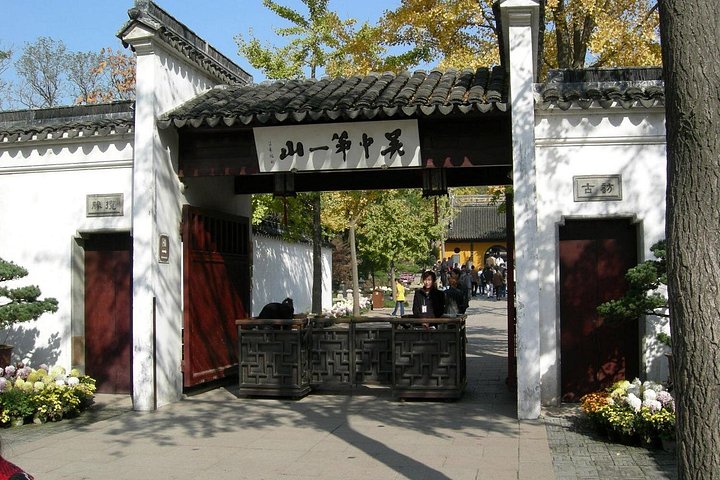
Tiger Hill is Suzhou’s oldest sightseeing spot and a favourite with locals. Rising from the north-west edge of the city, the low hill is crowned by the Yunyan Pagoda, a seven-storey octagonal tower of about forty-eight metres that leans roughly 3.6 degrees to the north-west, a tilt it has had for centuries. The pagoda dates to the Northern Song period and has become a symbol of the city. The hill takes its name from the legend that a white tiger appeared to guard the tomb of King Helu of Wu, who died in 496 BC, three days after his burial. Around the hill you can find the Sword Testing Stone, split by a blow, and the Sword Pool, where his swords are said to lie buried. Paths wind through bamboo, pavilions and temple courtyards, and the site mixes history, legend and quiet gardens. It is an easy half-day trip and combines well with Shantang Street, which runs from the city to its foot.
Getting there
The main route is by bus. Bus 32 and the Huqiu tourist line stop at Huqiu Beimen, the north gate, and Gusu tourist bus line 3 serves the north gate car park. Taxis are easy from the old city. A more atmospheric option is to walk down Shantang Street, a canal street of about 3.6 kilometres that ends near the hill, so you can arrive on foot after lanterns and shops. Metro Line 2 stops at Shantangjie for the start of that walk.
Tickets and hours
Entry is by ticket that varies by season, higher in spring and autumn, and children under 1.4 metres and seniors over seventy enter free, with half price for ages six to eighteen and ages sixty to seventy. From November to April the hill opens from about half past seven to half past five. Bring your passport if booking ahead, and allow two to three hours.
What to see
The Yunyan Pagoda is best admired from the outside, as visitors cannot climb it, and the surrounding temple buildings, the Sword Pool and the rock formations make a circular walk. A celadon bowl found inside the pagoda in 1956 is now in the Suzhou Museum. Autumn is pleasant, with cooler air and fewer crowds than summer. Stay on the main paths, as some stone steps can be slippery after rain. A walk down Shantang Street at dusk makes a good end to the day.
What to expect
The experience
A self-guided walk up a wooded hill past the leaning pagoda, the Sword Pool and temple courtyards.
Best time
Weekday mornings, or autumn for cooler weather and thinner crowds.
How long
Two to three hours, longer if you add Shantang Street.
Tips
Take bus 32 or walk down Shantang Street, stay on the main paths after rain and remember the pagoda is for looking at, not climbing.
Quick picks
- Best for
- History lovers and first-timers who want Suzhou’s best-known leaning landmark.
- Families
- Good for older children who enjoy legends and rocks, though there are steps and slopes throughout.
- Couples
- A leisurely walk through the bamboo paths, then Shantang Street at dusk for the lanterns and canal.
- Pair with
- Shantang Street and the Lingering Garden for a west-side day.
- Time needed
- Two to three hours.
Good questions
Why does the Tiger Hill pagoda lean?+
It has tilted about 3.6 degrees to the north-west for centuries. It is one of Suzhou’s best-known symbols.
Can I climb the pagoda?+
No, the Yunyan Pagoda is viewed from outside. The temple grounds and hill paths are open to walk.
How do I get to Tiger Hill?+
Take bus 32 or the Huqiu tourist line to Huqiu Beimen, or walk the length of Shantang Street. A taxi from the old city is also quick.
Who is buried at Tiger Hill?+
Legend says King Helu of Wu, who died in 496 BC, was buried on the hill. A white tiger is said to have appeared to guard the grave.
How long should I allow?+
Two to three hours for the hill, and more if you walk Shantang Street first.