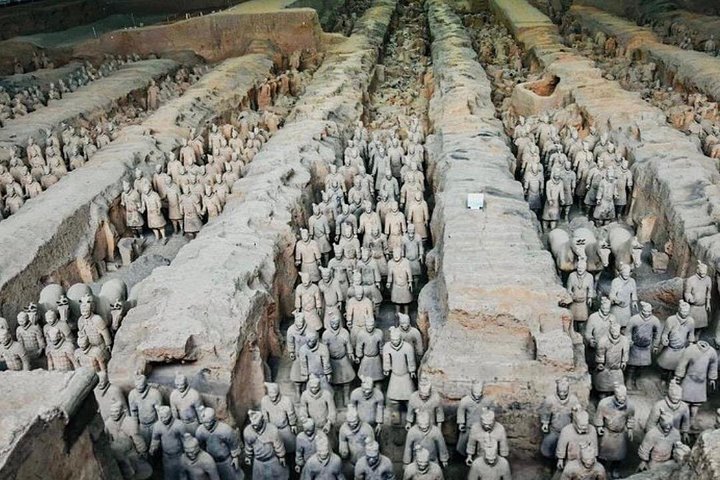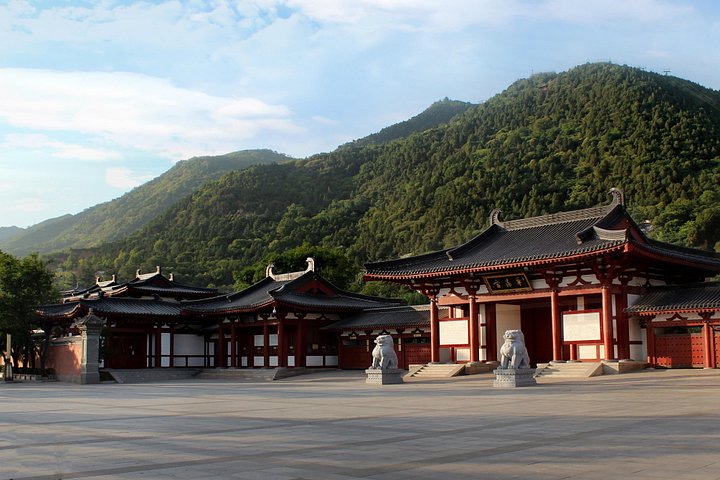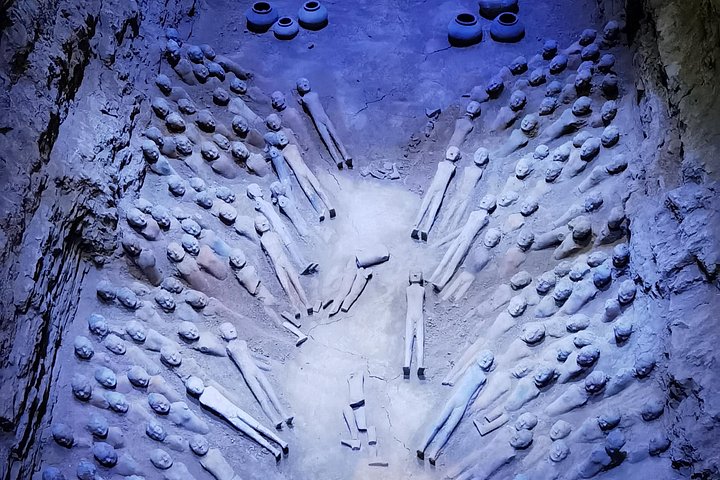
Hanyangling is the burial complex of Emperor Jing, the fourth emperor of the Western Han dynasty, and his empress, built in the second century BCE on the plateau north of Xi’an. It is much less famous than the Terracotta Army, and that is part of its charm: the site is calm, the galleries are rarely crowded and the exhibits are so small and delicate that you find yourself leaning in rather than standing back. The centrepiece is an underground exhibition hall built over excavated burial pits, where glass-covered walkways let you look straight down onto the finds, much as an archaeologist would see them. What lies in the pits is the opposite of the Terracotta Army. Instead of life-size soldiers, the Han court buried figures at roughly one third of life size: standing servants, soldiers, eunuchs and court attendants, along with pigs, sheep, dogs, chickens, oxen and horses, plus grain, tools and household goods, all meant to serve the emperor in the afterlife. The human figures were once dressed in cloth and fitted with wooden arms, which have long since decayed, so the clay bodies you see are bare. The result is a close, human view of how the Han imagined the next world, and of the ordinary things that made up palace life.
How to visit
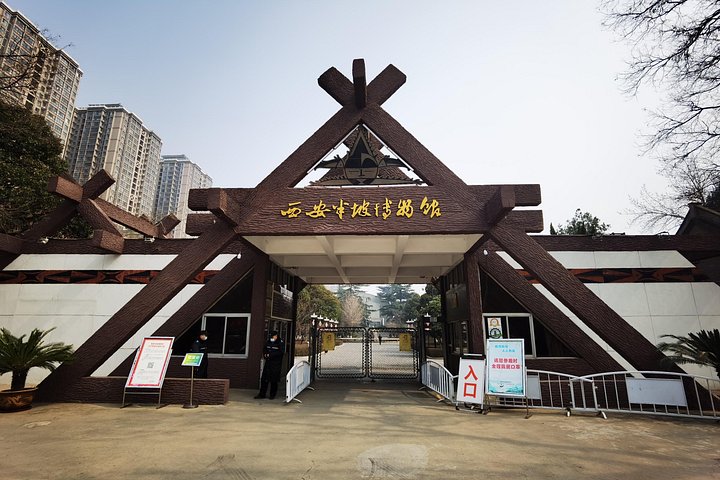
The museum is on the northern edge of the Xi’an area, north of the city centre, on the side of Xi’an nearest the airport, so most visitors go by taxi, ride-hailing car or a guided transfer rather than public transport. A guide service is a sensible way to go, because labels are limited and the story of the Han emperors, their burial customs and the way the figures were made is what turns a quiet gallery into something memorable. Bring your passport or ID in case it is asked for at the gate.
What to expect
Allow around two hours. There is an above-ground exhibition hall with objects from the tomb and a plan of the whole mausoleum complex, and then the underground gallery, which is air-conditioned and dimly lit, so it feels cool in summer and mild in winter. Photography is generally permitted without flash, though glass reflections make good pictures hard to get. The site is mostly flat and accessible, with a walk across open ground between the buildings, so wear comfortable shoes and take a hat or umbrella in the heat.
Making the most of it
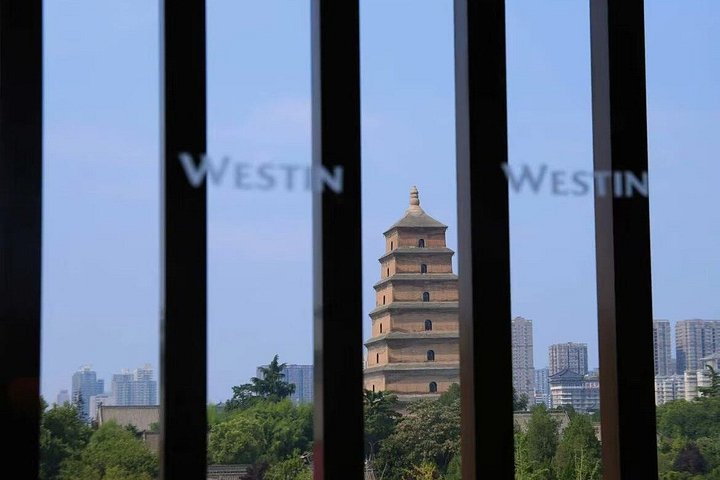
Combine it with the Terracotta Army for a full day of ancient China, as the two sites show very different sides of the same imperial burial tradition, or pair it with a morning at the Small Wild Goose Pagoda on a city day. Go on a weekday for near-solitude, and treat it as a good option for travellers who have already seen the big sights and want something more reflective.
It is a weaker choice for young children, as the exhibits are behind glass and the pace is slow. Bring a bottle of water, as there are few places to buy refreshments between the halls, and take a little time at the end to look again at the animal figures, which are often the most charming part of the collection. Staff are generally helpful, and the site is well kept.
What to expect
The experience
An above-ground exhibition hall followed by an underground gallery with glass-covered walkways above the burial pits, best done with a guide.
Best time
A weekday, when the galleries are almost empty.
How long
About two hours at the site, plus the trip from the city.
Tips
Go with a guide for context, wear comfortable shoes, carry ID, and pair it with the Terracotta Army for a full day.
Quick picks
- Best for
- Travellers who want a quieter, more thoughtful ancient-China site after the big names.
- Families
- Older children interested in history will enjoy it, but younger ones may find it slow.
- Couples
- Good for couples who like museums and quiet places, and who want a break from crowds.
- Pair with
- The Terracotta Army on the same day, or the Shaanxi History Museum for more Han and Tang objects.
- Time needed
- Half a day, or a full day combined with another site.
Good questions
What is in the Hanyangling Museum?+
The museum shows the burial pits of the Han emperor Jing and his empress. Glass floors let you look down on small painted clay figures, animals and household objects that were buried to serve the emperor in the afterlife.
How is it different from the Terracotta Army?+
The Terracotta Army is vast, life-size and crowded. Hanyangling is small in scale, with figures about a third of life size, far fewer visitors and a quieter, more intimate feel. Many visitors do both on one day.
How do I get there from Xi’an?+
It is north of the centre, on the airport side of the city. Taxis, ride-hailing cars and guided transfers are the usual options, and the journey takes a little under an hour depending on traffic.
How long should I allow?+
Plan on about two hours for the exhibition hall and the underground gallery. Add travel time from the city, and a few more hours if you combine it with another sight.
Is it worth visiting if I have limited time?+
If you have only two or three days, the Terracotta Army, City Wall and old town come first. With a fourth day or a spare half day, Hanyangling is one of the most rewarding extras.