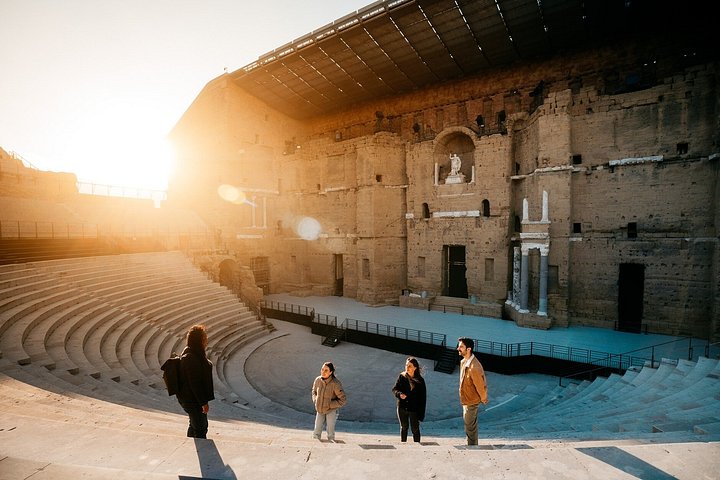
Orange is a small town about twenty kilometres north of Avignon, and it holds one of the great survivors of the Roman world. The Théâtre Antique was built in the first century and its enormous stage wall, roughly thirty-seven metres high and over a hundred metres wide, is the only one of its kind left standing in Europe with its full height intact. Louis XIV is said to have called it the finest wall in his kingdom, and standing below it you understand why: it is a flat cliff of dressed stone that once carried columns, statues and a roof over the stage. In the central niche stands a statue of the emperor Augustus, and the semicircular tiers of seats climb the hillside opposite in a bowl that held thousands of spectators. The theatre is not a ruin to be admired from a fence. It is still a working venue, and every summer the Chorégies d'Orange opera festival fills the seats again, which is why you may see stage equipment and lighting rigs in front of the ancient stone. The ticket sold for this visit includes an immersive virtual reality element, which is meant to show how the theatre looked in Roman times, so read the product page for the details. Together with the Arc de Triomphe on the northern edge of town, the theatre forms a single UNESCO World Heritage Site, and both can be seen in a leisurely half day.
The theatre makes more sense once you know how Roman towns were laid out. Orange, then called Arausio, was a colony founded for veterans, and like every Roman town of standing it needed a place for plays, music and public gatherings. The builders cut the seating into a natural slope and then raised the great back wall to throw the actors' voices out to the audience, a clever piece of acoustic design that still works.
Later centuries were less kind. The building was stripped of its decoration, used as a fortress and crammed with houses, and only a major clearance and restoration brought it back to what you see now. The frieze fragments and the surviving architectural pieces on display give a good idea of how rich the original must have looked.
Orange is easy to reach without a car. Regional trains run between the stations at Avignon and Orange in roughly twenty to thirty minutes, and the theatre is a walk of about fifteen to twenty minutes from the station through the old streets. A ticket bought in advance saves time at the entrance in busy months, and the visit takes around an hour to ninety minutes, longer if you sit and listen to the audio commentary.
Take a hat and water in summer, because the stone seating is exposed to the sun, and wear shoes with a good grip for the worn steps. In cooler months a jacket is welcome, since the stage wall funnels the wind. Opening hours vary with the season, and the site can close for evening events in the summer festival period, so confirm the day's hours before you travel.
Give the rest of the town a little time. The Arc de Triomphe stands on the road north of the centre, covered in carved battle scenes and remarkably complete, and the old streets between the two monuments have cafes and a market. Many visitors combine Orange with a Pont du Gard day or a Nîmes and Uzès excursion on a second day, because the three together make a strong Roman theme for anyone who enjoys ancient history.
If you only have a day for the Roman sights and prefer someone else to plan the route, a guided day trip can cover more ground, but the theatre itself is best taken slowly, sitting high in the seats and looking down at the wall.
What to expect
The experience
A self-guided visit to the Roman theatre, with its giant stage wall, the tiered seating and the museum-style displays of carved fragments, plus an immersive virtual reality element.
Best time
Morning or late afternoon, when the light is soft on the stone and the seating is not baking in the sun.
How long
About an hour to ninety minutes on site, and a half day including the short train ride from Avignon.
Tips
Take the regional train rather than a car, bring a hat and water in summer, wear grippy shoes for the worn steps and check the day's hours before you go.
Quick picks
- Best for
- History lovers and anyone who wants a Roman monument at its most complete, without a long journey.
- Families
- Children like climbing the tiers and shouting from the stage, and the virtual reality element helps keep them interested.
- Couples
- Sit high in the seats and watch the light change on the great wall, then have lunch in the old streets.
- Pair with
- The Pont du Gard or a Nîmes and Uzès day, which together make a Roman theme for the trip.
- Time needed
- Half a day with the train, or a full day if you add the Arc de Triomphe and a long lunch.
Good questions
How far is Orange from Avignon?+
About twenty kilometres north. Regional trains connect the two towns in roughly twenty to thirty minutes, and the theatre is a walk from the station.
Why is the Roman Theatre of Orange famous?+
Its stage wall still stands at nearly its full original height, which makes it the best-preserved Roman theatre in Europe and a UNESCO World Heritage Site.
Is the theatre still used for performances?+
Yes. The Chorégies d'Orange opera festival is staged there in summer, so parts of the site can be closed or fitted with stage equipment around event dates.
How long should I spend there?+
Allow an hour to ninety minutes inside the theatre. Add time for the Arc de Triomphe and lunch in town to make a relaxed half day.
Can I visit Orange without a car?+
Yes. The train from Avignon is the easiest way, and everything worth seeing is within walking distance of the station.