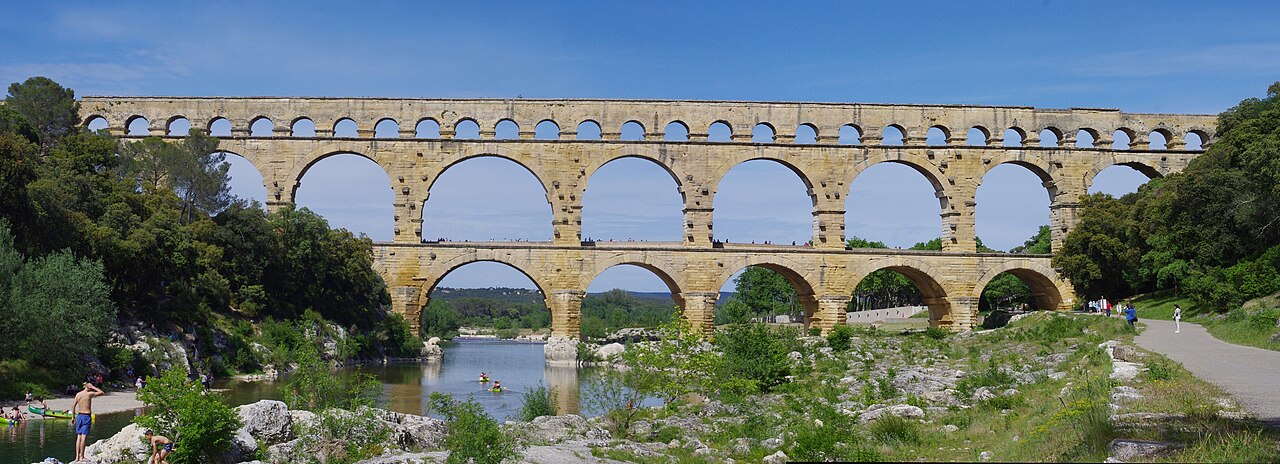
Standing under the Pont du Gard, you feel the scale of Rome. The great three-tier bridge of honey-coloured limestone rises almost fifty metres above the Gardon river, a section of an aqueduct that carried water for about fifty kilometres to the Roman city of Nîmes. It was built in the first century AD without mortar, using enormous cut blocks lifted into place, and it has survived two thousand years of floods, wars and neglect. UNESCO inscribed it as a World Heritage site in 1985, and it is one of the most visited monuments in France. The site is more than the bridge itself. The grounds include a museum with models and films explaining how the aqueduct worked, a children's discovery area, shaded paths through the Mediterranean scrub, and gravel banks along the river where you can sit and stare up at the arches. You can cross the river on a lower road bridge beside the aqueduct, and there are walking trails to viewpoints on both banks. It is an easy and rewarding day trip from Avignon, by car in under forty minutes or as part of a guided tour.
The aqueduct's purpose explains its beauty. Nîmes needed fresh water from springs near Uzès, and the Romans solved the problem with a gentle gradient, dropping only about a third of a metre for every kilometre, and with bridges to cross valleys. The Pont du Gard is the most dramatic of those bridges, and its three tiers of arches were designed to handle both the weight of the stone and the force of the river.
The water channel on top once carried the whole flow. Later centuries used the lower tier as a road crossing, and a nearby bridge now carries traffic.
The visit is straightforward. The ticket covers the site and the museum, and the site itself is open every day from early morning until late at night, which makes sunset and evening visits an option in summer. The museum has its own hours, with a later start on Mondays, so check before you plan around it.
Parking is paid on site, and arriving early in July and August avoids the heaviest traffic. You can spend as little as an hour at the bridge, but two to three hours with the museum, the trails and a picnic is more rewarding.
Tips for the day
Bring sun protection and water in summer, since shade is limited near the bridge, and sturdy shoes for the paths. In the warm months people swim in the Gardon in designated areas, so bring a towel if the weather is hot, and check the rules on site. Spring and autumn offer pleasant temperatures and fewer visitors. If you prefer not to drive, choose a guided Provence day tour that stops at the aqueduct, or combine it with Uzès and Nîmes for a full Roman and market-town circuit.
What to expect
The experience
A self-guided visit to the aqueduct, the museum, the discovery area and the riverside trails, with a ticket that includes the museum.
Best time
Early morning or late afternoon for gentler light and cooler air, and spring or autumn for fewer crowds.
How long
Two to three hours on site, plus about forty minutes each way from Avignon by car.
Tips
Bring sun protection and water, arrive early in summer for parking, wear sturdy shoes and check the museum's days and hours.
Quick picks
- Best for
- History and architecture lovers, and anyone who wants a Roman monument in a beautiful natural setting.
- Families
- Excellent: a children's discovery area, shaded trails and, in summer, river swimming in designated spots.
- Couples
- A late-afternoon visit as the stone turns gold, followed by a drink in nearby Uzès.
- Pair with
- Uzès and Nîmes for a Roman day, or a wine tasting in the Gard hills.
- Time needed
- Half a day including the drive, or a full day with Nîmes.
Good questions
How far is the Pont du Gard from Avignon?+
It is about 25 kilometres west of Avignon, roughly forty minutes by car. Guided day tours also stop there.
How old is the Pont du Gard?+
It dates from the first century AD and was built by the Romans to carry water to Nîmes. UNESCO listed it in 1985.
Can you walk across the Pont du Gard?+
You can cross the river on the lower bridge beside the aqueduct and follow trails to viewpoints on both banks. The aqueduct's upper channel is not a general walkway.
How long do I need?+
Allow two to three hours for the bridge, museum and a walk. A full day works well if you add Uzès or Nîmes.
Can you swim at the Pont du Gard?+
In the warm months swimming is allowed in the Gardon in designated areas. Check the rules and conditions on arrival.