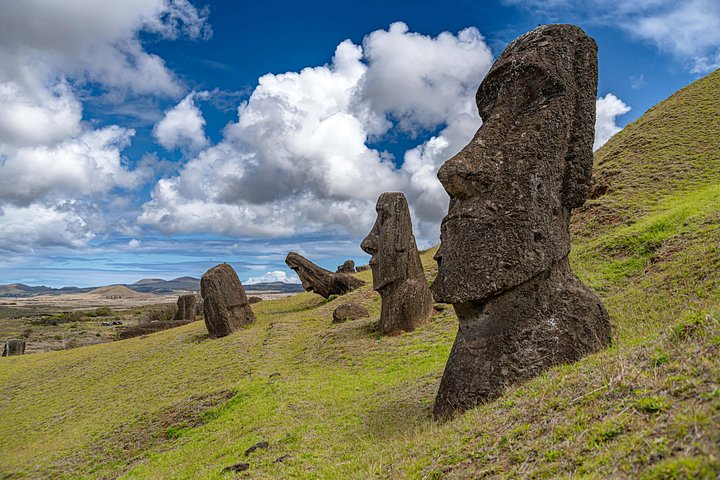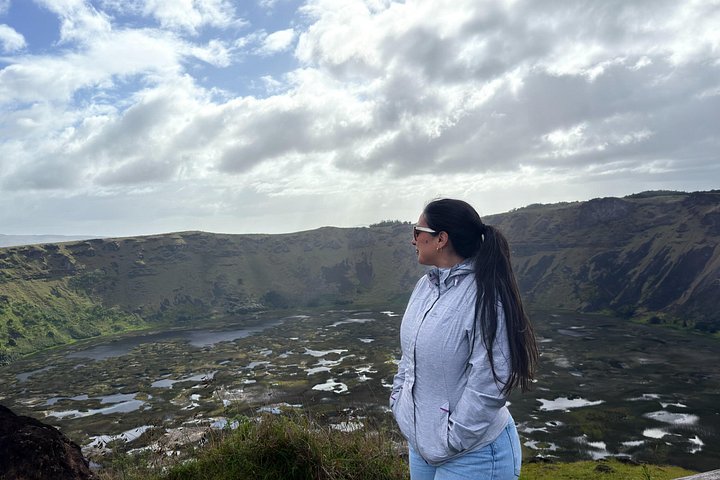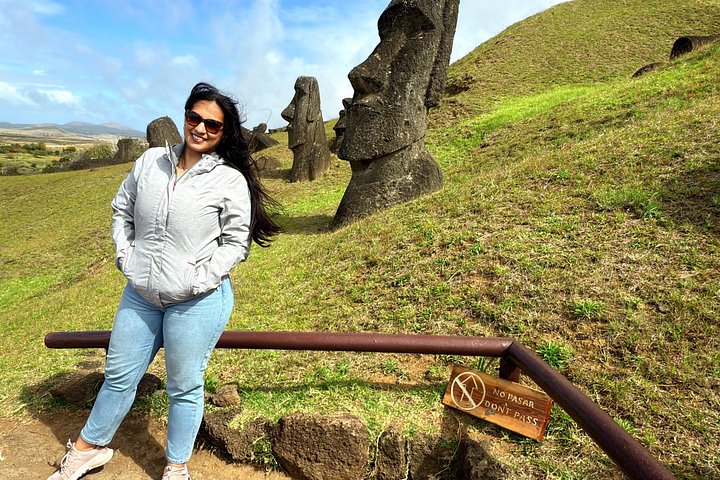
Rano Raraku is where the moai were born. This extinct volcano of soft volcanic tuff was the island's sculpture workshop, and the slopes still hold hundreds of figures in every state: some half-carved into the cliff face, some finished and standing in the grass with their bodies buried to the shoulders, and one gigantic unfinished figure lying in the rock that would have been more than twenty metres long. Walking the paths between them gives you a feeling no restored platform can match. The faces look out over the plain toward the sea, and the heads emerge from the hillside at odd angles, because over centuries soil has washed down and buried the bodies. Inside the crater a freshwater lake fringed with reeds fills the bowl, and a path climbs to the rim for a view over the south coast and Tongariki. The whole place feels less like a monument and more like a workplace abandoned in the middle of a shift.
Understanding the quarry changes how you see everything else. Carvers worked the tuff with hard basalt tools, shaping the figure lying face-up on the rock, then detaching it from the mountain and lowering it down the slope. Transport to the platforms around the island is still debated, but local oral tradition says the statues walked, and experiments in recent years have shown that a standing moai can be rocked along upright with ropes.
Guides at the site are good at presenting both stories without claiming certainty. You will see the Tukuturi, an unusual kneeling statue with a goatee-like beard, and the famous huge unfinished figure known as El Gigante, which suggests why the work stopped: the scale had outrun the craft.
Plan the visit around the entry rules. Rano Raraku can be entered only once per park ticket, so make it count: take your time, and ask your guide to explain the paths before you start. Allow around 90 minutes, longer if you want the crater rim, and watch your footing on the wet grass after rain, which can make slopes slippery.
The light is best early in the morning or late afternoon, when the long shadows pick out the carving. Bring water, a hat and a windproof layer, because there is almost no shelter. Photographers tend to favour the afternoon, when the sun lights the faces on the outer slope, while the crater lake is calmer in the morning.
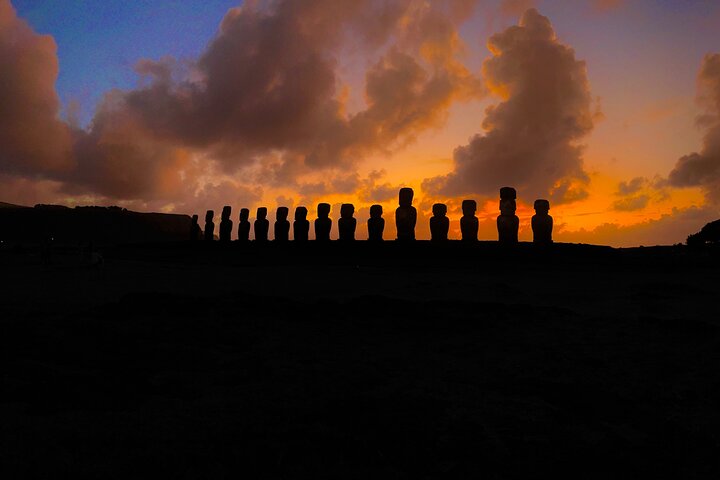
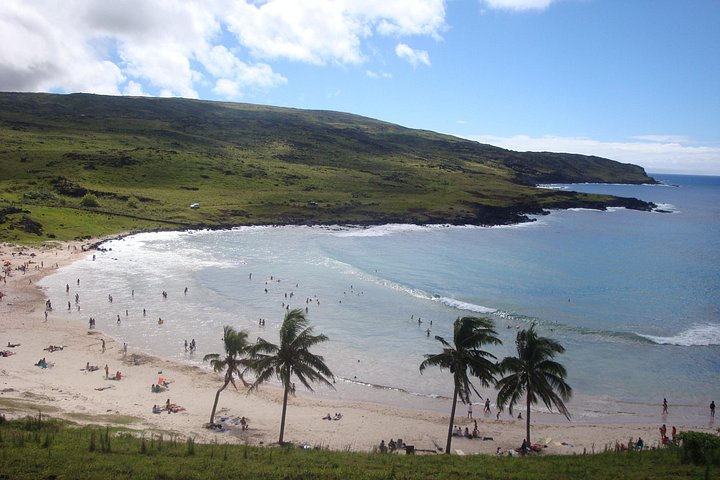
Most tour itineraries pair the quarry with Ahu Tongariki, five minutes down the road, and with Anakena beach for a swim. The product linked here is a full-day journey that covers all three, which is the most efficient way to see the east and north of the island with transport and a guide in one booking. It is a long day, so lunch and sun protection matter. If you prefer a slower pace, split the quarry and Tongariki onto separate half days and enjoy the quarry in quiet late-afternoon light.
A few extra tips make the visit smoother. Start with the outer southern slope, where the densest cluster of statues stands, then decide whether you have the energy for the crater lake. The path to the lake is short, and the reed-lined water is a peaceful contrast to the stone figures.
Ask your guide about the carved details on a few of the buried torsos, which show hands, belts and even boat designs. Photographers should carry a lens that handles both wide landscapes and close faces, and everyone should keep a respectful distance from the statues, many of which are fragile and partly eroded.
What to expect
The experience
A guided walk among hundreds of moai on the slopes of the quarry volcano, with optional climbs to the crater lake and the rim. Entry is once per park ticket.
Best time
Early morning or late afternoon, when the low light picks out the carved faces and crowds are thinner.
How long
About 90 minutes on site, more if you climb to the rim.
Tips
Wear sturdy shoes, because slopes can be wet and slippery. Bring water and sun protection, and stay on the marked paths.
Quick picks
- Best for
- History lovers and anyone curious about how the moai were made.
- Families
- Children enjoy the scale of the figures and the open space; keep them on the paths.
- Couples
- A long unhurried wander among the statues in late-afternoon light.
- Pair with
- Ahu Tongariki and Anakena beach complete the classic east-coast day.
- Time needed
- At least 90 minutes, or a half day with the rim climb.
Good questions
Why does Rano Raraku have so many unfinished moai?+
It was the quarry for nearly every statue on the island, so figures at every stage of carving remain in the rock. Work appears to have stopped abruptly rather than gradually.
Can I enter more than once?+
No. Park rules allow one entry to Rano Raraku per ticket, so pick the time of day carefully.
How long should I allow?+
Plan around 90 minutes, more if you climb to the crater rim or want to photograph the lake.
Are the buried bodies a mystery?+
Many statues look like heads only because soil has washed down from the slope over centuries and buried the torsos. Excavations have shown the bodies carry carvings.
Is it suitable for children?+
Yes, with supervision. The paths are open and the statues impress children, but slopes can be slippery and there is no shade.