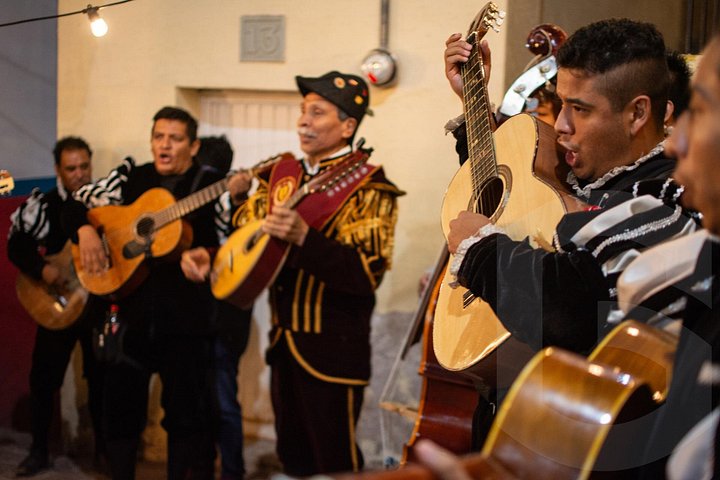
If Guanajuato has a single place where everything meets, it is the Jardín de la Unión. The garden occupies what used to be the Plazuela de San Diego, once part of the atrium of the neighbouring San Diego church, and its sharp triangular outline has earned it a local nickname, la rebanada de queso, the slice of cheese. Dense, trimmed trees give shade through most of the day, a bandstand-style kiosk sits at the centre, and benches line the paths for people-watching. During the nineteenth century, after the Liberal victory, the garden became the city's principal gathering point, with brass bands playing for residents, and it was even the starting point of the old tramway. That social role has barely changed. Around the edges you will find cafés, restaurants, bars, hotels, a museum and the Teatro Juárez, many with tables set out facing the kiosk so that you can eat, drink and watch the whole performance of local life at once. Students come between classes, families take an evening stroll, street musicians and mariachi groups work the terraces, and in the late afternoon the light turns the surrounding façades gold. It is a place you will pass through repeatedly, whether you intend to or not.
The garden is also the practical centre of the visit. Several of the city's best-known sights are within a few minutes' walk: the Teatro Juárez is on the corner, the white steps of the University are just up the street, the Basílica and the Plaza de la Paz are a short stroll away, and the lanes toward the Callejón del Beso begin close by.
Two of the hotels we recommend face the garden directly, which makes it an easy base for early starts and late returns. If you arrive without a plan, sit down here with a coffee and work out the rest.
Working the visit
There is nothing to book and no ticket to buy. The garden is open as a public space and feels comfortable at any hour, with the tourism board describing it as welcoming for families by day and by night. Late afternoon and early evening are the liveliest times, when the terrace tables fill and the music begins. Mornings are quieter, with delivery trucks, shoe-shiners and office workers crossing on their way to work, and they are the best time for photographs without crowds.
Around the Day of the Virgin of Dolores, known locally as the Day of Flowers, the garden fills with flowers, food and music, and during the autumn arts festival the whole neighbourhood is busier and noisier than usual. Prices on the terraces are higher than in the side streets, which is the fair price of the view, so consider eating one meal here and the rest around the market.
Who it suits
Everyone. Couples like it for a drink as the lights come on, families like the open space and the ice cream, solo travellers can sit comfortably with a book, and anyone who has just climbed the Pípila stairs will appreciate a bench. If you are a light sleeper staying nearby, remember that the same music that makes the garden attractive can carry into rooms overlooking it.
What to expect
The experience
A free, open public garden ringed by cafés, restaurants and hotels, with shaded benches, a central kiosk and live music on many evenings.
Best time
Late afternoon into the evening, when the terraces fill and the musicians arrive; mornings for quiet and photographs.
How long
Half an hour for a stroll, or an entire evening over dinner and drinks.
Tips
Take a terrace table facing the kiosk for the best view, ask for a quiet hotel room if you are staying on the garden, and use it as the hub for the Teatro Juárez and the University.
Quick picks
- Best for
- Anyone who wants to feel the daily rhythm of the city, especially first-timers.
- Families
- Open space, benches, ice cream and an easy atmosphere; a relaxed place to let children unwind after the stairs.
- Couples
- Settle at an outdoor table at dusk and let the mariachis and the lit-up theatre do the rest.
- Pair with
- The Teatro Juárez, the University steps and the Night Walk with the Estudiantina.
- Time needed
- Allow thirty minutes to pass through, or an evening to enjoy it properly.
Good questions
Why is it called the slice of cheese?+
Locals nickname the garden la rebanada de queso because of its triangular shape, which resembles a wedge of cheese.
Is the Jardín de la Unión free?+
Yes, it is a public garden and there is no charge to enter or sit. You only pay if you order at one of the surrounding cafés or restaurants.
What is the best time to go?+
Late afternoon and evening are liveliest, with music and full terraces. Mornings are calm and good for photographs.
What is nearby?+
The Teatro Juárez is on the corner, the University of Guanajuato is a couple of minutes away, and the Basílica and the Callejón del Beso are a short walk.
Is it safe in the evening?+
It is a busy, well-used central space with families and students, and it is generally comfortable after dark. Use normal city care with bags and phones in crowds.