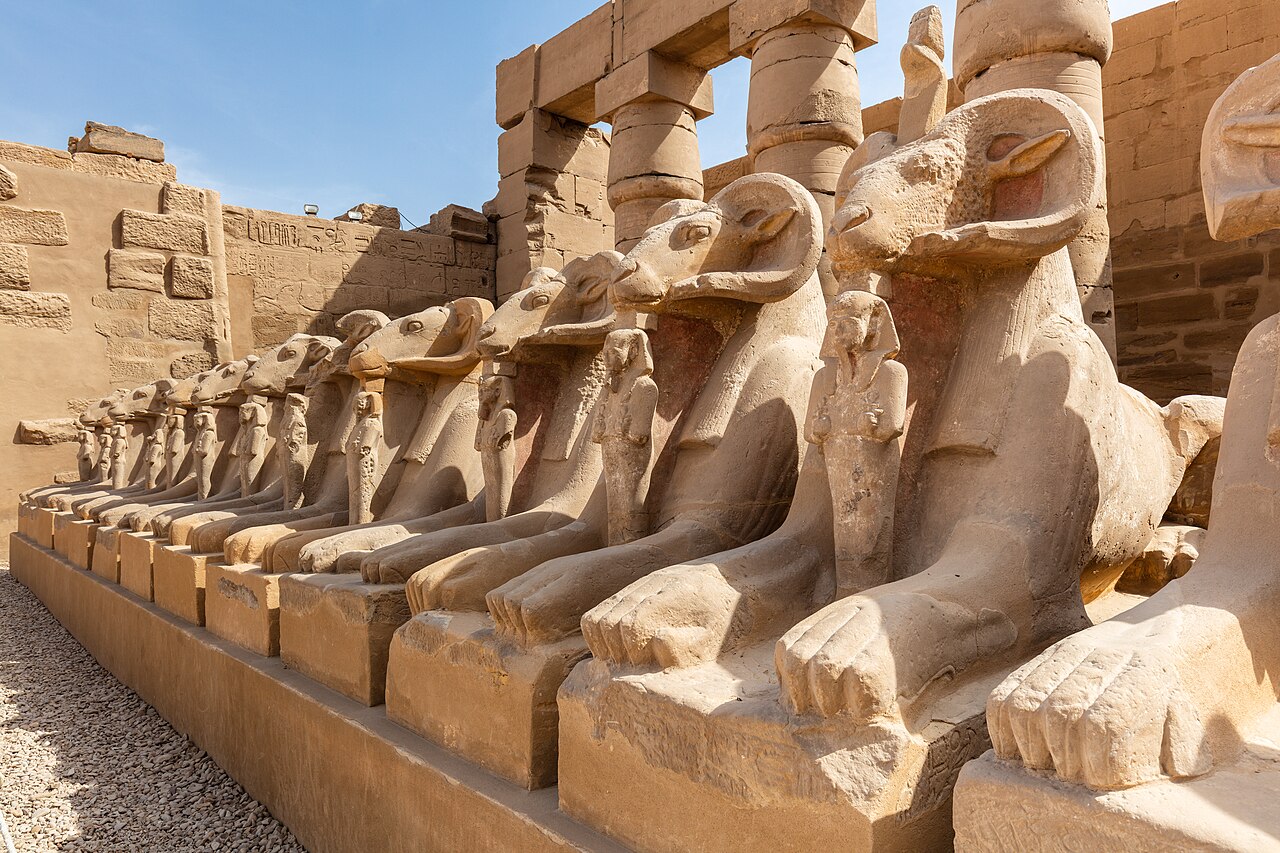
Medinet Habu is the great mortuary temple of Ramesses III, built in the twelfth century BC on the West Bank, just south of the Colossi of Memnon and the village of Deir el-Medina. It is one of the largest temple complexes in Egypt and, for many visitors, the most rewarding surprise of the West Bank. You enter through a fortified gateway modelled on a Syrian-style fortress, an unusual piece of military architecture for a religious building, and beyond it the temple proper unfolds in a sequence of pylons, courts and halls. What sets Medinet Habu apart is its decoration. The outer walls carry huge battle scenes showing Ramesses III defeating the Sea Peoples and the Libyans, and the inner courts and columns are covered in carved and painted reliefs of festivals, offerings and the king before the gods. Colour survives here in places that have been sheltered from the sun, including on column capitals and ceiling beams in the first court, which gives you a sense of how brightly these temples once glowed. The site is also layered with later history: an older temple of Amun built under Hatshepsut and Thutmose III stands inside the enclosure, and the ruins of a later Christian settlement cling to the walls. It is spacious, easy to walk and usually calm, with room to look closely without a crowd.
Why it matters
The reliefs at Medinet Habu are among the most important historical records to survive from ancient Egypt, because they preserve one of the few detailed accounts of the great migrations and sea battles that unsettled the eastern Mediterranean at the end of the Bronze Age. You can follow the story along the walls, from the king marching out to the ships crashing together in the Nile delta, then the piles of captured hands and prisoners brought before Amun. The carving is deep and bold, so it reads well even in strong light, and it makes an excellent subject for photographers.
Planning the visit
Medinet Habu is a standard stop on a West Bank day, usually combined with the Ramesseum, Deir el-Medina and the Valley of the Queens, and it is only a few minutes by road from the Colossi of Memnon. Entry is priced in Egyptian pounds with a higher rate for foreign visitors, so carry some cash.
Most guided half-day trips include it, and a private guide helps greatly with the battle scenes, which are easy to misread without context. Allow about ninety minutes to two hours. Wear a hat and sturdy shoes, bring water, and expect little shade in the outer courts.
Making the most of it
The best time is early morning or the last hour before closing, when low sun picks out the relief and the air is cooler. Walk the outer wall first to take in the battle scenes, then enter the first court to look up at the surviving colour on the ceilings and capitals.
If you are short on time, concentrate on the first and second courts and skip the minor chapels. Families will find the animals, ships and giant figures easy to enjoy, and the open layout lets children move around freely.
A useful way to frame the day is to think of Medinet Habu as the West Bank's counterpart to Karnak: a single king's vision on a monumental scale, but with room to breathe. If your itinerary is tight, it is a better use of a spare morning than a second visit to a crowded site, and it rewards photographers and history lovers alike.
What to expect
The experience
A self-paced walk through the fortified gate, two great courts and the hall behind them, with the battle reliefs on the outer walls, best done with a guide.
Best time
Early morning or the last hour before closing, when the light is low and the air is cooler.
How long
About ninety minutes to two hours, or a little longer if you read the reliefs.
Tips
Bring a hat, water and cash for entry, look up at the painted ceilings in the first court, and walk the outer wall for the battle scenes.
Quick picks
- Best for
- Visitors who love detailed reliefs and want a calmer alternative to the big East Bank crowds.
- Families
- Open and easy to walk, with ships, animals and giant figures that children can spot.
- Couples
- Beautiful in the golden hour, followed by a sunset on the river.
- Pair with
- The Colossi of Memnon, Deir el-Medina and the Valley of the Queens on the same West Bank morning.
- Time needed
- Two hours at the site, or a half day with neighbouring stops.
Good questions
Why is Medinet Habu worth visiting?+
It is one of the best-preserved temples in Egypt, with huge battle reliefs and surviving colour, and it is usually much quieter than Karnak or the Valley of the Kings.
How long do you need at Medinet Habu?+
Allow about ninety minutes to two hours. You can see the main courts in an hour, but the reliefs reward a slower visit.
Is Medinet Habu close to other West Bank sights?+
Yes. It is a few minutes from the Colossi of Memnon and close to Deir el-Medina and the Valley of the Queens, so it fits neatly into a half-day trip.
Do I need a guide?+
A guide is not required, but the battle scenes and inscriptions are much easier to follow with explanation. Many half-day West Bank tours include a guide and the stop.
When is the best time to go?+
Early in the morning or just before closing. Midday is hot and the courts have little shade.