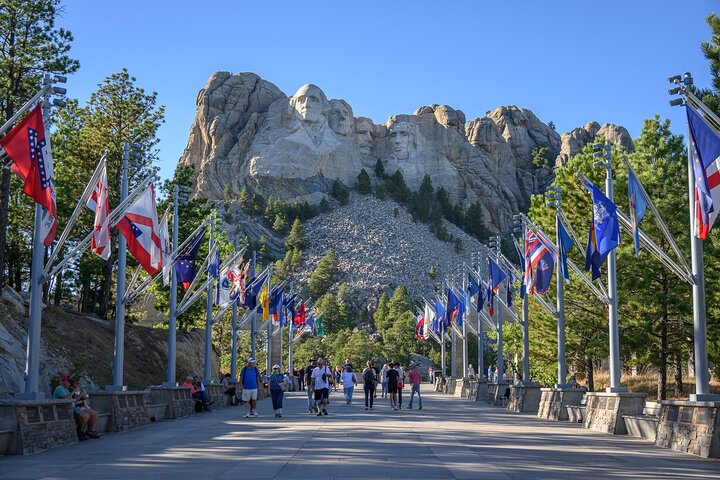
The Black Hills reward people who drive slowly. The region's best roads were designed in the 1920s and 1930s to show off the scenery rather than to move traffic, and they are part of what makes a trip memorable. The three most famous are in and around Custer State Park, and together they make a very full day.
The Peter Norbeck Scenic Byway
Peter Norbeck, a governor and later a senator, planned many of the region's scenic roads. The byway that carries his name links Iron Mountain Road, Needles Highway and the Wildlife Loop, and it is worth treating as one experience rather than separate drives. The roads are slow by design, and the limit that Norbeck recommended on Iron Mountain Road was about twenty miles per hour.
Iron Mountain Road (US 16A)
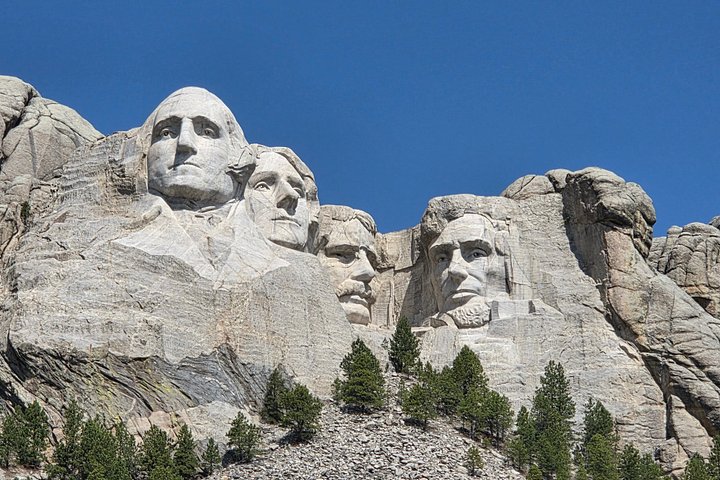
Seventeen miles between Custer State Park and Mount Rushmore, taking at least an hour. It has three narrow tunnels, named for Doane Robinson, C.C. Gideon and Scovel Johnson, and wooden pigtail bridges that loop over themselves as the road climbs. Some of the tunnels are aligned to frame the faces of Mount Rushmore in the distance. Tunnel clearances run from roughly ten feet nine inches to just over eleven feet in height and from about ten feet nine inches to twelve feet in width, so check your vehicle. It can close periodically in winter.
Needles Highway (SD 87)
Fourteen miles of granite spires, forest and meadow, taking an hour or more. Two tunnels stand out: the Needles Eye Tunnel, about eight feet wide and just under ten feet high, and the Iron Creek Tunnel, slightly larger. Wide vehicles, large RVs and trailers cannot pass. Needles Highway closes to vehicles with the first snow and reopens in April or later, depending on conditions, and when closed it is open to hikers, bikers, snowshoers and skiers. Sylvan Lake sits along the route.
The Wildlife Loop Road
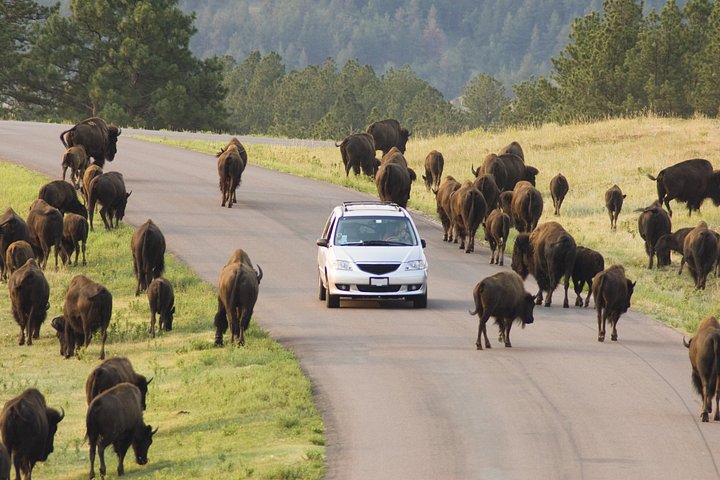
Eighteen miles through the prairie of Custer State Park, taking about an hour and a half depending on wildlife jams. About 1,350 bison roam free, with deer, elk, pronghorn, prairie dogs and burros, and bighorn sheep and coyotes are possible. Go early or in the evening, stay in the car near animals and never feed the burros. The road is open year-round, though winter conditions need care.
Beyond the park
Two other famous drives lie outside the southern Hills and are covered on their own destination pages: the Spearfish Canyon Scenic Byway in the northern Hills, with its waterfalls and limestone cliffs, and the Badlands Loop Road in Badlands National Park. Both are worth a day, and both pair well with a night in Rapid City.
Combining the drives
A classic loop starts in Keystone, visits Mount Rushmore, follows Iron Mountain Road to the park, continues along Needles Highway past Sylvan Lake and returns via the Wildlife Loop and Custer. Allow a full day with stops. A shorter version skips the Wildlife Loop. Whichever you choose, start early, because the best light and the best wildlife viewing are in the morning.
Practical tips
Fill the tank before entering the park, since stations are few. Carry water and snacks. Mobile coverage is patchy, so download maps. Slow traffic is part of the experience, so build in extra time. Watch for cyclists, motorcyclists and animals on the road, particularly at dusk. A park entrance license is required for Custer State Park drives, and passes for national parks do not cover it.
Photography and pacing
The best light on these roads is early morning and late afternoon, when granite glows and animals move. Tunnels and pull-offs are the best places to stop, and it is polite to let faster traffic pass. Allow more time than the mileage suggests, because a single bison on the road can stop traffic for twenty minutes. Rushing spoils the point of these drives, so plan fewer stops and enjoy the ones you make. Motorcyclists and cyclists share the roads, so watch for them on blind curves.
Winter driving
Several roads close or become difficult in winter, and conditions can change quickly. Check South Dakota 511 before you set out, carry emergency supplies and be prepared to change the plan. A guided tour can remove the stress, and winter has its own quiet beauty.