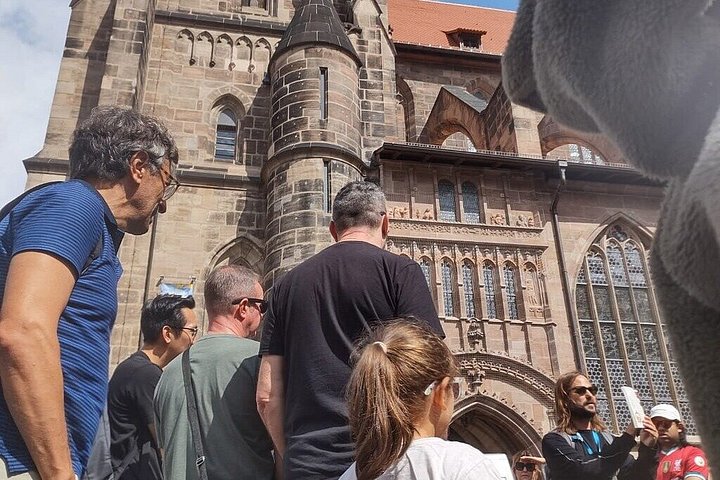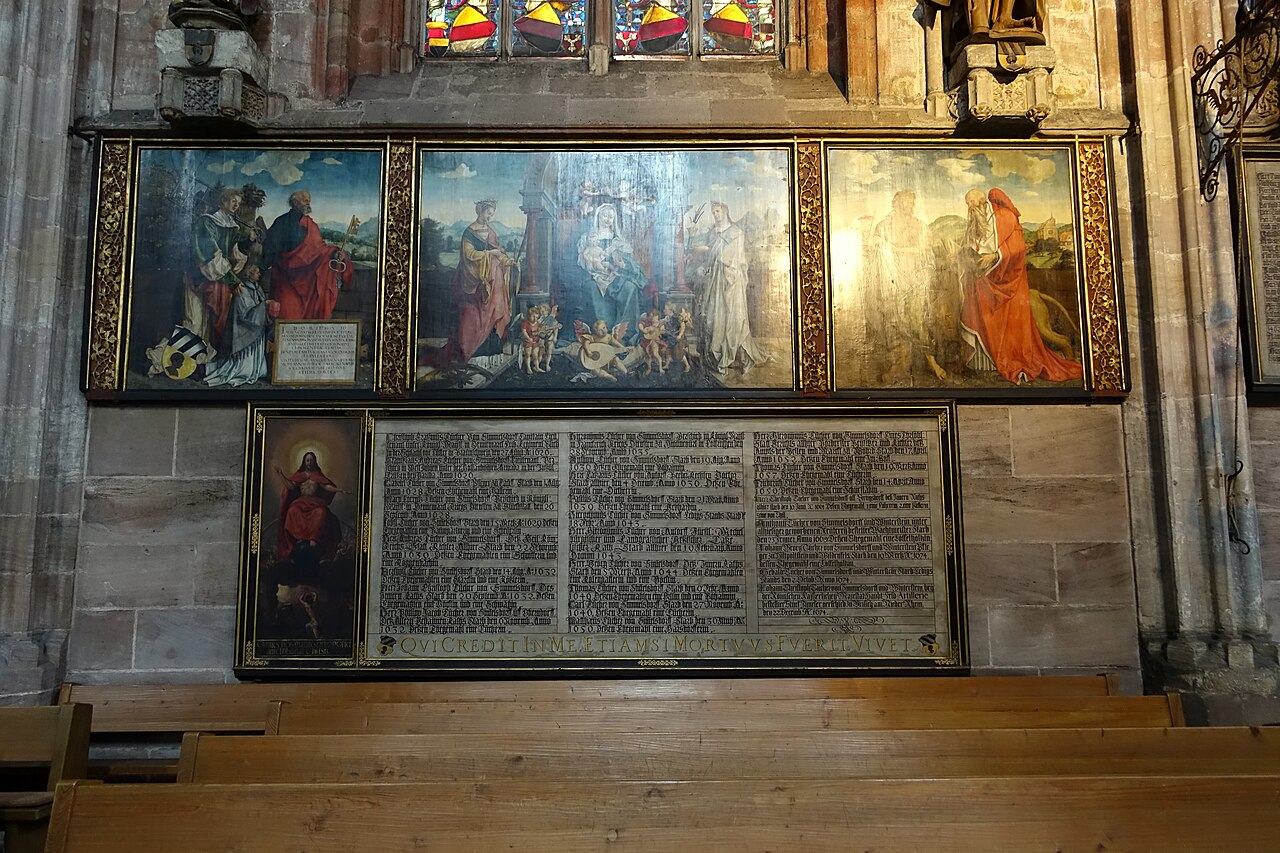
Two Gothic parish churches dominate the old town: St. Lorenz on the south side of the Pegnitz and St. Sebald on the north. Both are Lutheran today, both were heavily damaged in the war and both were carefully restored, and together they hold some of the finest late-medieval art in Germany. They are not museums but working churches, so visits sit alongside services and concerts. Free to enter, they offer a quiet counterpoint to the bustle of the market square. Visit both if you can, since each has a different character and different treasures, and together they explain why Nuremberg was a centre of religious and artistic life in the age of Dürer.
St. Lorenz is the larger of the two, with twin towers on the west front and a rose window above the main doorway. Inside, the soaring Sacrament House by Adam Kraft, a stone tabernacle about twenty metres tall and carved like a slender spire, is the star. Nearby, the Annunciation by Veit Stoss hangs from the ceiling above the choir, a carved wooden group of the angel and Mary encircled by a rosary garland.
These two works are among the most celebrated pieces of late-medieval sculpture. The church also contains stained glass, including windows donated by wealthy families, and the nave's lightness shows the Gothic ambition of the city.
St. Sebald is the older church, with a Romanesque nave and later Gothic choir, and it honours the city's patron saint, Sebaldus, whose relics lie in a bronze shrine made by Peter Vischer the Elder and his sons in the early sixteenth century. The shrine is a Renaissance masterpiece, richly detailed with figures and ornament, and sits in the choir. Other highlights include the carved Schreyer-Landauer monument and sculptures by Veit Stoss. The exterior doors and carvings are worth a close look as well.
Opening hours vary through the year, and services and concerts can restrict access, so check ahead. Dress modestly and keep voices down. Organ concerts are frequently held and offer a lovely way to experience the space. Allow thirty to forty-five minutes at each, and walk between them along the Königstrasse and across the river for a pleasant route.
Combine with the Hauptmarkt and a visit to the Dürer House for a rich morning. The churches are free, though donations are welcome, and the towers may be open for climbs on certain days at an extra cost.
Some background makes the churches richer. Nuremberg adopted the Lutheran Reformation in 1525, and both churches were converted from Catholic to Protestant use while keeping most of their medieval art, which is unusual in Europe. That is why Gothic sculpture, stained glass and shrines survive in a Lutheran setting. Veit Stoss, a sculptor of extraordinary skill, worked in Nuremberg for much of his life, and his work here shows his ability to give wood a nearly liquid movement.
Peter Vischer and his sons were bronze casters whose workshop became famous across Europe. Seeing their work in the setting for which it was made is worth more than any photograph, and the quiet of the naves gives time to look properly at details that guidebooks skip.
What to expect
The experience
Self-guided visits to two working Gothic churches, each with famous late-medieval sculpture, with concerts and services at set times.
Best time
Daytime for light through the stained glass; check service times and enjoy an evening organ concert if available.
How long
Thirty to forty-five minutes per church.
Tips
Look up for the Veit Stoss Annunciation, find the bronze shrine in St. Sebald and check for organ concerts.
Quick picks
- Best for
- Art and architecture lovers, and anyone wanting a calm break from the crowds.
- Families
- Children appreciate the hanging sculpture and the tall spires; keep visits short.
- Couples
- Quiet, beautiful settings for couples, especially with a concert.
- Pair with
- The Hauptmarkt, the Dürer House and the Imperial Castle.
- Time needed
- One to one and a half hours for both.
Good questions
Which church should I visit if I only have time for one?+
St. Lorenz has the Sacrament House and the Veit Stoss Annunciation, which many visitors consider the bigger draw. St. Sebald has the bronze shrine.
Are the churches free to enter?+
Yes, though donations are welcome. Tower climbs, where offered, have a small charge.
Were the churches damaged in the war?+
Both were badly damaged in 1945 and rebuilt. Many artworks had been moved to safety beforehand.
Can I attend an organ concert?+
Concerts are held regularly in both churches. Check the schedule locally.
Are there dress codes?+
No strict code, but modest dress and quiet behaviour are expected in working churches.