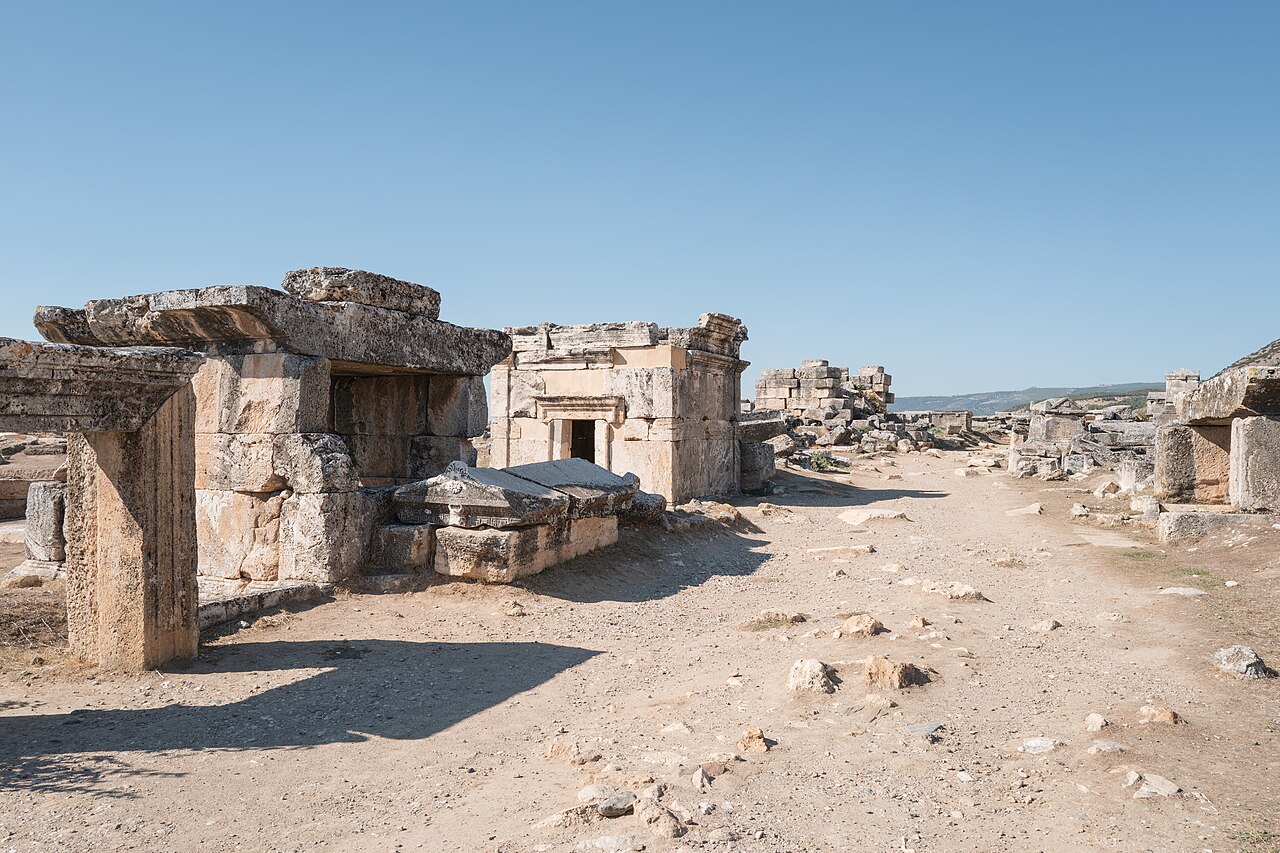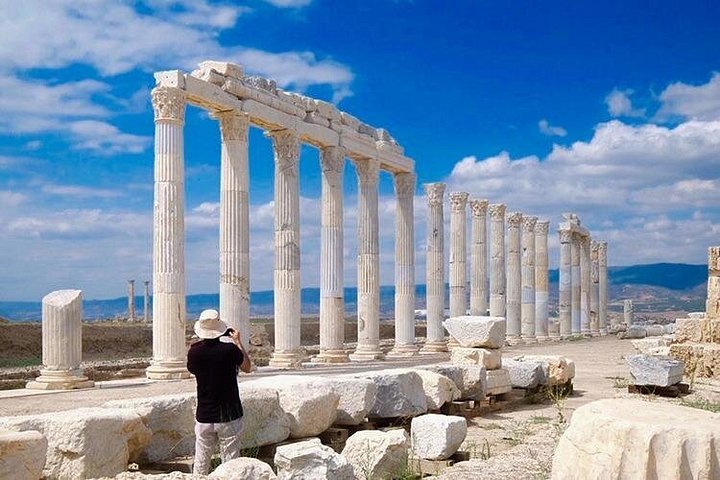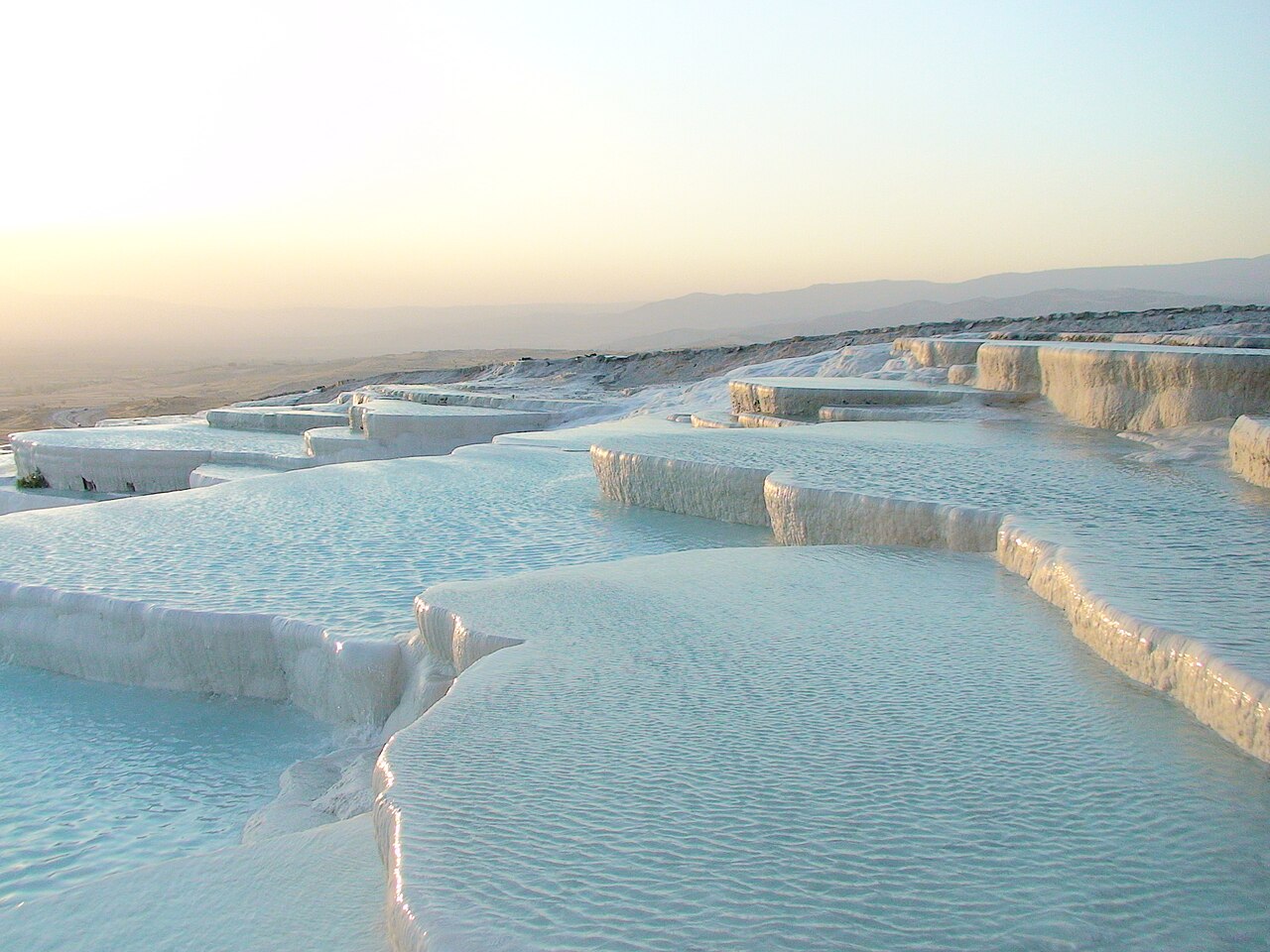
The main street of Hierapolis, often called Frontinus Street after a Roman governor of the province, is a broad, straight avenue that runs for roughly a kilometre through the ancient city. In its heyday it was lined on both sides by columns and covered walkways, with shops, workshops and houses behind them, and the paving still carries the ruts of carts. At its northern end it begins at a monumental gate, usually called the Domitian Gate or Frontinus Gate, which is dated to the later first century AD and dedicated to the emperor Domitian. Three arched passages are flanked by two round towers, and the whole structure frames the entrance to the city in a way that still impresses. Walking the street is a lesson in how a Roman provincial city worked. Shop fronts open onto the colonnade, drainage channels run beneath the road, and the carefully dressed stones show the wealth of a town that lived on pilgrims, healing waters and trade. Beyond the gate and the street you reach the open area of the former agora and the smaller buildings around it. It is a striking contrast with the soft white terraces below, and it makes a wonderful downhill walk if you enter by the north gate.
Where it fits
Most coach visitors arrive at the north gate, which puts Frontinus Street right at the start of the walk. From there the street leads gently downhill past the theatre turn-off toward the terraces, so the route works nicely as a one-way trip that ends with a barefoot walk on the white slopes. If you start at the south gate, you can climb the street in the other direction, which takes longer but lets you save the gate for last.
What to notice
Look at the columns and capitals, the worn paving and the remains of shop fronts, and imagine the street crowded with pilgrims, traders and carts. Near the gate, the Byzantine gate and later fortifications show how the city adapted over the centuries. You will also see fragments of inscriptions and architectural details scattered along the sides, and some walkers enjoy spotting the small public structures that line the route. Information panels are modest, so a guide, an audio guide or a good map helps a great deal.
Practical tips
The street is open and exposed, with very little shade, so carry water and a hat in warm weather and a layer when the wind blows. The paving is uneven, so wear proper shoes rather than flip-flops, and remember that you will need to take your shoes off when you reach the travertines. Early morning gives the best light for photographs through the arches, while late afternoon is quieter.
Allow about an hour for the street and its gate, or two if you combine it with the nearby agora and the museum. It is a gentle, easy walk compared with the climbs to the theatre or the martyrium, and it suits most ages.
Context and extras
Beyond the street lie the remains of the northern necropolis and the Byzantine gate, which show how the city changed from a Roman spa town to a fortified Christian one. Families can turn the walk into a game of spotting columns, drains and inscriptions, and photographers will find that the long straight perspective of the street, with the arches behind, makes a classic composition. Take your time, because the street is best enjoyed slowly, with a pause to read the inscriptions or simply look back at the gate.
What to expect
The experience
A self-guided walk along a long colonnaded Roman street, starting or finishing at a monumental gate with two round towers.
Best time
Early morning for the best light through the arches.
How long
About an hour for the street and gate, longer with the agora and museum.
Tips
Wear proper shoes for the uneven paving, carry water and bring a hat.
Quick picks
- Best for
- First-timers who want to feel the scale of a Roman provincial city.
- Families
- An easy, mostly level walk that suits most ages, with space for children to roam.
- Couples
- Photograph the gate arches at sunrise or late afternoon.
- Pair with
- The Hierapolis Theatre, the archaeology museum and the necropolis.
- Time needed
- Allow about an hour.
Good questions
Why is it called Frontinus Street?+
It is named after a Roman governor of the province, linked to the gate at its northern end. Sources vary on the details.
How long is the street?+
Roughly a kilometre in total, though visitors usually walk only part of it.
Is it included in the Pamukkale ticket?+
Yes, the street lies within the ancient city of Hierapolis, which the main site ticket covers.
What is the Domitian Gate?+
It is a monumental Roman gate with three arches and two round towers, usually dated to the later first century AD.
Should I start at the north or south gate?+
The north gate gives a mostly downhill walk through the ruins to the terraces, which suits most visitors.