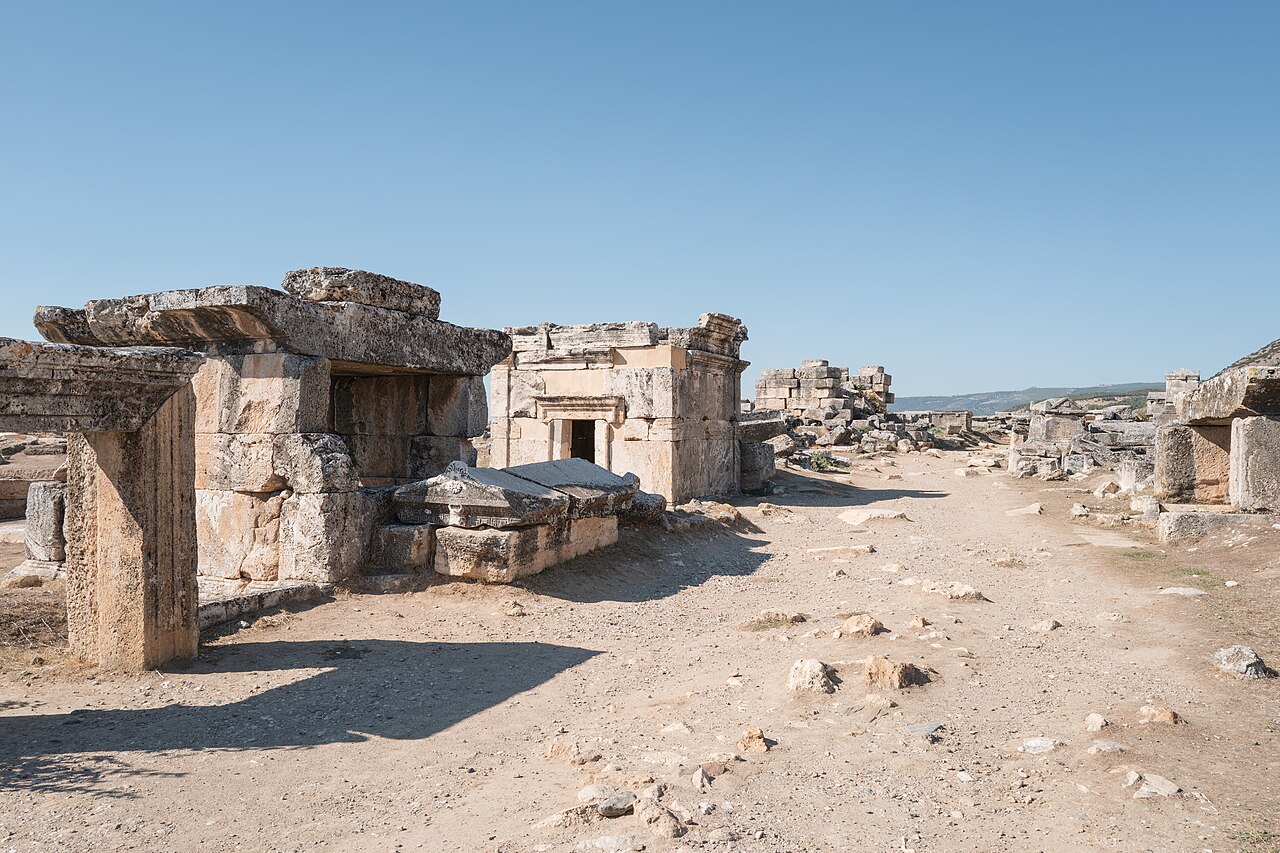
High on the hillside above the theatre, a steep climb from the busier parts of Hierapolis, stand the ruins of the Martyrium of Saint Philip. According to Christian tradition, Philip the Apostle ended his life in Hierapolis, and in the early fifth century a remarkable building was raised on this hill to honour him. It was an octagon, with a central space surrounded by chapels arranged around the sides, a plan designed to move pilgrims through the holy place in a processional route. Today the walls are broken and the roof is long gone, but the geometry is still easy to read, and the stones carry the scale of what the place must have been. Hierapolis became an important Christian centre in the Byzantine centuries, and the martyrium is the most telling reminder of that chapter. In 2011 an Italian archaeological team announced the discovery of what it believes is the tomb of Philip in a church just below the martyrium, a claim that scholars continue to discuss with caution. Whether or not the tomb belongs to the apostle, the finds underline how devoted pilgrims once were to this hilltop, and why the city's Christian community invested so much in it.
The climb and the setting
The martyrium sits on a hill northeast of the theatre, reached by a path that rises steadily and can feel long in hot weather. Expect uneven ground, loose stones and few handrails, and wear shoes with proper grip. The effort is rewarded with quiet, open views over the ruins, the valley and the edge of the travertine slope, and you will often have the place almost to yourself while the coach groups remain below.
Take water, and consider a light jacket in the cooler months, because the hilltop catches the wind.
What to look at
Walk the perimeter first to understand the octagonal plan, then step into the central space and notice how the chapels radiate out from it. The building may have included a pilgrim route passing the tomb and sacred spots, and archaeologists have found traces of Byzantine decoration and later reuse.
Information panels give a basic outline, but a guide or a good guidebook turns the visit into a story. Remember that excavation and conservation work continues in this area, so some parts may be fenced off, and access can change from season to season.
Who it suits
Pilgrims and church-history enthusiasts will find the martyrium moving, but it also appeals to anyone who enjoys a quiet ruin and a view away from the crowds. It is not a stop for visitors with mobility difficulties, since the route is steep and rough. Budget about an hour including the climb up and the walk back down, and add a little more if you want to photograph from several angles.
Pair the martyrium with the theatre and the necropolis for a morning that covers the pagan, Roman and Christian layers of Hierapolis in one walk, then reward yourself with a soak in the antique pool or a hot drink in the village.
Context and extras
The hill is also a good vantage point for understanding the layout of Hierapolis, with the theatre below, the main street leading toward the northern gate and the plain stretching beyond. Bring a snack and a bottle of water, and sit for a while, because the stillness is a large part of the appeal. In the cooler months the light is clear and the air fresh, while in summer an early start is essential, since the hilltop has almost no shade at all.
What to expect
The experience
A steep self-guided climb to a hilltop ruin, with a short walk around the octagonal plan and wide views.
Best time
Morning or late afternoon, outside the hottest hours.
How long
About an hour including the climb up and the walk back.
Tips
Wear grippy shoes, take water, and check on the day that the area is open.
Quick picks
- Best for
- Church-history fans and anyone who wants quiet, high views.
- Families
- Fine for sturdy older children, but the path is steep and rough.
- Couples
- A peaceful hilltop picnic spot away from the tour groups.
- Pair with
- The Hierapolis Theatre, the necropolis and the Temple of Apollo.
- Time needed
- Allow about an hour.
Good questions
Who was Saint Philip?+
Philip was one of the twelve apostles. Christian tradition places his martyrdom in Hierapolis, and the city became a pilgrimage centre around his memory.
When was the martyrium built?+
It is generally dated to the early fifth century AD, in the Byzantine period.
Was Philip's tomb found?+
An Italian archaeological team announced in 2011 that it had found what it believes is his tomb nearby, though scholars discuss the identification with caution.
Is the climb difficult?+
It is steep and uneven but short. Allow extra time in heat and avoid it if you have mobility problems.
Is it included in the Pamukkale ticket?+
Yes, the martyrium lies within the ancient city of Hierapolis, so the main site ticket covers it.