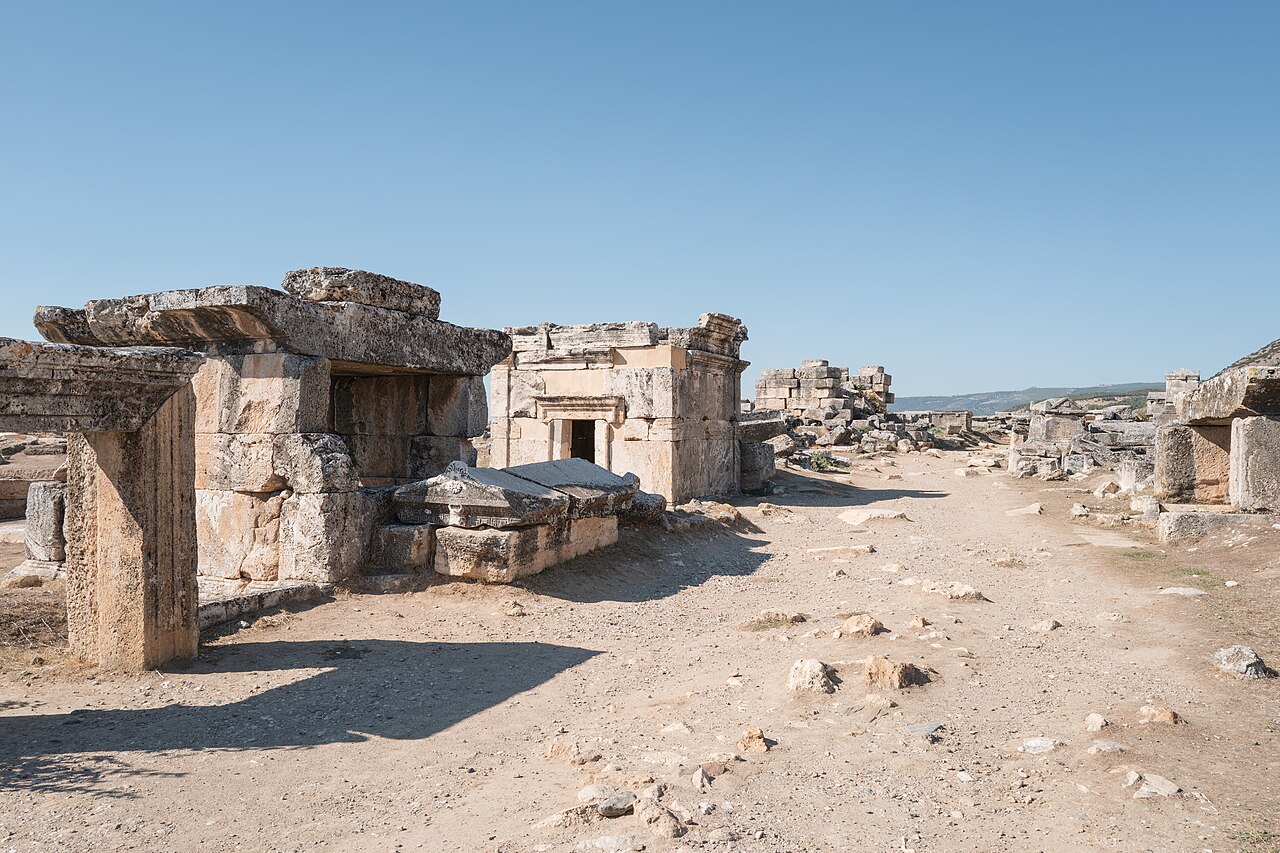
Beside the sacred pool in the middle of Hierapolis lies the religious heart of the ancient city: the foundations of the Temple of Apollo and, just next to them, a small cave known in antiquity as the Plutonium. Apollo was the patron god of Hierapolis, and a temple to him stood here from Hellenistic times, though the ruins you see mostly belong to a rebuilding in the Roman period after earthquakes damaged the city. The remains are modest, a platform, steps and scattered blocks, but the setting is memorable, surrounded by columns, springs and the pale slope above the pool. The Plutonium is the real draw. Ancient writers, including the geographer Strabo, described a cave mouth in Hierapolis that breathed out a deadly vapour. Priests of the goddess Cybele were said to enter unharmed while birds and small animals died in the fumes, and the place was regarded as a gateway to the underworld, which is why visitors today call it the Gate of Hell. The gas is carbon dioxide rising from the volcanic and thermal activity beneath the valley, the same forces that feed the springs. Archaeologists re-identified the cave in the early 2010s, and the opening is now fenced so that visitors can look from a safe distance. Treat the barriers seriously: gas can collect in low, still air.
What you will see
A short flight of steps leads to a dark opening in the rock, with a barrier and warning signs in front. Beside it are the remains of the temple platform and fragments of a nearby fountain building, and the sacred pool lies just below.
Information panels explain the story in several languages, and the area is usually busy with guides retelling the legend. Do not expect dramatic staged demonstrations: the value of the stop is the atmosphere and the chance to connect the ancient descriptions with the real, rather eerie, hole in the ground.
Safety and etiquette
Stay outside the barriers, keep children close and never lean over the opening. Carbon dioxide is heavier than air, so it can pool in hollows, especially on calm, cool mornings. Access arrangements and the exact extent of the fencing can change as conservation and safety work continues, so follow the staff and the signs on the day. Photography is allowed in the open air, and the best pictures are usually taken from the upper steps with the temple platform and the pool in the frame.
Making the most of it
The sanctuary sits close to the antique pool, the archaeology museum and the theatre, so it fits naturally into a loop around the middle of the site. Come early or late for quieter conditions, because tour groups cluster here at midday. A guided tour makes a big difference, since the ruins are sparsely labelled and the myths are half the fun.
Allow half an hour to an hour, longer if you combine it with a swim in the pool. Combine it with the theatre above and the main colonnaded street for a satisfying morning of ancient Hierapolis, then finish with lunch in the village.
Context and extras
The sanctuary shows how Greek religion blended with local Anatolian traditions, including the cult of Cybele, the mother goddess whose priests were linked to the cave. Beside the temple, the sacred pool and the fountain structures show how the thermal water itself was treated as divine. If you read a little of Strabo's description before you go, or let a guide tell the story, the small opening in the rock becomes much more vivid. Keep your expectations realistic and enjoy the atmosphere.
What to expect
The experience
A short stop at a fenced cave mouth and a ruined temple platform in the middle of Hierapolis, best with a guide or audio commentary.
Best time
Early morning or late afternoon, when groups are thinner and the light is better.
How long
Thirty to sixty minutes, longer if you combine it with the antique pool.
Tips
Stay behind the barriers, keep children close and read the information panels for the legend.
Quick picks
- Best for
- Mythology and history lovers who enjoy a good ancient story.
- Families
- Children usually love the Gate of Hell story, but keep them well back from the opening.
- Couples
- A quiet moment at the temple platform before a swim in the pool next door.
- Pair with
- Cleopatra's Antique Pool, the Hierapolis Theatre and the archaeology museum.
- Time needed
- Allow thirty to sixty minutes.
Good questions
What is the Plutonium?+
It is a cave mouth in Hierapolis that ancient writers described as breathing out deadly gas, regarded as an entrance to the underworld. The gas is carbon dioxide from thermal activity.
Why is it called the Gate of Hell?+
Because the Greeks and Romans believed it led to Pluto's realm, and because the fumes were genuinely lethal to animals that came too close.
Can I go inside the cave?+
No. The opening is fenced and entry is not permitted, so visitors look from a safe distance. Rules on the day take priority.
Is it part of the main Pamukkale ticket?+
Yes, the sanctuary lies within the ancient city of Hierapolis, which is covered by the main site ticket.
Who was Apollo in Hierapolis?+
Apollo Archegetes, the founding god, was the patron of the city and the focus of its main temple.