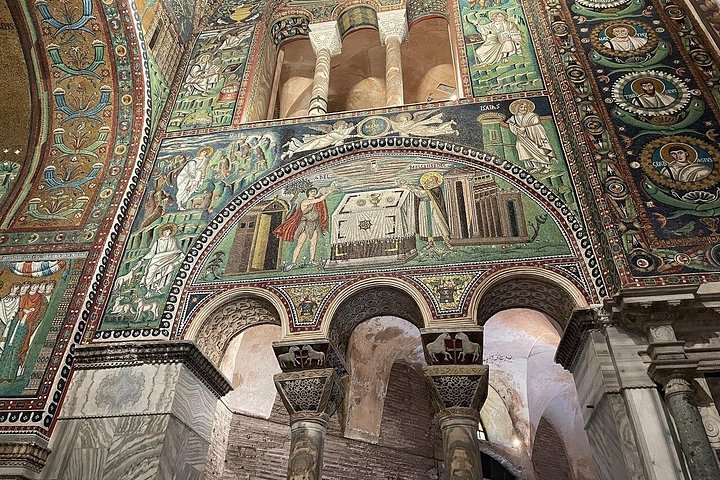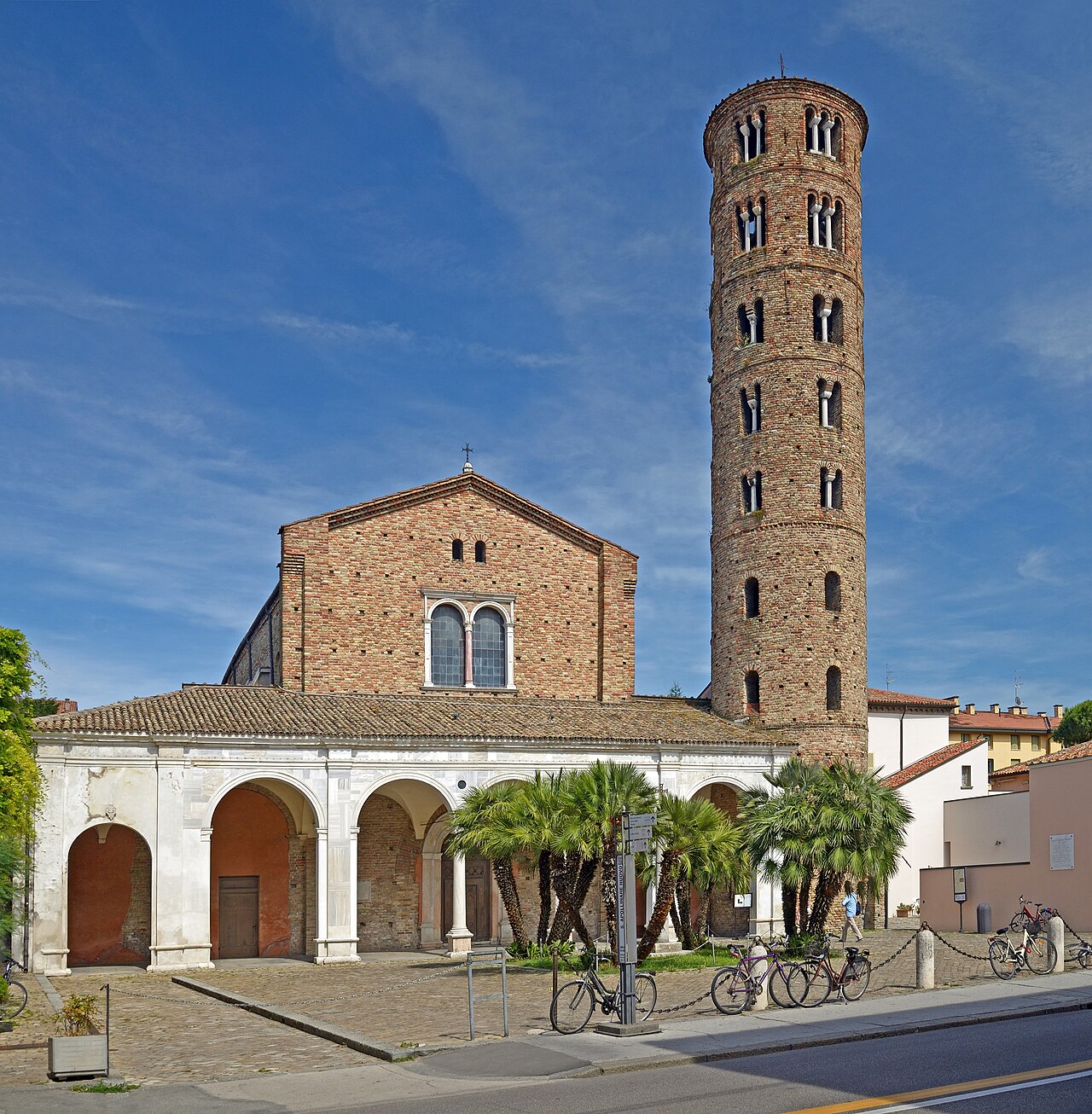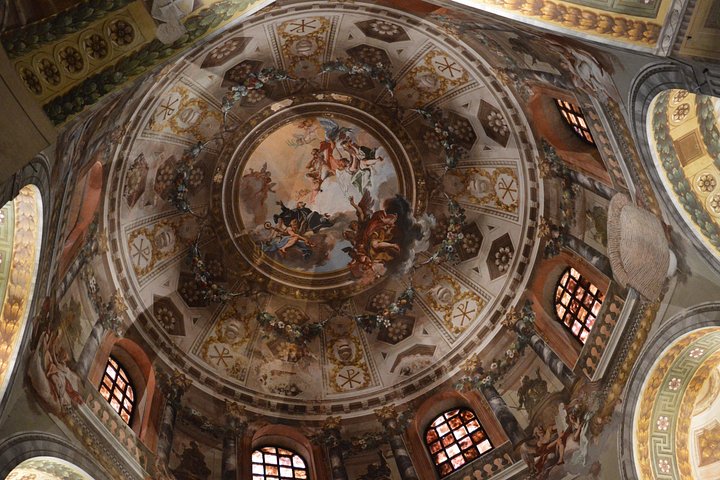
San Vitale is the reason many travellers come to Ravenna at all. Begun around 526 under the Ostrogothic king Theodoric's last years and finished in 547 after the Byzantine reconquest, it is an octagonal church unlike anything else in Western Europe: a double-shell plan of eight piers and curved galleries rising to a central dome, with light falling through tall windows onto every surface. The brickwork outside is plain, almost austere, which makes the interior hit harder. Walk through the door and the walls, vaults and apse are covered in glass and gold tesserae, in scenes that mix Old Testament stories, vine scrolls, peacocks and birds with Christ enthroned on a blue globe in the apse. The scale is human rather than monumental, so you can stand close enough to see individual tiles set at slightly different angles to catch the light, a trick the mosaicists used to make gold shimmer as visitors move.
The famous panels sit on either side of the apse. On one wall, Emperor Justinian stands holding a gold paten, flanked by Bishop Maximian, court dignitaries and soldiers carrying a shield marked with the Chi-Rho; opposite, Empress Theodora holds a gold chalice, her ladies in waiting and a eunuch chamberlain beside her, her robe hem embroidered with the three Magi. Neither ruler ever visited Ravenna, yet the pair appear as donors, a piece of imperial image-making aimed at a conquered Italy.
Look closely at the faces
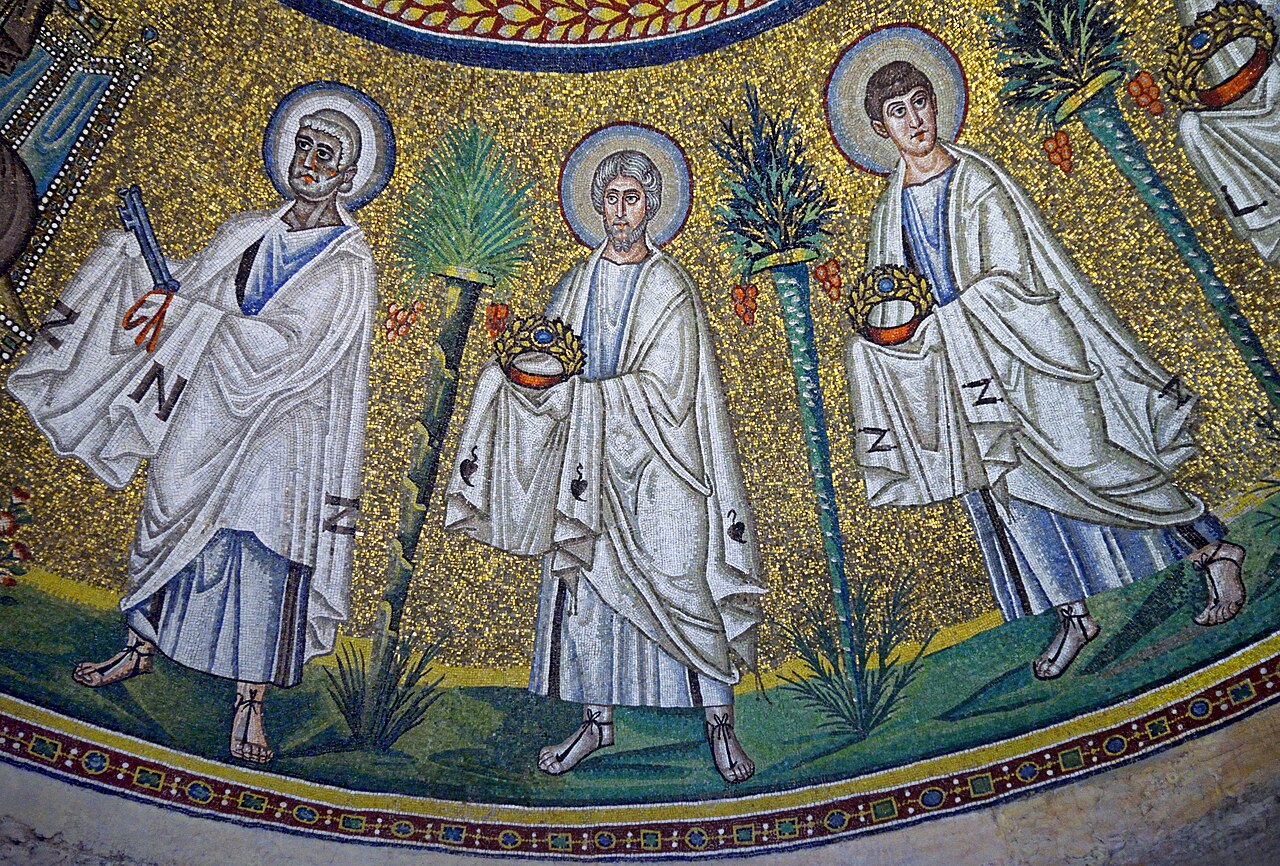
The large dark eyes, the frontal poses and the way the figures seem to float above the ground with no real shadow are the signature of Byzantine style, and the colour range, from deep purple to emerald and a dozen shades of white, is far richer than photographs suggest.
Do not rush past the rest of the building. The sanctuary vault is a riot of green foliage, fruit and animals around a central lamb, and the two lunette scenes of Abraham's hospitality and the sacrifice of Isaac are some of the earliest large-scale narrative mosaics in the city. The floor has patches of original marble paving including a small labyrinth, and the capitals carry the deep lace-like carving typical of the era. Many visitors go in thinking of it as a ten minute stop for the Justinian panel and stay for an hour.
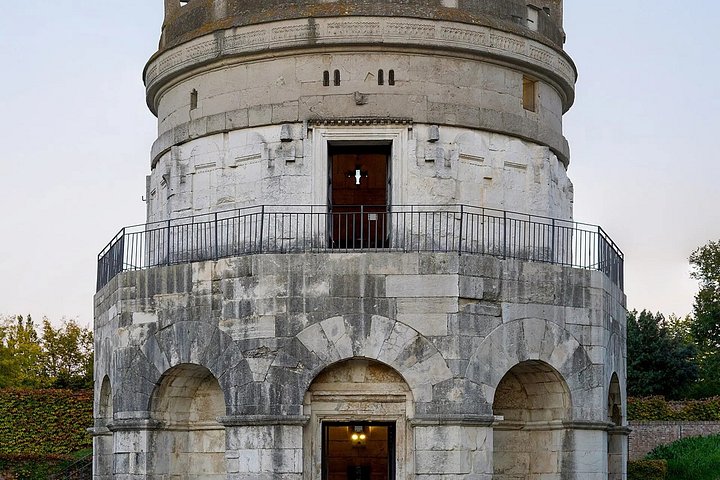
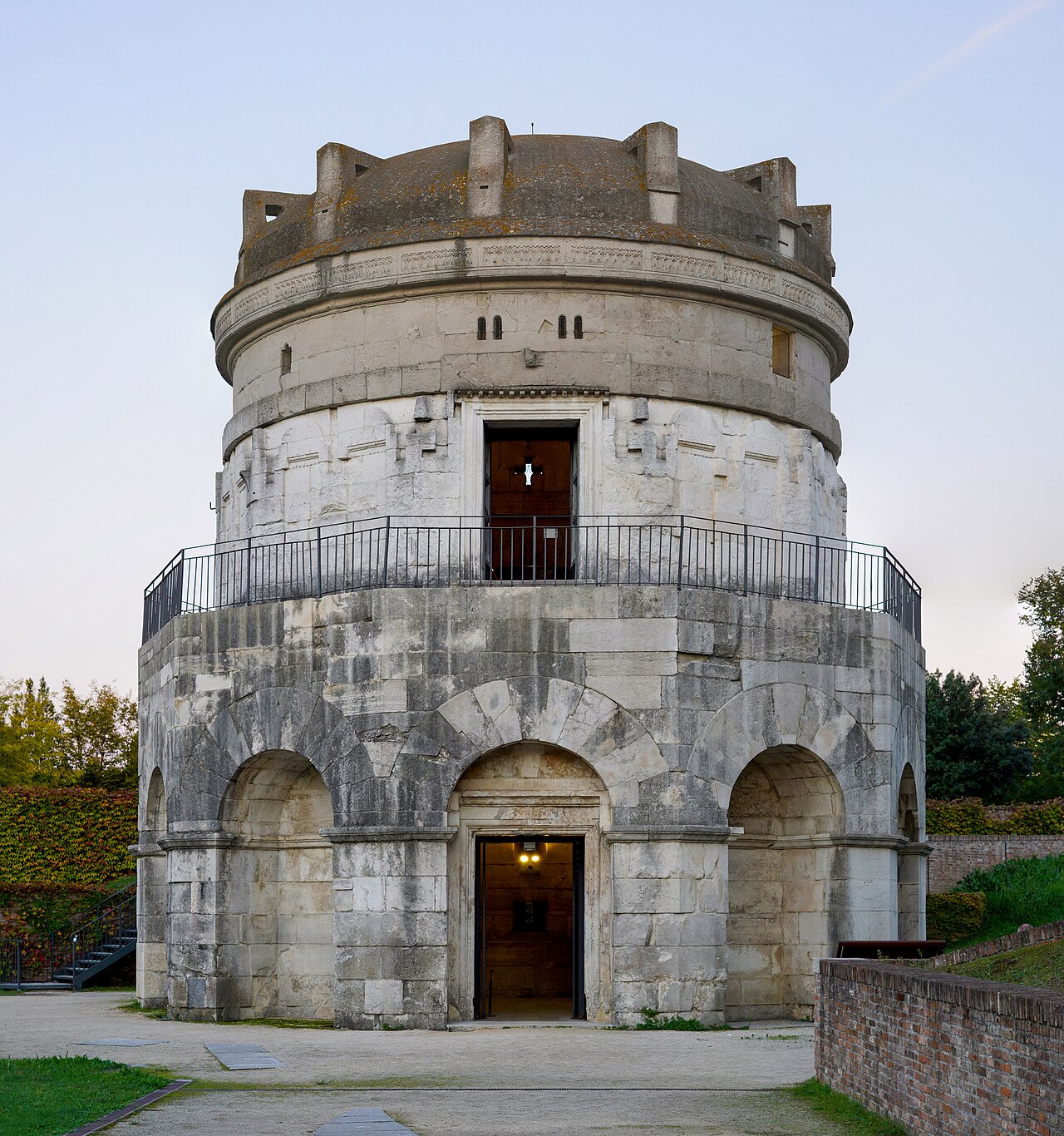
San Vitale stands beside the Mausoleum of Galla Placidia and the Archiepiscopal Museum in a quiet garden complex a few minutes' walk from the main square, and entry is bundled into the combined ticket for the city's mosaic monuments. A pass that covers several sites in one go is the practical choice, since San Vitale alone takes most visitors well over half an hour once you add the apse and the galleries. Guided walking tours add useful context on who the figures are and how the mosaics were made, but the building rewards a slow self-guided visit too, particularly in the early morning when the tour groups have not arrived and the light moves across the apse.
What to expect
The experience
A self-guided visit inside an octagonal basilica, with the apse mosaics of Justinian and Theodora as the centrepiece, plus the sanctuary vault, galleries and a quiet garden approach.
Best time
Early morning or late afternoon, when queues thin and the light on the gold is warmest. Midday in summer is the busiest slot.
How long
Plan 45 to 60 minutes inside, longer if you add the neighbouring Galla Placidia mausoleum.
Tips
Bring binoculars or use your phone camera zoom for the faces. Dress respectfully since it is still a place of worship, and book the combined ticket in advance in high season.
Quick picks
- Best for
- Anyone who wants to see the best-known Byzantine mosaics in the world.
- Families
- Older children enjoy spotting the animals and symbols; keep it short for under-tens.
- Couples
- A calm, beautiful stop that pairs naturally with a slow lunch in the old town afterwards.
- Pair with
- Mausoleum of Galla Placidia, the Archiepiscopal Museum and a stroll through the old centre.
- Time needed
- About an hour.
Good questions
Why are the Justinian and Theodora mosaics so famous?+
They are among the best-preserved portraits of imperial power from late antiquity, made around the 540s. Both rulers appear as donors in the apse, with their courts, in a style of frontal poses, huge eyes and shimmering gold that defined Byzantine art.
Did Justinian and Theodora ever visit Ravenna?+
No. They never travelled to Ravenna, so the panels are a statement of presence and authority rather than a record of a visit, aimed at a newly reconquered Italian population.
Do I need a ticket or can I just walk in?+
Entry is ticketed, and the combined pass covering several mosaic monuments is the usual route. Buy ahead in busy periods so you can walk straight in.
How long does a visit take?+
Most people spend 45 to 60 minutes. If you also visit the Mausoleum of Galla Placidia next door, allow around two hours for the complex.
Is photography allowed?+
Photography without flash is generally permitted inside, but rules can change and tripods are not usually allowed. Follow the signs and any staff instructions on the day.