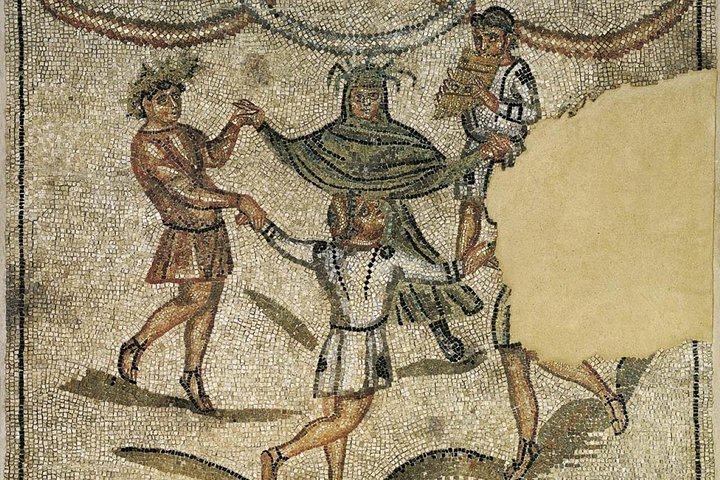
Under the church of Sant'Eufemia, about four metres below the level of the modern street, lies one of Ravenna's most surprising archaeological sites. The Domus of Stone Mosaics, known in Italian as the Domus dei Tappeti di Pietra or House of Stone Carpets, is the remains of a large Byzantine residence of the sixth century, with fourteen rooms and over 700 square metres of floor mosaic preserved. Excavated in the 1990s and opened to the public in 2002, it is reached by a walkway that threads over the floors, so you look down on patterns that were laid for ordinary rooms, not for churches. The mosaics are mostly geometric, in clean black, white, red and ochre, with interlocking squares, stars and spirals that give the name carpets. Among them is a spectacular central panel of the Good Shepherd and a scene of dancers that is one of the most vivid pieces of the city.
The best-known panel is the Dance of the Seasons or Dancing Genii, a floor in which small human figures in coloured tunics dance among garlands, a lively image rarely found in Christian sites. Elsewhere you find birds, baskets of fruit and geometric borders in very fine tesserae. The pieces were sometimes redone in later periods and in some places lifted and reset, which is why you can read the building's long history in the layers.
Many of the rooms are thought to have belonged to a high-ranking family or dignitary of the Exarchate, possibly connected to the church above.
What makes the site special is the vantage point. At San Vitale you look up at gold. Here you look down at the everyday luxury of an elite household, which is a different but equally revealing view of Ravenna's culture. The raised walkways, lighting and information panels in English make the site easy to understand even without a guide, and the cool, quiet atmosphere is a pleasant break in hot weather. The pavement is slightly damp and the air is cool, so a thin layer helps.
It is a short walk from the main square, and a visit takes about thirty to forty minutes. Entrance is ticketed separately from the main UNESCO pass, and a stand-alone entry ticket is the simplest way to see it. It pairs well with a visit to the Archiepiscopal Museum or a Dante walk, and it suits visitors who want something beyond the best-known churches. Families with older children often find this site engaging, because the walkways and the dancing figures give it a treasure-hunt feeling.
What to expect
The experience
A self-guided walk on raised walkways over the floors of a sixth-century palace, with information panels in English.
Best time
Hot afternoons, since the site is cool and shaded.
How long
30 to 40 minutes.
Tips
Look for the dancing figures and the Good Shepherd panel. A light layer helps in the cool air.
Quick picks
- Best for
- Travellers who have seen the churches and want something different.
- Families
- The walkways and animals make it engaging for older children.
- Couples
- A quiet stop and a cool refuge in summer.
- Pair with
- Archiepiscopal Museum and a Dante walk.
- Time needed
- Forty minutes.
Good questions
What is the Domus of Stone Mosaics?+
The remains of a sixth-century Byzantine residence under the church of Sant'Eufemia, with fourteen rooms of preserved floor mosaics.
Is it part of the main UNESCO pass?+
No, it is usually a separate ticket, so buy a stand-alone entry if you want to include it.
Why is it underground?+
The ground level of Ravenna has risen over the centuries, so the original floors now sit several metres below the street.
Is there a guide?+
Panels in English explain the site. A guide adds context but is not required.
Is it suitable for children?+
Yes for older children who enjoy archaeology, and the dancing figures are a highlight.