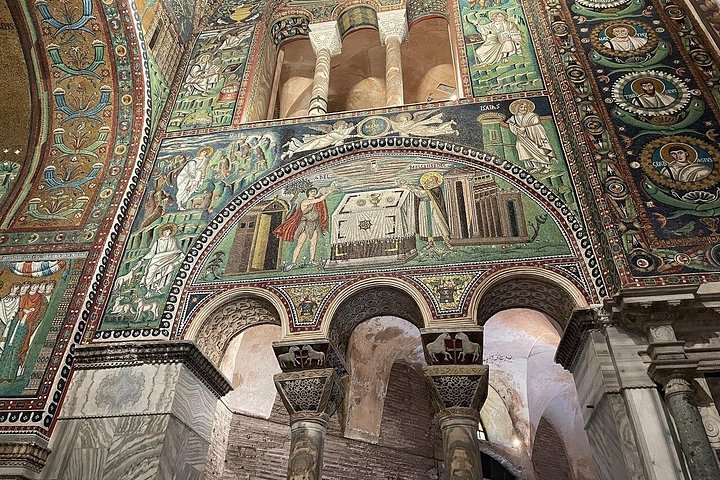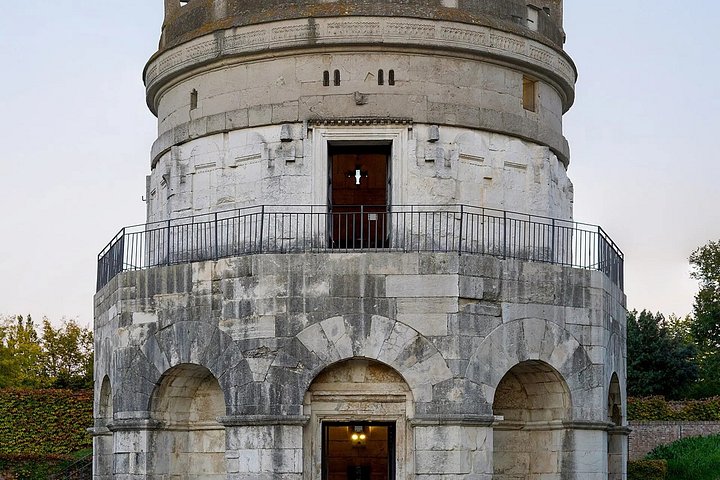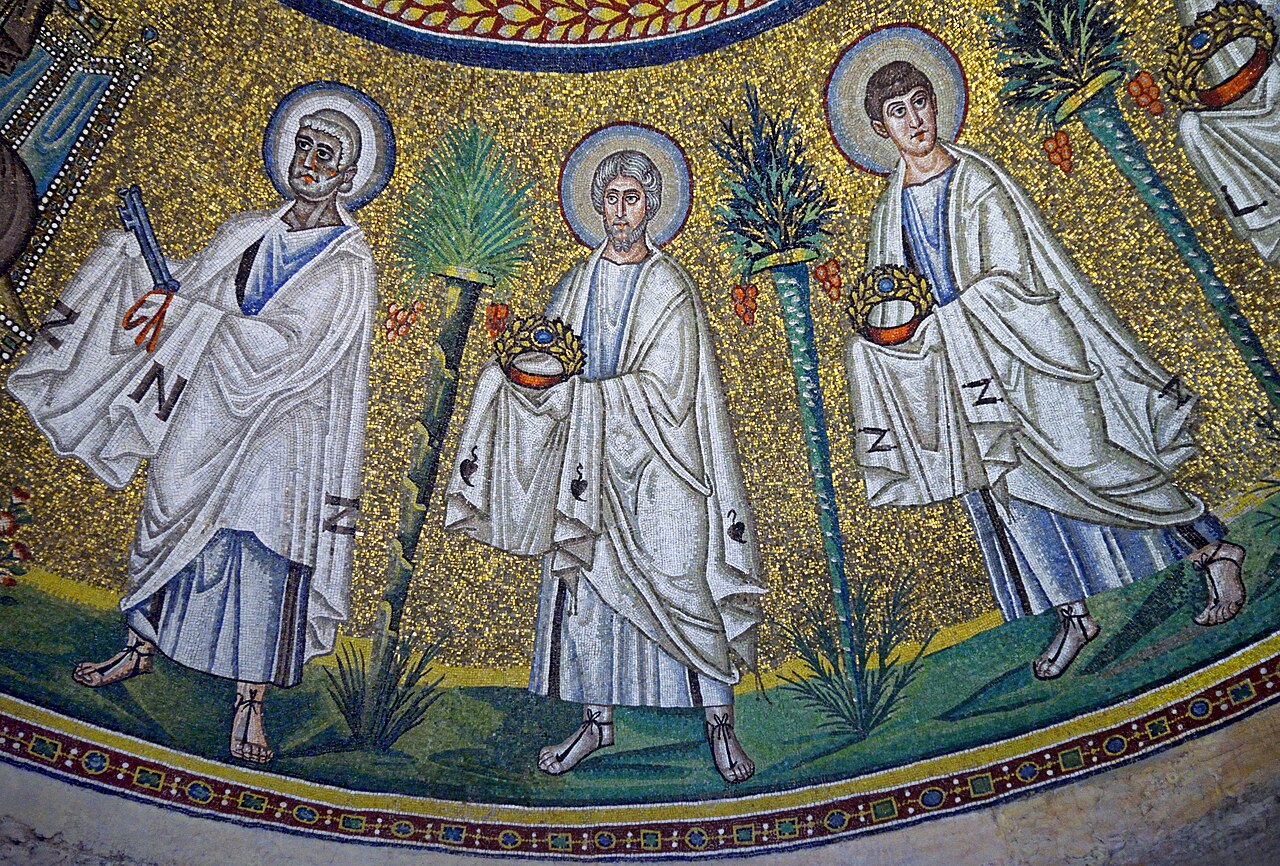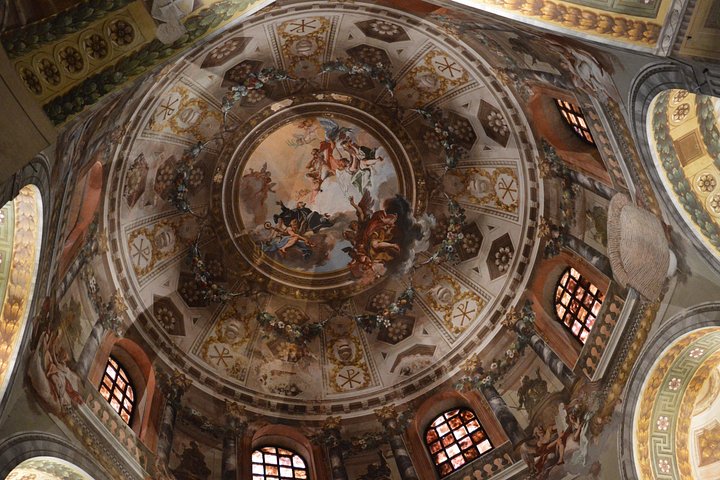
The Neonian Baptistery, also called the Orthodox Baptistery, is the quiet gem among Ravenna's monuments. It is a small octagonal brick building tucked just off the cathedral square, and it is easy to underestimate. Inside, the lower walls are dressed in coloured marble and stucco, with arcades of recessed arches, and the eye lifts almost at once to the dome. There, a vast circle of mosaic shows the baptism of Christ in the river Jordan, with John the Baptist at his side and the river personified as an old man in a reed crown. Around them, in two rings, march the twelve apostles in gold and white robes against a deep blue ground, each with a slightly different pose, interspersed with thrones and altars.
The building was begun in the late fourth century and decorated under Bishop Neon in the middle of the fifth century, which is why the name stuck. It stands on the site of a Roman bathhouse, and the level of the old city has risen so far over the centuries that the floor now sits well below street level.
That detail alone tells a lot about Ravenna's long history: it was a port city on marshy ground, and the soil has been quietly rising for fifteen hundred years. Look at the font in the centre and the way the walls curve in layers; the architects used hollow clay tubes to build the dome lightly, a method common in Ravenna.
The mosaic is a masterpiece of composition. Each apostle is distinct, yet they feel like one rhythmic procession, with palm-like trees, columns and golden backgrounds that give the scene depth. Some of the figures have been restored over the centuries, so keen eyes can notice slight differences in the hues, but the overall effect is intact. Unlike the busy interiors of the bigger churches, this one is meditative; the space is circular, the light is soft, and the eye keeps going round and round.
It stands very close to the Archiepiscopal Museum and the cathedral, so it is natural to visit it in the same walk. It is part of the combined ticket and appears in almost every guided mosaic tour. Spend at least twenty minutes, and if you can, sit for a moment on the bench provided and let the dome unfold. It is the best place to understand how early Christian ritual and imperial art came together here.
What to expect
The experience
A short visit to an octagonal baptistery, with a dome mosaic of Christ's baptism and a ring of twelve apostles.
Best time
Mid-morning, when the lighting in the dome is even and the cathedral square is lively.
How long
20 to 30 minutes.
Tips
Look down at the floor level compared with the street outside. Bring a light jacket in summer since the interior stays cool.
Quick picks
- Best for
- Mosaic lovers who like a quiet, circular space.
- Families
- Short and visual, easy to keep children engaged by counting the apostles.
- Couples
- A peaceful stop that is rarely crowded.
- Pair with
- Archiepiscopal Museum, the cathedral and Piazza del Popolo.
- Time needed
- Twenty to thirty minutes.
Good questions
Why is it called the Neonian Baptistery?+
Bishop Neon completed the decoration in the mid fifth century. It is also called the Orthodox Baptistery to distinguish it from the Arian one built by Theodoric.
Why is the floor below street level?+
The old city has sunk and the ground has risen over fifteen centuries, so the original baptistery floor now lies well below modern streets.
What does the dome mosaic show?+
Christ is baptised by John the Baptist in the Jordan, with the river shown as an old man, while the twelve apostles circle the dome.
Is it worth visiting if I have seen San Vitale?+
Yes. It is smaller, calmer and older, and the circular dome composition is different from the apse panels.
Is it part of the combined ticket?+
Yes, it is normally included in the multi-monument ticket for Ravenna's mosaic sites.