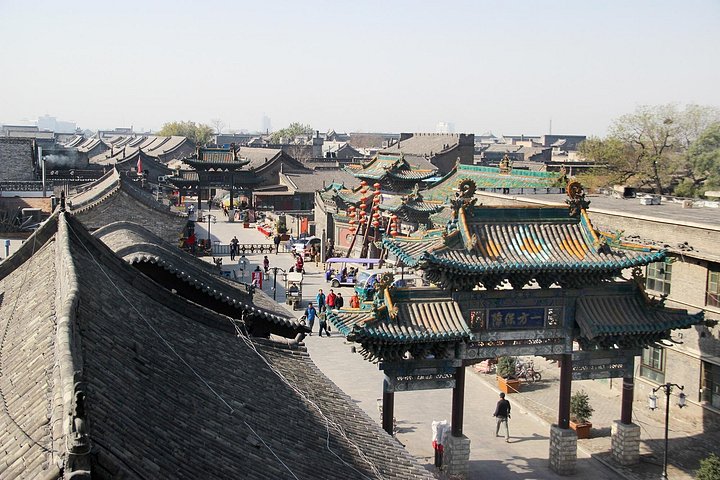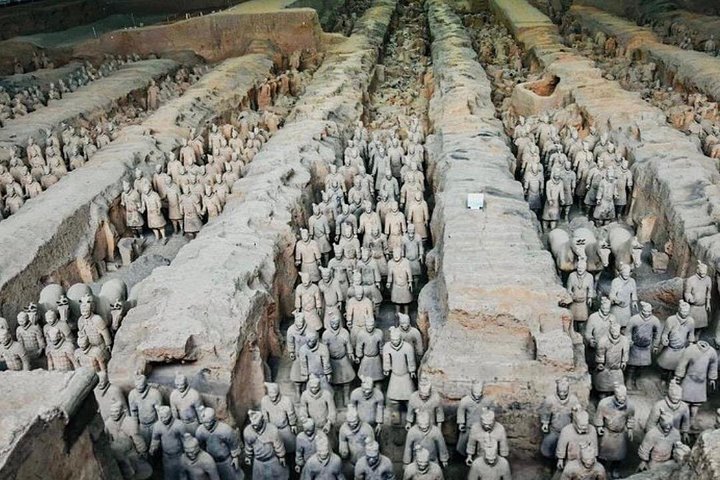
Xi’an’s best-known sights lie outside the city, and they are easy to reach on a day trip. Three of them dominate the choices: the Terracotta Army, Huaqing Palace and Mount Huashan. They sit east of the city in the same general direction but are quite different in character, and the key to a good plan is to pair the first two on one day and give the mountain a day of its own.
The Terracotta Army
About 40 kilometres east of Xi’an, near the tomb of Qin Shi Huang, the first emperor of a unified China, thousands of life-size clay soldiers stand in battle formation in huge excavation halls. Pit 1 is the largest and the most dramatic, a long hall of soldiers in ranks, with others still being pieced together from fragments. The smaller pits and the hall of bronze chariots add context, and there is a museum with many individual figures that you can see up close. Allow about three hours at the site. Entry is tied to your passport, so bring it, and go early, because it is busy by late morning. A ticket with a driver, or a tour with an English-speaking guide, saves effort and gives context, and the main alternative is public transport, which is cheap but takes planning. The guide adds real value here, since the army is hard to appreciate without the story of the emperor and the discovery by farmers in the 1970s.
Huaqing Palace
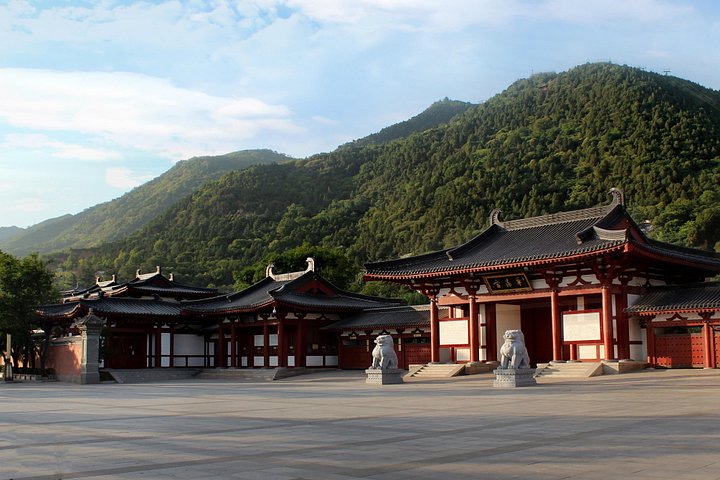
Often combined with the Terracotta Army, this is the hot-spring retreat of Tang emperors, set against Mount Li. It is known for its gardens, pools and the story of the emperor Xuanzong and his consort Yang Guifei, and the modern history of the 1936 Xi’an Incident adds another layer. It takes about two hours and makes a gentler second stop after the army. Walkers can climb Mount Li behind it for views, and the evening show in the grounds runs from late March to October, so check whether it fits your dates before you plan a late return.
Mount Huashan
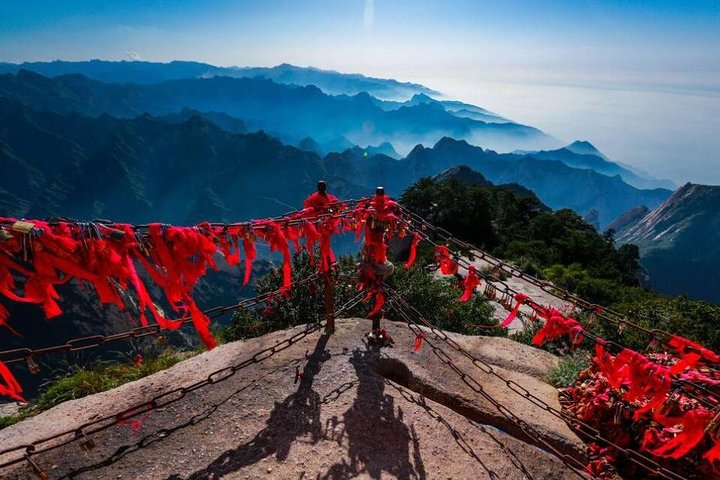
About 120 kilometres east, this granite peak is one of China’s five sacred mountains and a place of Taoist pilgrimage. It is famous for steep stone stairs, narrow cliff paths and the plank walk, a path of boards fixed to a sheer rock face. This is a full day, usually nine to ten hours including the journey, and it is physically demanding. The fastest way is the high-speed train to Huashan North station, followed by a shuttle to the visitor centre, or you can go with a private driver, which handles the early start and the return. A cable car takes most of the strain out of the ascent, though there are still many steps along the ridge. Go on a clear weekday, wear shoes with good grip and bring layers, water and snacks. If you have a fear of heights, enjoy the main paths and the views, and skip the plank walk.
How to combine them
A classic day trip is the Terracotta Army in the morning and Huaqing Palace in the afternoon, with the return to Xi’an in time for dinner. Do not try to fit Mount Huashan into the same day. If you have four days, give each its own slot and keep a fresh day for the old town between them, because walking up and down a mountain after a morning of pits is too much. If you have only two days in Xi’an, choose the Terracotta Army and Huaqing Palace, and leave the mountain for another trip.
Other excursions
The region has many more ancient tombs, temples and imperial sites, and some travellers with extra time hire a driver for them. For most first visits, the three above are the best use of time, and the old town and the Tang south fill the remaining days.
Practical tips
Take your passport on every trip, because the Terracotta Army and several other sites require ID. Start early to avoid crowds and queues, carry some cash and a mobile payment app, and check the weather before the mountain. Book transfers and tours a few days ahead in busy seasons and avoid national holidays, when these sites are very crowded. Choose a hotel in the old town or near the Tang south so that your drive out in the morning is short and you can eat well when you return.