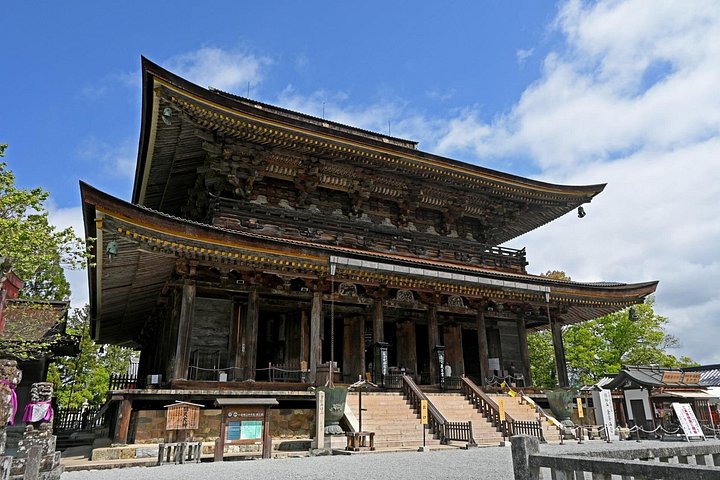
Mount Yoshino is one of the great sacred mountains of Japan, part of the Sacred Sites and Pilgrimage Routes in the Kii Mountain Range World Heritage listing. It has been admired for its cherry blossoms since the Heian period, and the slopes are planted with thousands of trees in groves that bloom in sequence, from the foot of the mountain to the ridge, so that the pink wave climbs the hillside through April. At the heart of the mountain stands Kinpusen-ji, a temple of the mountain-ascetic Shugendo tradition. Its main hall, the Zao-do, is a National Treasure and one of the largest wooden buildings in Japan, second only to Todai-ji's Great Buddha Hall, and it holds three huge blue statues of Zao Gongen that are shown to the public only rarely. Beyond the temple, a ridge road of shops, inns and viewpoints leads to quiet shrines and long views down the valley. November is the autumn colour season, when maples brighten the paths and the crowds are far smaller than in April.
What to see
Begin in the village near the Zao-do, with its steep lanes of inns and shops selling kudzu sweets, and visit the temple grounds. Look for the huge cherry trees in front of the hall, and for the Niomon Gate, which can be covered when conservation work is under way. Walk along the ridge toward the upper groves and viewpoints for the best views. Kinpusen-ji holds a fire ritual each morning that visitors can watch.
The guided option
The booking link here is for a guided tour of Mount Yoshino and the UNESCO landscape of the Kii mountains, a useful choice because getting to Yoshino without a car takes some planning and the area is rich in Shugendo history. Confirm the meeting point, the transport arrangements and what is included before you book, and check the hours of the temple halls and any ropeway on the day.
Planning the visit
Yoshino is roughly two hours from Nara by train with a change, on the Kintetsu line to Yoshino Station, followed by a steep walk or the ropeway up to the village if it is running. This makes it a long day, so leave early and carry water.
The mountain is cooler than the city, so bring a jacket in autumn, and wear shoes with grip for steep lanes and steps. Spring is the busiest time and accommodation fills early, while November offers the colour without the crowds. Plan four to five hours on the mountain and time for lunch.
What to expect
The experience
A day on a sacred mountain: a village of inns and shops, the huge wooden Zao-do hall of Kinpusen-ji and ridge paths with viewpoints, with an optional guided tour.
Best time
Mid-April for the cherry blossoms, or November for autumn colour with far fewer visitors.
How long
Four to five hours on the mountain plus about two hours of travel each way from Nara.
Tips
Leave Nara early, carry water, bring a warm layer, wear shoes with grip for steep lanes and check ropeway and hall hours on the day.
Quick picks
- Best for
- Nature and heritage lovers who want to get out of the city for a full day.
- Families
- Fine for older children who can handle a long day and steep paths.
- Couples
- A beautiful autumn day on a quiet ridge, with a long lunch in the village.
- Pair with
- Horyu-ji or Nara Park on a separate day, since Yoshino needs a full day.
- Time needed
- Allow a full day.
Good questions
When is the best time to visit Yoshino?+
Mid-April is the cherry blossom peak and the busiest period. November offers autumn colour and a calmer mountain.
How do I get there from Nara?+
Take the Kintetsu line toward Yoshino, usually with one change, which takes roughly two hours. From Yoshino Station climb on foot or take the ropeway if it is running.
What is Kinpusen-ji?+
It is a temple of the Shugendo mountain-ascetic tradition, with the huge wooden Zao-do hall as its centre. The hall is a National Treasure.
Are the Zao Gongen statues always on view?+
No, they are shown to the public only on rare occasions, so check the temple's schedule. The hall is still impressive without them.
Is a tour worthwhile?+
It saves planning time and adds context on the area's Shugendo history. Check the booking page for transport and inclusions.