Between the great monuments, Ravenna is a charming and manageable provincial city, and Piazza del Popolo is its living room. The square is a handsome piece of civic theatre, lined with arcades and anchored by the Palazzo del Comune on one side. At the head of the square stand two tall granite columns topped with statues of Saint Apollinaris and Saint Vitalis, the city's patron saints, set there by the Venetians who ruled Ravenna from 1441 to 1509. Cafes spill across the pavement in the evening, bicycles lean against every wall and locals meet for the passeggiata. Few visitors realise how much of the city's charm comes from this unhurried, bike-friendly rhythm. The surrounding pedestrian streets are the best way to see it.
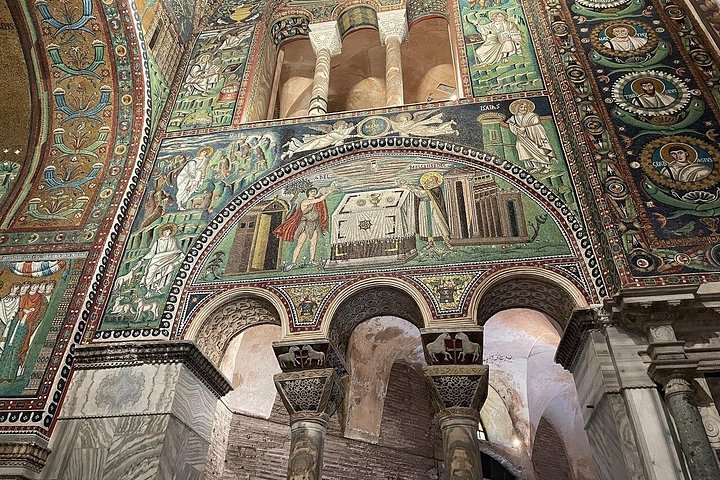
From the square, the old town opens in all directions. Via Cavour and the lanes toward San Vitale are lined with shops, ateliers and mosaic studios, where artists still cut and set tesserae using the ancient method, and some will let you watch or even try. Small bars serve piadina, the thin Romagna flatbread, filled with prosciutto and squacquerone cheese.
The Venetian rule left traces of its taste in arcades and small palaces, while the Byzantine and Gothic layers stay below, in churches and cloisters that still serve the community. A short walk takes you to the Basilica of San Francesco, the Dante precinct and the Rocca Brancaleone park, where locals relax on the grass.
The best way to use the square is as a base for a slow day. Start with a coffee and a pastry, tour the main monuments in the morning, then return for a long lunch under the arcades. In the evening, aperitivo hour fills the square, with spritz, local Sangiovese and small plates. Because the centre is flat and compact, the whole old town can be walked in half an hour, but a day is better. Rent a bicycle to explore like the locals do.
There is no admission and no ticket, so the square is perfect for a free first hour in town or a last stroll before the train. It is also the natural meeting point for walking tours, which start nearby and add stories about the Venetian, Byzantine and Gothic layers. Evening is the most atmospheric time, when the arcades are lit and the mosaics of the nearby churches are quiet. For travellers who prefer to wander, it is the easiest orientation to the city.
What to expect
The experience
A free stroll through the main square and the pedestrian lanes of the historic centre, with cafes, shops and mosaic studios.
Best time
Early evening for the passeggiata and aperitivo.
How long
1 to 2 hours, or more with a meal.
Tips
Try piadina at a local bar, rent a bike, and look into mosaic studios along the side streets.
Quick picks
- Best for
- Everyone, as a free orientation and a place to relax.
- Families
- Flat, traffic-free and easy for strollers; gelato stops help.
- Couples
- Aperitivo under the arcades is the classic date.
- Pair with
- Dante's Tomb, San Vitale and a mosaic workshop.
- Time needed
- One to two hours.
Good questions
Why are there Venetian columns?+
Venice ruled Ravenna from 1441 to 1509 and left statues of Saint Apollinaris and Saint Vitalis on columns in the square.
Is the centre walkable?+
Yes. It is compact, flat and largely pedestrian, and cycling is very popular.
What should I eat here?+
Piadina romagnola, cappelletti pasta, local cheese and a glass of Sangiovese or Albana.
Can I watch mosaic artists working?+
Several studios around the centre welcome visitors, and some offer short workshops.
When is it liveliest?+
Early evening, when the aperitivo crowd fills the cafes.