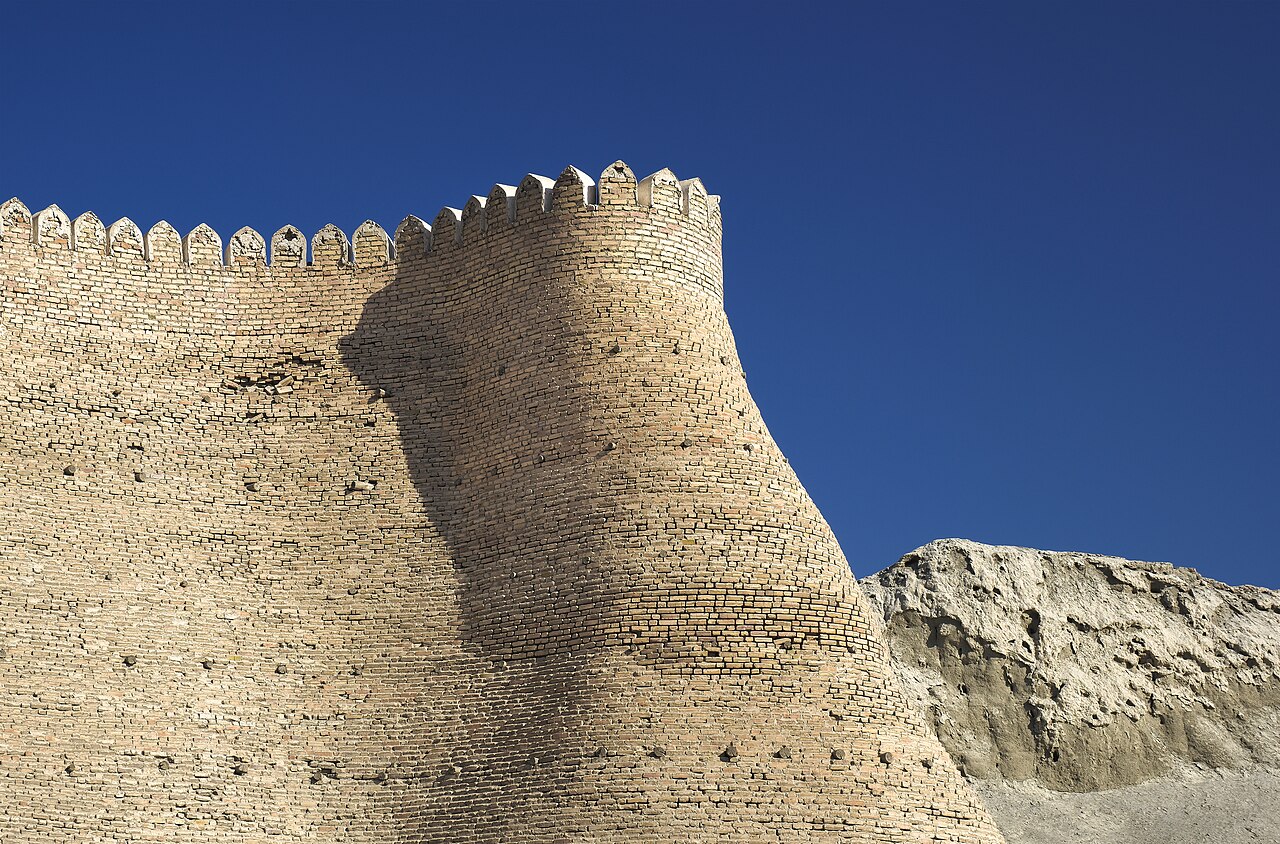
The Ark is the great fortress at the north-west edge of Bukhara's old city, a walled citadel raised on an artificial mound where the city's rulers lived and governed for roughly a thousand years. Its massive sloping walls, entered through a ramped gateway flanked by towers, rise above the open square called the Registan of Bukhara. Inside, the Ark was once a small city of its own, with the palace, the throne room, the mint, workshops and a prison. In 1920 the Red Army bombarded and captured it during the fall of the emirate, and much of the interior was destroyed. Today a large part is ruins, as one travel source puts it, perhaps eighty percent, but what remains houses museums of local history, archaeology and natural history, and the seventeenth-century Juma mosque, a quiet courtyard of carved wooden columns. Visitors can walk the ramp, wander the courtyards and climb to viewpoints looking over the old town. It is less glamorous than the tiled madrasas, but it explains the city's political history, and the sense of scale is impressive. A guide helps make sense of the ruined areas, and a full-day Bukhara old-city tour usually includes the Ark among the main stops.
The history is the reason to go. The fortress is traditionally linked with the legendary founding of Bukhara in antiquity and rebuilt many times through the Samanid, Mongol, Shaybanid and Manghit eras. The last emirs ruled from here until 1920, and the Ark was the scene of great ceremony, with the coronation of rulers taking place on its grounds. The museum rooms hold coins, weapons, costumes, manuscripts and photographs from the late emirate period, including early colour photographs of the city. Guides often point out the old treasury and describe the rituals of the royal court.
Working the visit: arrive when it opens, because the sloped ramp, the courtyards and the exhibition rooms take an hour or more. Look at the entrance towers and the stone ramp from the square first, then walk up and through the gate. Photography rules in individual museums can vary, so check at each door. Take water, as the mound is exposed and there is little shade. The views from the upper walls over the old city's domes and the surrounding rooftops are among the best in Bukhara.
When to go and what to avoid: spring and autumn are best, and in summer mornings are essential. Opening hours and ticket arrangements can shift, so confirm the current schedule locally. Do not expect the glittering tilework of the Kalon complex; the Ark has a plainer, defensive mood, and its charm lies in its size and history. A good way to see it is within a full-day private or small-group old-city tour that links the Ark with the Kalon complex, the trading domes and Lyab-i Hauz, so that you have a driver or guide between stops and enough time to absorb the story of the emirate.
What to expect
The experience
A walk up the ramp and through the courtyards of the fortress, with museum rooms, the Juma mosque and views over the old city.
Best time
Opening time in spring or autumn, before heat and tour groups build.
How long
About an hour to ninety minutes at a steady pace.
Tips
Bring water and a hat, check photography rules at each museum door and consider a guide to make sense of the ruined areas.
Quick picks
- Best for
- History fans and anyone who wants to understand Bukhara as a seat of power rather than only a city of tile.
- Families
- Ramps, courtyards and old weapons give children plenty to look at, though shade is limited.
- Couples
- Viewpoints over the old town make a good photo stop, particularly in the late afternoon.
- Pair with
- Kalon complex and Lyab-i Hauz on the same day circuit.
- Time needed
- Ninety minutes on site, or a full day within a private old-city tour.
Good questions
What is the Ark?+
It is the historic citadel of Bukhara, a fortress and palace complex on a mound used by the city's rulers for centuries. Much of the interior was destroyed in 1920.
What can I see inside?+
Museums of local history and natural history, the seventeenth-century Juma mosque and the ramped gateway and courtyards. Views from the upper walls are a highlight.
How long do I need?+
About an hour to ninety minutes is enough for the main rooms and courtyards. A guide may take a little longer to explain the ruins.
Is it worth it compared with the tiled sights?+
Yes if you like history and views, because it explains the city's political story. It is plainer than the madrasas but impressive in scale.
Is a tour better than going alone?+
A full-day old-city tour with a guide and transport covers the Ark and the other sights efficiently, with commentary that the plain labels rarely provide.