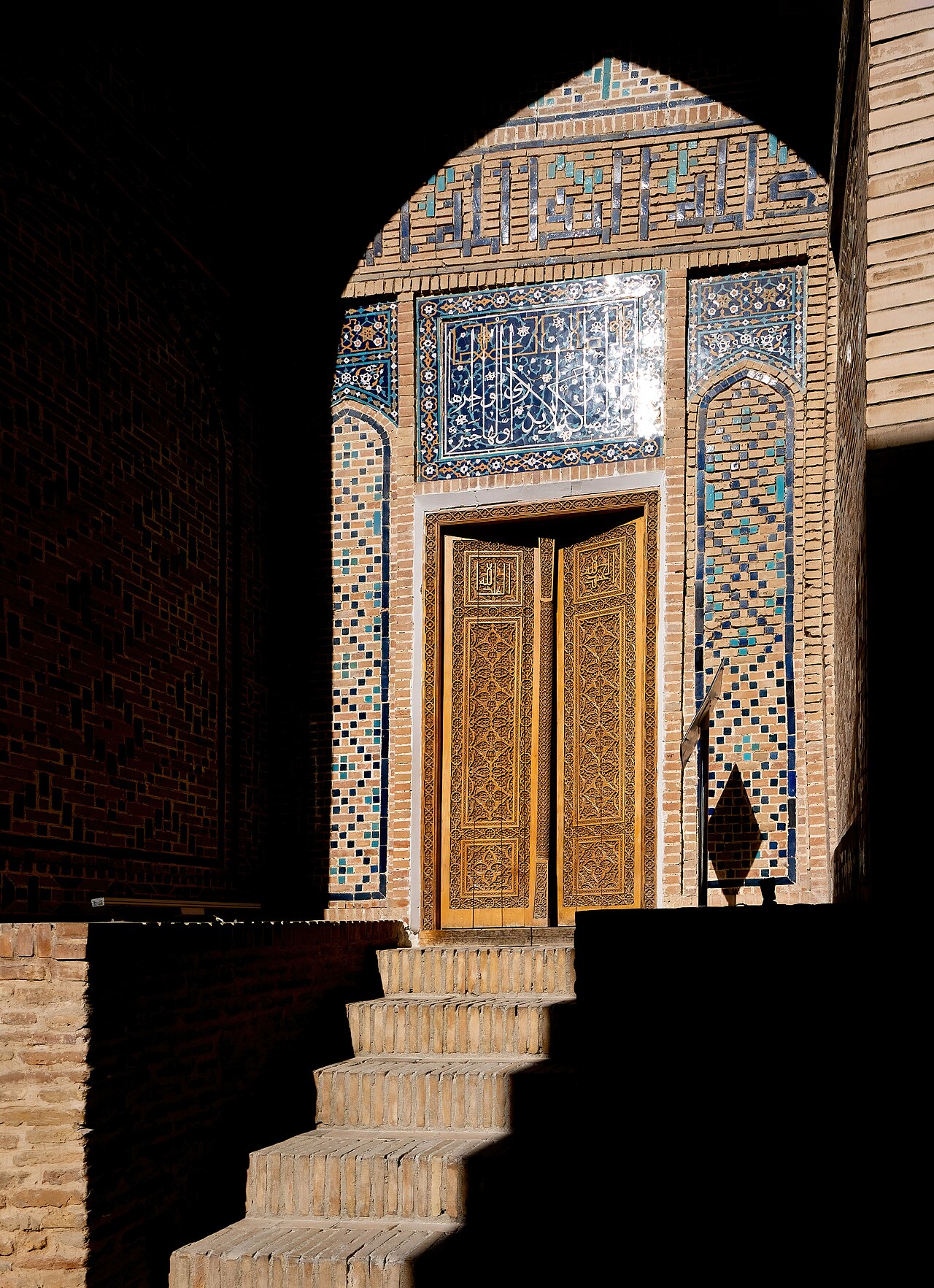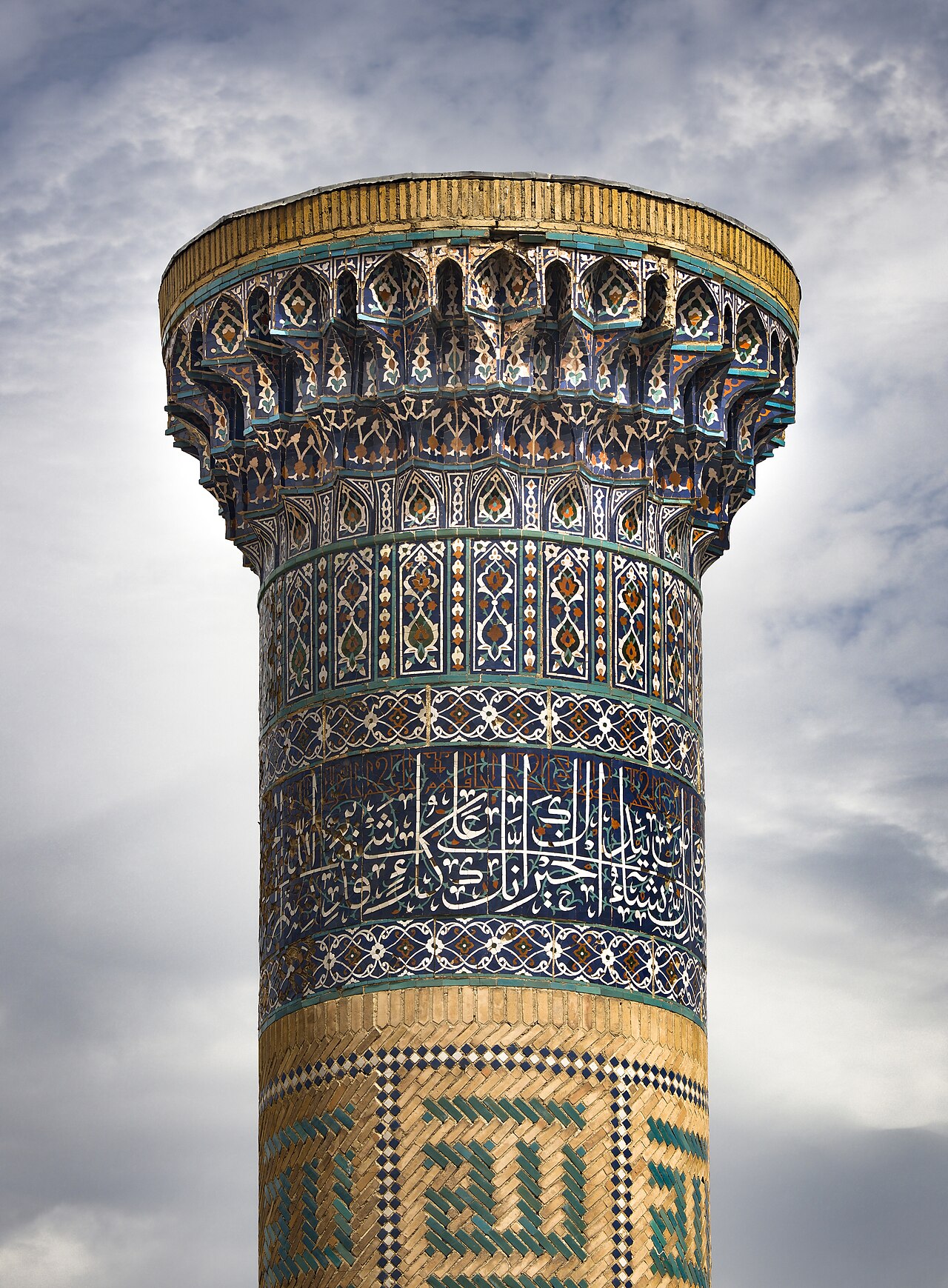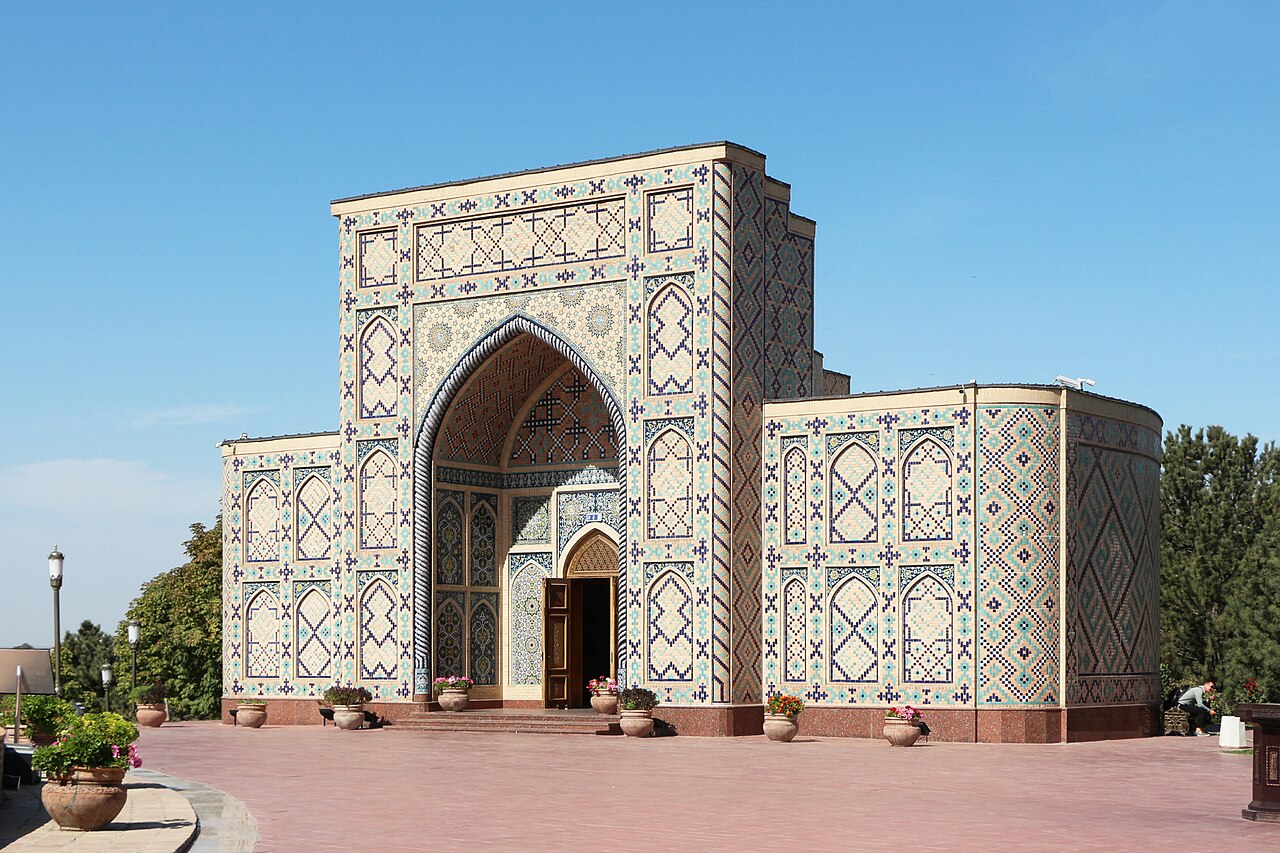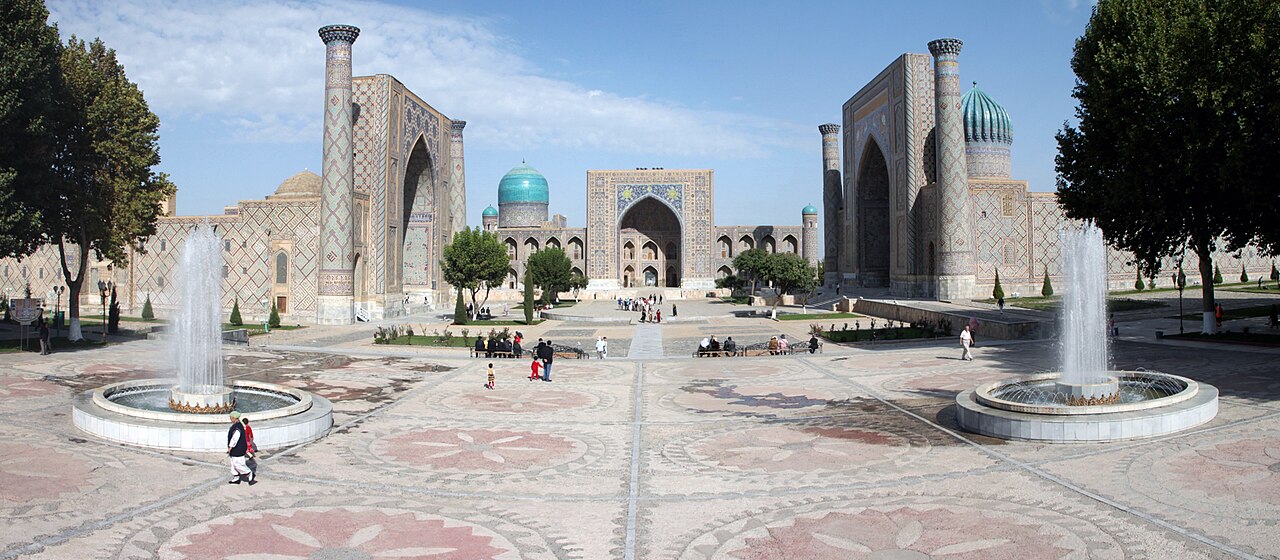
The Registan, whose name means sandy place, was the heart of Samarkand in the Timurid age and is still the city's grand public stage. Three madrasas, or Islamic colleges, frame a great rectangular square. The Ulugh Beg Madrasa on the west side dates from the early fifteenth century and was built under the astronomer-ruler who taught mathematics and astronomy here. Facing it across the square, the Sher-Dor Madrasa of the seventeenth century is famous for the lions and rising suns on its portal, an unusual image in Islamic architecture, and the Tilya-Kori Madrasa on the north side, with its gilded mosque interior, completed the ensemble. Together they form one of the most photographed groups of buildings in Central Asia and a centrepiece of the UNESCO-listed Samarkand: Crossroad of Cultures. The tilework is the draw: geometric stars, flowing calligraphy and glazed domes in every shade of blue. Visitors pay an entry fee at the gate, walk the square, step into the courtyards, where former student cells now house craft shops, and climb into the gilded prayer hall of Tilya-Kori, whose painted ceiling looks like a dome from inside but is flat. Because the stories behind the buildings are as striking as their surfaces, a guide adds a lot here. A Samarkand city tour with an English-speaking guide ties the Registan to the other great sights in a single morning.
The history explains the scale. Samarkand rose to imperial greatness under Timur, who brought craftsmen from across his empire, and under his grandson Ulugh Beg, who commissioned the first madrasa on the square in the 1410s and 1420s. For two centuries the Registan was a place for royal proclamations and markets. After a long decline the two later madrasas were built under the Shaybanid rulers, Sher-Dor between 1619 and 1636 and Tilya-Kori by 1660. Tilya-Kori also served as the city's main Friday mosque, which is why its interior is gold-leafed. Restoration in the twentieth century saved the complex, and while some of it is heavy-handed by conservation standards, the result is dazzling.
Working the visit: arrive when the gates open or in the last hour of daylight, when the light is warm and the tour groups are thinner, and allow at least ninety minutes. Walk the square once without stopping to take in the composition, then enter each madrasa in turn. Courtyard stalls sell silk scarves, ceramics and hand-printed paper; prices are negotiable, but quality varies, so look before buying. Hours are seasonal, longer in summer and shorter from late November, so check the current posting at the gate.
When to go and what to avoid: spring and autumn are best for comfortable walking, while July and August can be fiercely hot with little shade on the square. Dress modestly, with covered shoulders and knees, as the buildings are religious heritage. Keep an eye on the touts around the edge of the square who offer rooftop access or photo deals, and book guided time through a reputable tour instead. Gur-e-Amir, Bibi-Khanym and the Shah-i-Zinda are all a short taxi ride away, so most visitors fold the Registan into a half-day or full-day city circuit rather than treating it as a stand-alone stop.
What to expect
The experience
A self-paced walk around the square and through the three madrasa courtyards, or a guided Samarkand city tour that includes the Registan with other highlights.
Best time
Opening time or the last hour of daylight, in spring or autumn, when the light on the tile is best and the square is cooler.
How long
About ninety minutes to two hours, longer if you want to photograph each facade slowly.
Tips
Pay at the gate, dress modestly, look inside Tilya-Kori for the gilded interior and check the posted seasonal hours before you go.
Quick picks
- Best for
- Every first-timer: it is the single image that defines Uzbekistan and the anchor of any Samarkand visit.
- Families
- Open space and bright colours keep children interested, though there is little shade in summer, so bring hats and water.
- Couples
- Come for the golden light in the last hour of the day and stay as the facades lose their colour to dusk.
- Pair with
- Shah-i-Zinda, Gur-e-Amir and Bibi-Khanym with Siyob Bazaar in the same day.
- Time needed
- Allow two hours with the courtyards, or half a day inside a wider city tour.
Good questions
Do I need a guide at the Registan?+
You can walk it independently, but a guide explains the history, the lions on Sher-Dor and the flat painted ceiling in Tilya-Kori. A city tour that bundles several sights is usually the best value.
How much time do I need?+
Around ninety minutes to two hours covers the square and the three courtyards at an easy pace. Photographers and tile enthusiasts may want more.
When is the best time to visit?+
Spring and autumn are most comfortable, and early morning or the last hour of daylight gives the best light. Summer afternoons are very hot with little shade.
Is there a dress code?+
Dress modestly with covered shoulders and knees, since the madrasas are religious heritage sites. Light long clothing works well in summer.
Is it open in winter?+
Yes, the Registan stays open year round, but hours are shorter from late November. Check the posting at the gate for the current times.