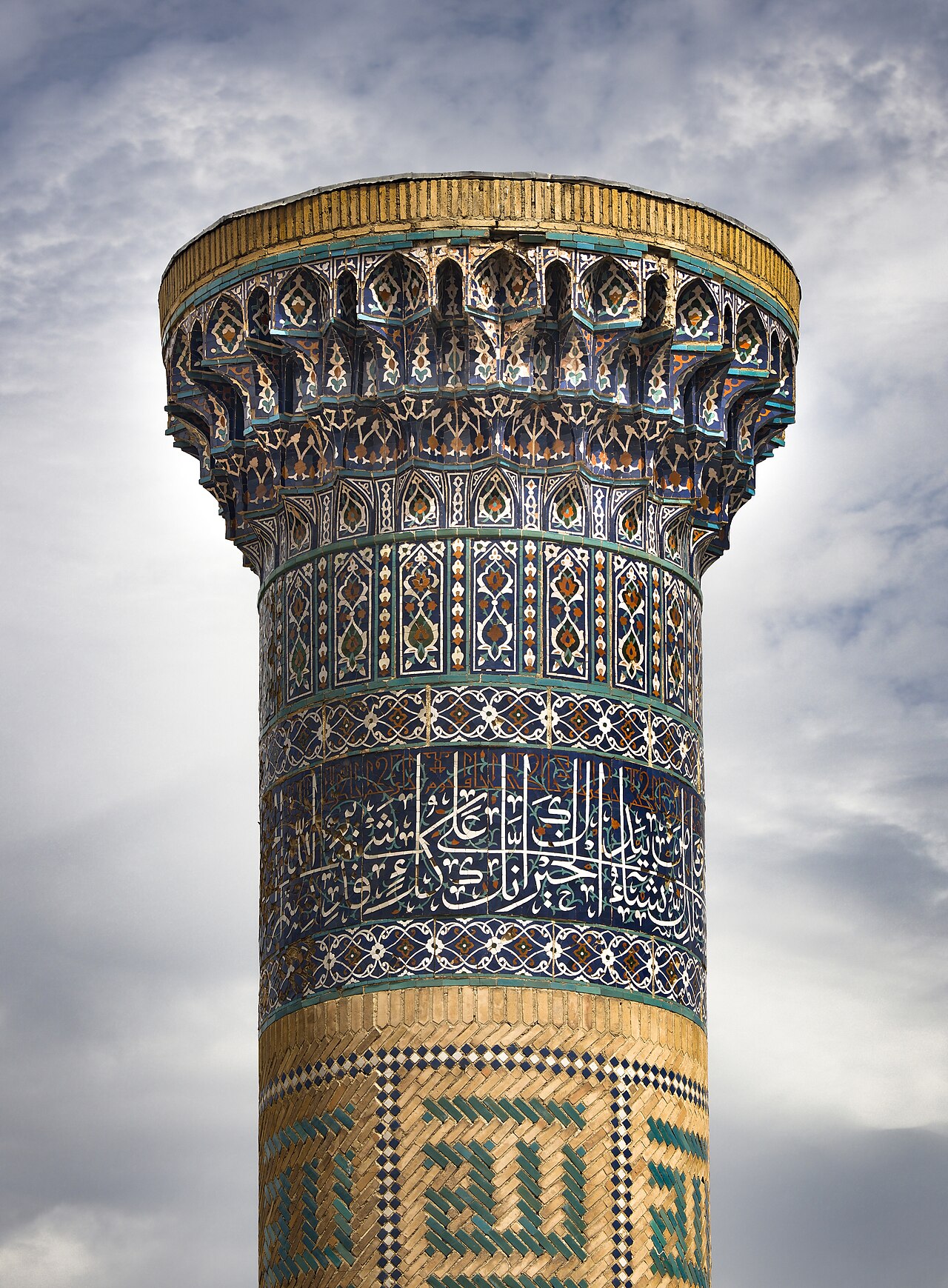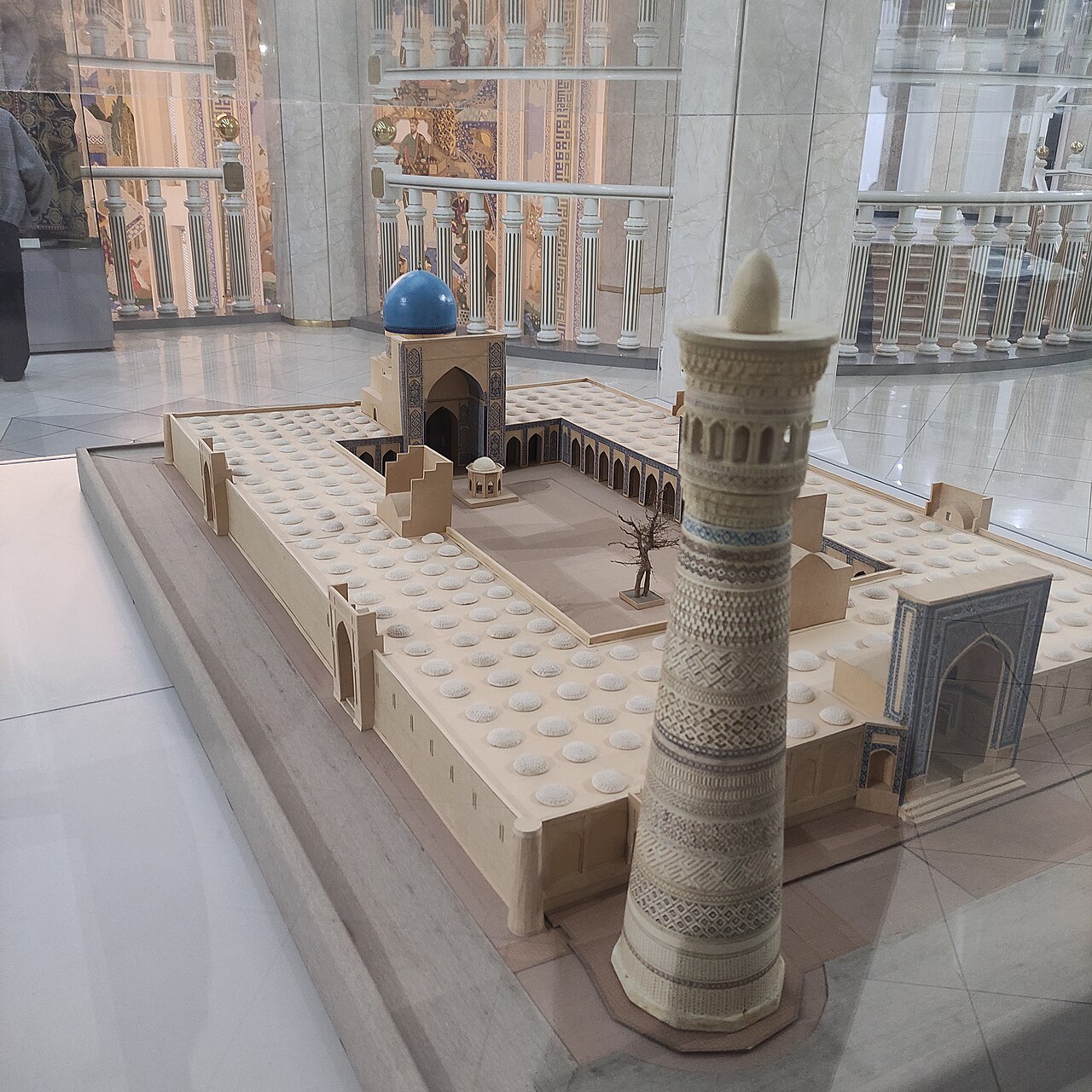
The Po-i-Kalyan complex, whose name means at the foot of the great one, is the architectural centrepiece of Bukhara. Its anchor is the Kalyan Minaret, built in 1127 and rising about forty-six metres, a tapering brick tower with bands of patterned brickwork that was so impressive that, according to the often-told story, Genghis Khan ordered it spared when he sacked the city. Beside it stands the Kalyan Mosque, one of the largest in Central Asia, with a huge courtyard framed by galleries of domes and arches that can hold thousands of worshippers. Facing the mosque across the square, the Mir-i-Arab Madrasa, founded in 1535, rises in blue-tiled splendour and still functions as a religious school, so it is generally admired from outside rather than visited. The result is a square where the scale of Bukhara's religious life feels clear at once. You can walk the court of the mosque when it is open to visitors and photograph the minaret from several angles; access to the minaret itself is not available, and arrangements at each building can change, so a guide who knows current rules is useful. A private old-town tour with a local expert ties the complex into a route through the rest of the historic centre.
The history layers deep. The minaret was built under the Karakhanid ruler Arslan Khan and served both as a call-to-prayer tower and, in the tales, as a lookout and a place from which condemned prisoners were once thrown, which earned it the nickname Tower of Death. The Kalyan Mosque dates from the early sixteenth century in its present form, on the site of an earlier mosque destroyed by the Mongols. The Mir-i-Arab Madrasa dates from the Shaybanid era, in the 1530s, and is one of the few functioning madrasas in Uzbekistan, which is why access is limited.
Working the visit: arrive early, when the square is quiet and the light is soft on the brickwork. Stand in the middle of the square to take in the full ensemble, then enter the mosque courtyard if open, where the galleries and the large central space reward a slow walk. A guide can explain the layout and the stories. Photographers should return in the evening, when the minaret is lit and the square is calm. Respect the religious function of the buildings, with modest clothing, covered shoulders and knees, and quiet voices.
When to go and what to avoid: the complex lies a few minutes from Lyab-i Hauz on foot, so it fits naturally into an old-town walk. Midday summer heat on the open square is intense, so aim for morning or late afternoon. Opening arrangements for the mosque and neighbouring sights may change around prayer times and religious holidays, so confirm locally. Souvenir sellers cluster nearby; browse politely and bargain with a smile. Combining the complex with the trading domes, the Ark and the Samanid Mausoleum makes a full and rewarding day, especially with a private guide who can set the pace.
What to expect
The experience
A visit to the square with the minaret, mosque and madrasa, best as part of a private all-day old-town tour with a local expert.
Best time
Early morning for soft light and quiet, or the evening when the minaret is lit.
How long
About an hour to ninety minutes, longer with a guide and photo stops.
Tips
Dress modestly, ask your guide which parts are open on the day and accept that the minaret and the madrasa are viewed from outside.
Quick picks
- Best for
- Anyone who wants Bukhara's most dramatic and photographed ensemble in one spot.
- Families
- Open space for children to move, though the mosque and madrasa call for quiet and modest dress.
- Couples
- Evening light on the minaret and the nearly empty square after dark is memorable.
- Pair with
- Lyab-i Hauz, the trading domes and the Ark of Bukhara.
- Time needed
- An hour or so, or a full day inside a private old-town tour.
Good questions
Can I climb the Kalyan Minaret?+
No, the minaret is viewed from the ground. Its scale and brickwork are best appreciated from the square.
Can I visit the Mir-i-Arab Madrasa?+
It still functions as a religious school, so access is limited and visitors usually admire the facade from outside. Ask a local guide about current arrangements.
Can I enter the Kalyan Mosque?+
The mosque courtyard is generally open to respectful visitors at set times, but access can change around prayers and holidays. Check locally on the day.
How far is it from Lyab-i Hauz?+
It is a short walk of around ten minutes through the old town lanes. The route passes the trading domes.
What should I wear?+
Cover shoulders and knees and carry a scarf for women. Modest clothing is expected at all active religious buildings.