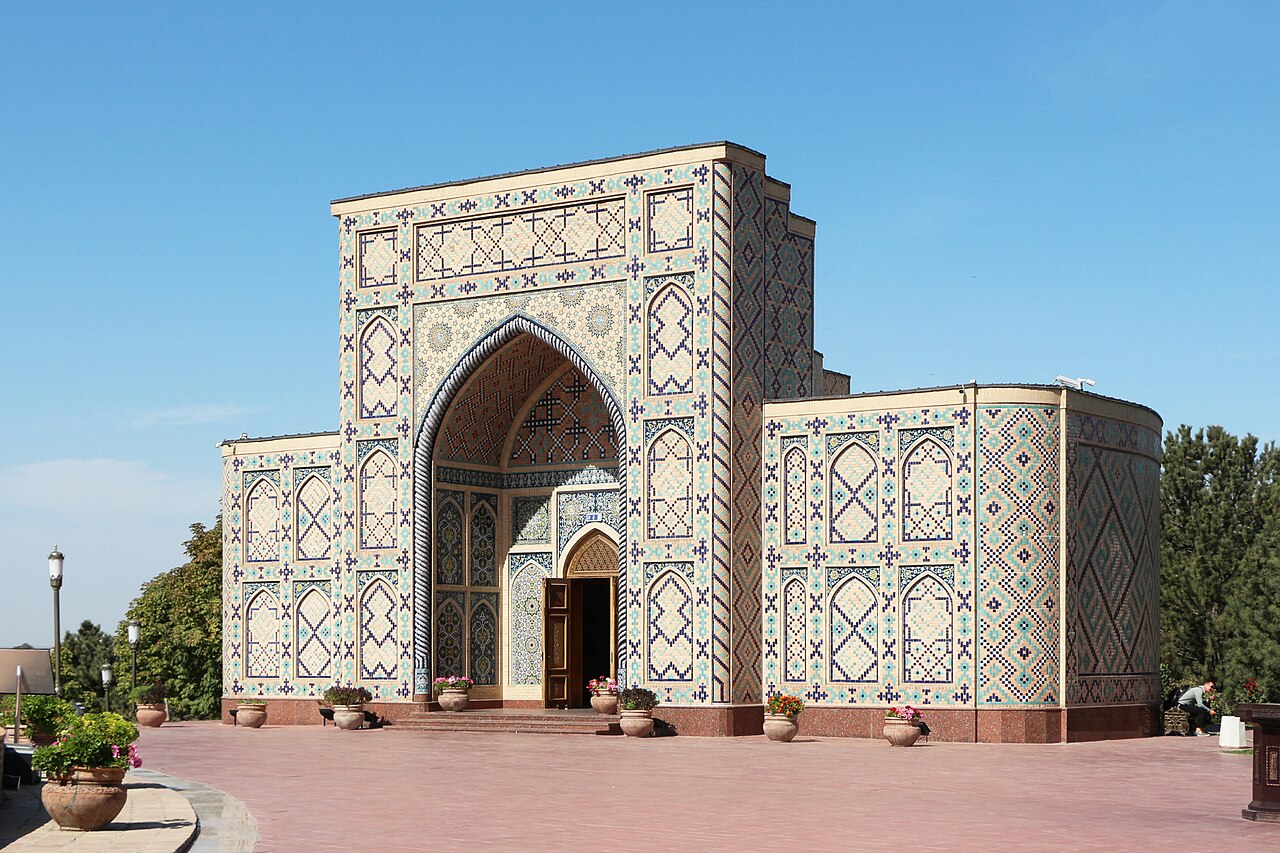
Ulugh Beg ruled Samarkand in the fifteenth century and cared more about mathematics and astronomy than conquest. In the 1420s he built an observatory on a hill north-east of the city centre, a three-storey circular building that housed a huge meridian instrument, often described as a sextant, set into a trench cut into the hillside. From here he and his colleagues observed the sky and produced a famous star catalogue that remained a reference for generations, with positions more accurate than anything produced in Europe at the time. After his death the observatory was destroyed, and its location was lost until 1908, when a Russian archaeologist, Vasily Vyatkin, uncovered the surviving foundations of the great instrument. What you see today is the curved underground section of the arc, with its marble-lined track and its steps, protected by a modern structure, plus a museum in a building on the site with instruments, copies of the star catalogue and portraits of the scientists. It is a small site, but a thought-provoking one, and it adds a different dimension to the Timurid story. The observatory is included in the Samarkand UNESCO listing, so the UNESCO page is the best official reference.
The science is the interest. Ulugh Beg's catalogue recorded over a thousand stars and his team calculated the length of the year with remarkable precision. The instrument was a huge arc lined with marble and graduated in degrees, with a slit above to let sunlight or starlight pass; observers climbed steps beside it to take readings. The scale of the whole instrument, with a radius of tens of metres, is hard to grasp from the trench alone, so the museum models and diagrams help a great deal. Ulugh Beg himself was killed in 1449, and the observatory soon fell into ruin.
Working the visit: allow about an hour. The approach is a short taxi ride from the centre, and the grounds are pleasant, with a statue of Ulugh Beg and gardens around the museum. Go in the morning when it is cool, as there is little shade at the trench. Descend the steps to see the curved track from close up, then spend time in the museum, where a guide or the staff can explain the exhibits. Labels may be in several languages, though English can be limited, so a guide is helpful.
When to go and what to avoid: it is a small stop, so combine it with Shah-i-Zinda and the nearby Afrasiab museum on the same hillside, or with Bibi-Khanym and the Registan, rather than making a separate trip. Opening hours and ticket arrangements can change, so confirm locally on the day. Do not expect polished ruins; the pleasure is in the idea of a fifteenth-century observatory and in the story of a ruler who preferred stars to battlefields. Families with curious children, and anyone interested in the history of science, will get the most from it.
What to expect
The experience
A walk down into the surviving arc of the great instrument, then a small museum with models, instruments and portraits.
Best time
Morning, when it is cool and the site is quiet before tour groups arrive.
How long
About an hour, including the museum.
Tips
Take a taxi, bring water because there is little shade, and ask for a guide or read the museum labels closely to get the story.
Quick picks
- Best for
- Science and history lovers who want the Timurid story beyond mosques and tombs.
- Families
- Curious children enjoy the idea of a giant stone instrument and the star charts in the museum.
- Couples
- A quiet, thoughtful stop away from the crowds at the Registan.
- Pair with
- Shah-i-Zinda and Afrasiab nearby, or the Registan and Bibi-Khanym.
- Time needed
- One hour on site, a little more with travel by taxi.
Good questions
What is left of the observatory?+
The underground curved section of the giant meridian instrument survives, with its marble-lined track and steps, plus a museum built nearby. The original circular building was destroyed after Ulugh Beg's death.
Who was Ulugh Beg?+
He was Timur's grandson and a ruler of Samarkand who was also a leading astronomer and mathematician. His star catalogue was a reference for generations.
How did the instrument work?+
Observers climbed steps along a huge arc marked in degrees and sighted stars and the sun through a slit above. The size of the arc allowed precise readings.
How long should I allow?+
About an hour covers the trench and the museum. It is a small site, so pair it with other stops nearby.
Is it suitable for children?+
Yes, especially for children who like space and science. The steps into the trench need a little care.