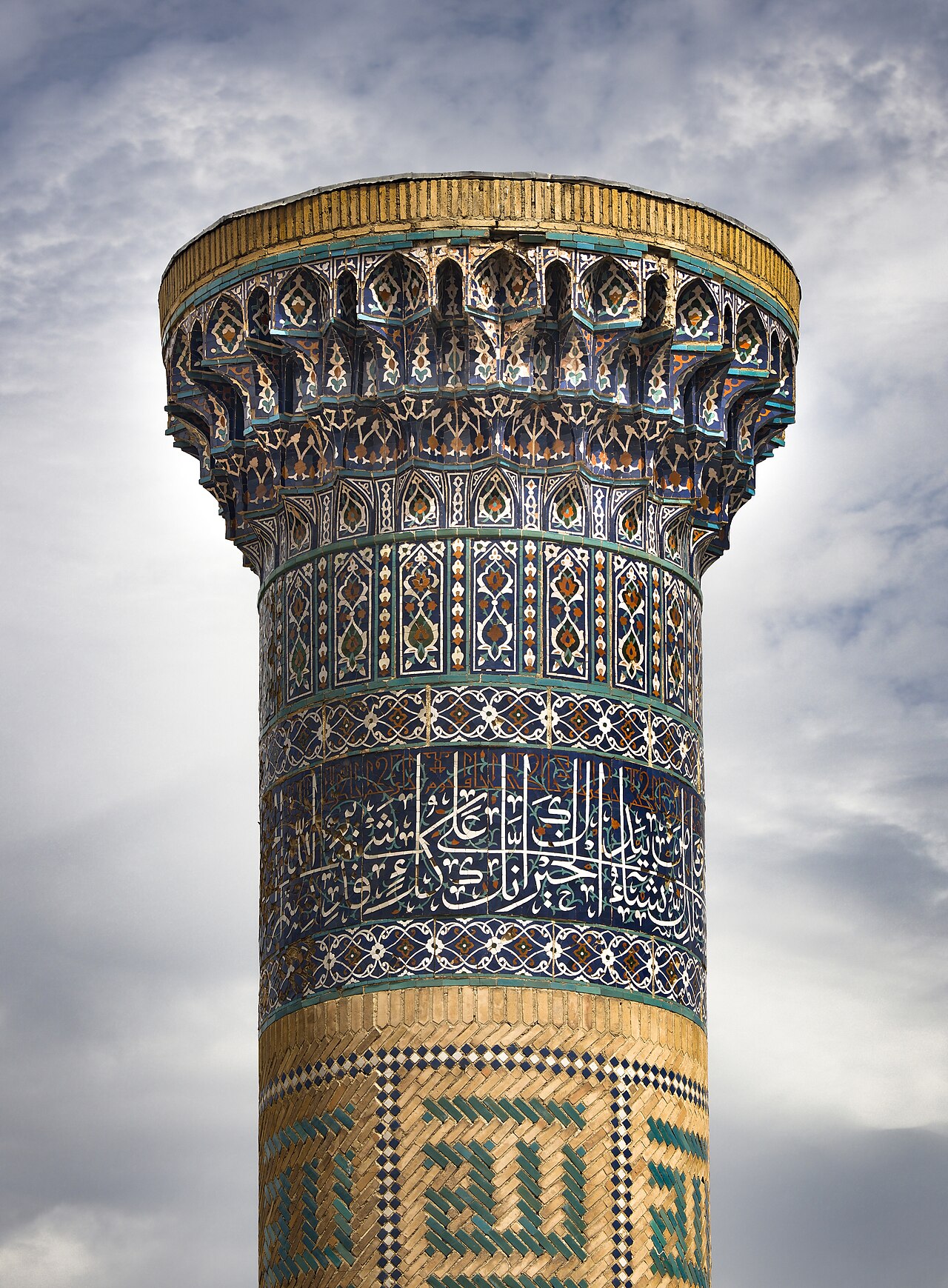
Gur-e-Amir, the Tomb of the Emir, is the burial place of Timur, who died in 1405 on the way to a campaign against China. The mausoleum was begun for his grandson and heir Muhammad Sultan, and became the family tomb of the Timurid dynasty: Timur lies here with his sons Shah Rukh and Miran Shah, and with his grandson Ulugh Beg, the astronomer. From outside, the building is dominated by a tall ribbed dome in vivid turquoise on a high drum, framed by a courtyard and the remains of a madrasa and khanaqah that once surrounded it. Inside, the walls are covered in gilded papier-mache and painted ornament, and the cenotaphs are arranged on a floor marked by a large slab of dark green nephrite jade traditionally identified with Timur. The real graves lie in a crypt below, a detail guides usually explain. The mausoleum is regarded as an early model for the Mughal tombs of India, including the Taj Mahal, whose builders descended from Timur. It is smaller than visitors expect, and a visit takes around forty-five minutes, but it is a strong stop because of the dome, the interior and the history. A guided tour makes sense, since the genealogy and the stories, including the famous curse legend, are what bring it alive.
The history is central here. Timur built an empire from the Mediterranean to India and made Samarkand its capital, and this mausoleum was a monument to his dynasty rather than to him alone, finished under Ulugh Beg. After the Timurids fell, it declined, and in the twentieth century it was restored. The exterior still looks magnificent in the early light, with the dome changing colour through the day. In 1941 Soviet archaeologists opened Timur's grave, and popular legend links this to the German invasion that followed, a story you will hear from every guide, whatever the historical truth.
Working the visit: the mausoleum opens daily, and the visit is short, so it fits easily before or after the Registan. Enter from the front courtyard, look up at the exterior dome, then step inside to the gilded hall. Photography rules inside can change, so follow the staff. You can see the cenotaphs from the entrance area. The surrounding gardens and a tree-lined approach are pleasant, and the building looks especially dramatic in late-afternoon sun, when it glows against the sky.
When to go and what to avoid: mid-morning and late afternoon bring the best light, and midday brings the tour groups. Dress modestly, since this is a tomb and a place of respect for many Uzbeks. Do not expect an elaborate museum; the interest is the building and the story. If you plan to see all the major Samarkand sights in one day, a private city tour with a driver is a practical way to link Gur-e-Amir with the Registan, Shah-i-Zinda, Bibi-Khanym and the bazaar without waiting for taxis in between.
What to expect
The experience
A short visit to the tomb complex: courtyard, exterior dome, gilded interior hall and the dark jade cenotaph, best folded into a guided Samarkand city tour.
Best time
Mid-morning or late afternoon, when the dome glows and the tour groups are thinner.
How long
About forty-five minutes, with extra time for the gardens and courtyard.
Tips
Dress modestly, follow staff instructions on photography inside, and ask your guide about the Timurid family tree and the curse legend.
Quick picks
- Best for
- History fans and anyone curious about Timur and the origins of the Mughal tomb.
- Families
- Short and striking, with a good story for older children about the conqueror and the curse.
- Couples
- Late-afternoon light on the dome is lovely and the garden approach is calm.
- Pair with
- The Registan and Shah-i-Zinda, with Siyob Bazaar nearby for lunch.
- Time needed
- Forty-five minutes on site, a few hours inside a wider city tour.
Good questions
Who is buried in Gur-e-Amir?+
Timur is buried here with his sons Shah Rukh and Miran Shah and his grandsons Muhammad Sultan and Ulugh Beg. The visible cenotaphs sit above crypt graves below.
What is the dark stone in the hall?+
It is a large slab of dark green jade traditionally identified with Timur's cenotaph. Guides explain that the actual graves are in the crypt below.
How long do I need?+
About forty-five minutes is enough for the courtyard, exterior and interior. It is a compact monument.
Is there a dress code?+
Yes, dress modestly with covered shoulders and knees out of respect for the tomb. Light long clothing is comfortable in summer.
Is a guide worth it?+
Yes, because the family tree and the legends make the visit far richer. A private city tour with a driver also links it efficiently to the other Samarkand sights.