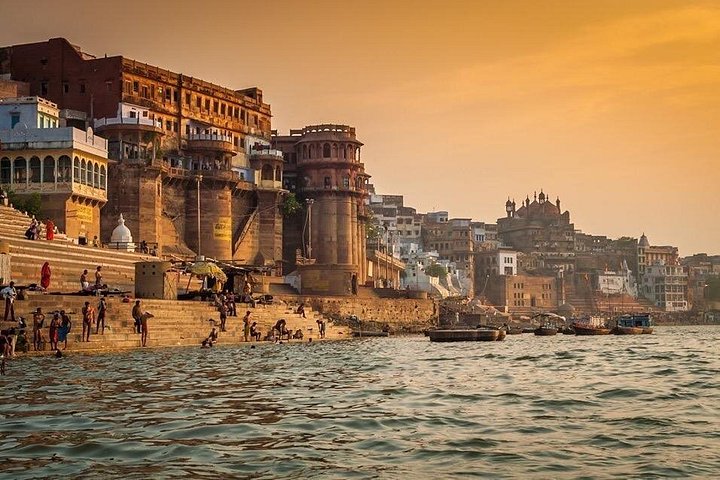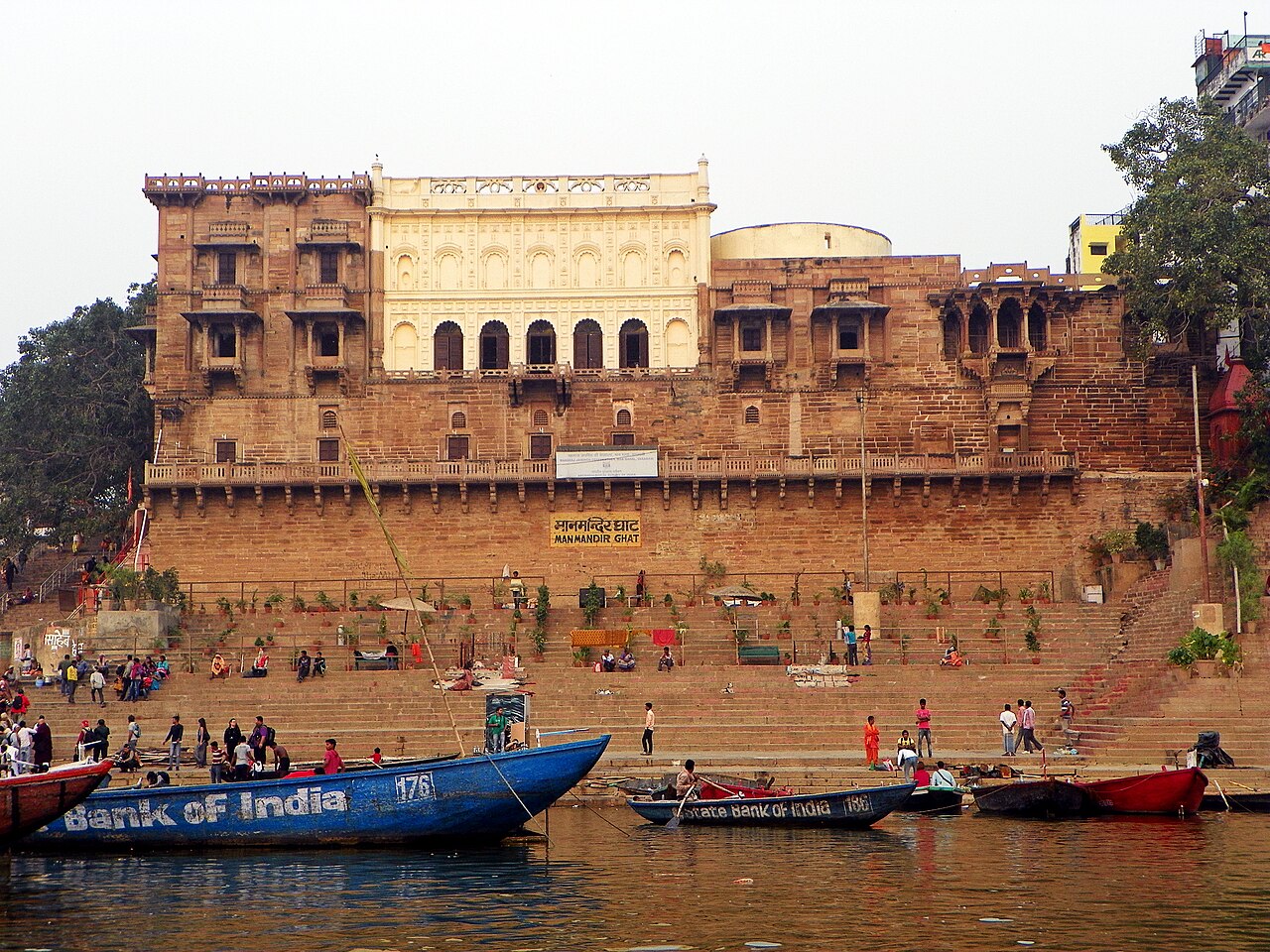
Man Mandir Ghat is one of the grand palace ghats of Varanasi, built beneath a royal palace that was constructed in the seventeenth century by Maharaja Man Singh of Amber, the ruler of the kingdom later known as Jaipur. On the roof of the palace sits a small observatory, one of the stone Jantar Mantar observatories commissioned by the astronomer-king Sawai Jai Singh II in the early eighteenth century, with large masonry instruments for measuring time, the position of the sun and the movement of the stars. The ghat itself is a broad stone stairway with carved balconies and windows overlooking the river, and it sits between Dashashwamedh Ghat and the cremation ghat of Manikarnika, so it is easy to reach on a ghat walk. Next to it is Lalita Ghat, where a wooden temple built in the Nepali style stands over the steps, a surprising sight among the stone buildings. The stretch gives visitors a clear picture of the architecture of the riverfront: royal patrons from different parts of India built palaces and steps here so that they could bathe and worship in the holy river. The ghat is open to walk through at any time, and the observatory and palace areas have their own access arrangements, so confirm them locally on the day. The carved windows and balconies of the palace face the river, which tells you that rulers once watched ceremonies and boats from these rooms, and the whole frontage is a good example of the Rajput style used across the ghats. Morning light on the stone is particularly good for photographs.
Why include it? Because most visitors see the ghats as a blur of steps and boats, and this is the place that explains them. The palace and the observatory show that Varanasi was not only a place of pilgrimage but also a centre of learning, where kings invested in astronomy and where Hindu and astronomical traditions met. It is a quieter and more architectural stop than Dashashwamedh, and the views from the upper terrace across the river are among the best on the ghats.
How to do it
Reach the ghat on foot from Dashashwamedh in a few minutes, or stop here on a boat ride, when the facade appears from the river. Go in the morning for the best light and the fewest crowds, and walk up the steps to see the carved windows and balconies. Ask locally about visiting the observatory terrace, because access and tickets can change.
Walk a little further to Lalita Ghat for the Nepali-style temple, and then continue on the old lanes. Be aware that the cremation ghat of Manikarnika is nearby, so follow the usual etiquette: do not photograph cremations or pyres, keep your voice low and step aside for processions.
Who it suits
History and architecture lovers, photographers and anyone who wants context for the ghats beyond the evening aarti. It works well as the middle stop of a ghats heritage walk and as a place to rest on the steps. The steps can be steep and uneven, and the area is busy with boats and vendors, so wear good shoes, watch your footing and decide in advance whether you want a guide. If you are short of time, the view from the water gives you the facade, but the terrace gives you the detail.
What to expect
The experience
A walk to a palace ghat with carved balconies, a rooftop stone observatory and the neighbouring Nepali-style temple at Lalita Ghat.
Best time
Morning for light and fewer crowds, or from a boat for the full facade.
How long
About an hour on foot, more if you add the observatory terrace.
Tips
Check access to the terrace locally, wear good shoes for steep steps, and follow cremation-ghat etiquette in the nearby stretch.
Quick picks
- Best for
- History and architecture lovers who want to understand how the ghats were built.
- Families
- The steps are steep and uneven, so hold hands with younger children.
- Couples
- A quieter stretch for a river view and photographs.
- Pair with
- Dashashwamedh Ghat for the aarti or the ghats heritage walk.
- Time needed
- About an hour.
Good questions
Who built Man Mandir Ghat?+
The palace above it was built in the seventeenth century by Maharaja Man Singh of Amber, and the observatory was added in the early eighteenth century by Sawai Jai Singh II.
What is the Jantar Mantar here?+
A small stone observatory with large masonry instruments for tracking time and the movement of the sun and stars, one of several built by Jai Singh II.
Is the ghat free?+
Yes, you can walk the ghat at any time. Access to the palace terrace and observatory has its own arrangements, so ask locally.
What is at Lalita Ghat?+
A wooden temple in the Nepali style stands above the steps, next to Man Mandir Ghat.
Is it near the cremation ghats?+
Yes, Manikarnika is a short distance along the river. Do not photograph cremations or pyres and keep your voice low.