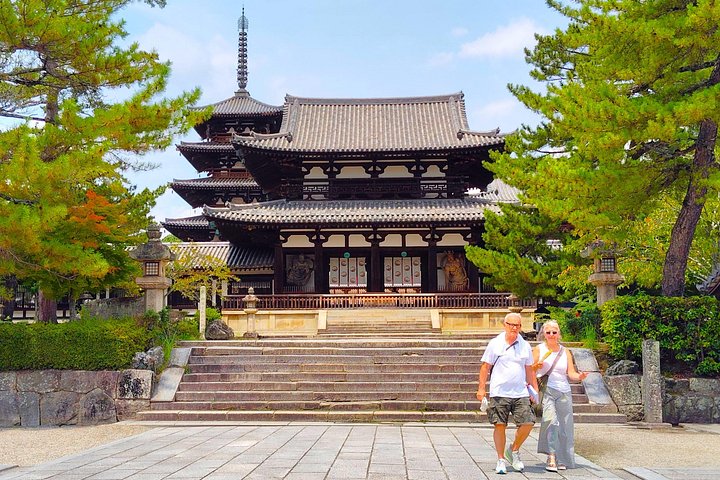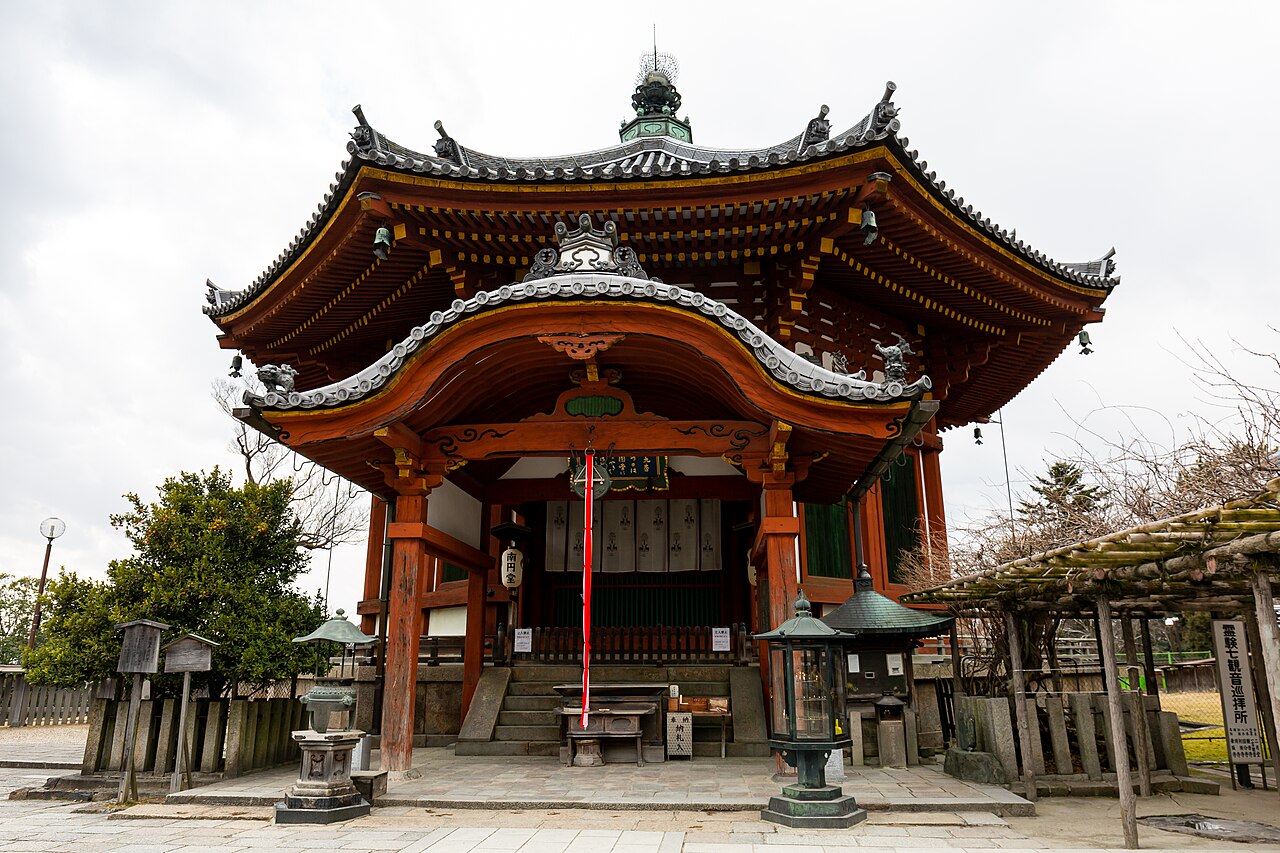
Long before Nara became the capital in the early eighth century, the early Japanese court was based in the Asuka valley, a few stops south of the city on the Kintetsu line. Today Asuka is a peaceful patchwork of rice terraces, persimmon orchards and scattered farmhouses, and it holds some of the oldest and most mysterious monuments in the country. There is little here that looks like a conventional tourist attraction. Instead, the pleasure lies in riding or walking from site to site across the quiet countryside, with mountains in the distance and a sense that history is lying just under the fields. The best-known sights include Asuka-dera, a modest temple that holds a large seated bronze Buddha, the Asuka Daibutsu, which dates from the early seventh century and is regarded as the oldest surviving Buddha statue of its kind in Japan. Not far away stands the Ishibutai Tomb, an enormous exposed stone burial chamber made of boulders weighing tens of tonnes, which has long been linked to the powerful Soga clan. Scattered across the valley are puzzling carved granite boulders, such as the Kameishi, the tortoise stone, and the Sarutaishi, and nobody knows for certain what they were for, which adds to their appeal.
What to see and how to go: the standard way to explore Asuka is by bicycle, which you can rent at the station, since the sites are spread across a few kilometres of flat or gently rolling lanes. The core route runs from the station area to the Ishibutai tomb, the Kameishi, Asuka-dera and the Asuka Daibutsu, with detours to smaller temples, hillside views and rice-field paths.
Most of the monuments are free or charge a small fee, and a single circuit takes about three to four hours at a relaxed pace. Interpretive signs in English exist at the major stops but are sparse elsewhere.
How the guided option works
The booking link on this page is for a private guided tour of Asuka that connects the ancient capital with its legacy, and it is a good fit if you would like the stories behind the stones explained, since many sites look like grassy mounds without context. A private tour can also adapt the pace and the mode of travel, so check the meeting point, the transport used, what is included and whether any entry fees are paid separately when you book.
Planning the visit
Asuka is south of Nara and is reached by train through the Kashihara area, with a change on the Kintetsu lines, and you should expect the journey to take about an hour or more each way. Spring and autumn are the best seasons, when the fields are green or golden, and in autumn the rice terraces are especially photogenic.
Summer is hot with little shade on the lanes, and winter can be cold but very quiet. Carry water, wear a hat, and keep to the lanes and paths so as not to trample crops.
If you love history that is more atmospheric than monumental, Asuka is the place to spend a full day, and it pairs naturally with a night in Nara before or after. Before you set out, pick up a simple map at the station and mark the main stops, because the lanes can feel confusing and signposts are modest. Keep a few small coins for the entry fees and a light jacket for the shaded stretches, and take time to stop at a farm stand for fruit or a cold drink.
What to expect
The experience
A day of cycling or walking between ancient tombs, carved stones and a very old temple in a quiet farming valley, on your own or with a private guide.
Best time
Spring and autumn, when the fields are green or golden and the air is comfortable for cycling.
How long
Three to four hours for the main circuit, or a full day with detours and the journey from Nara.
Tips
Rent a bicycle near the station, carry water and a hat, take cash for small entry fees and keep to the paths around the fields.
Quick picks
- Best for
- History lovers who prefer atmosphere and countryside to big monuments.
- Families
- Good for families with confident cyclists, though the distances add up and shade is limited.
- Couples
- A slow, romantic day among the rice fields and old stones.
- Pair with
- Hase-dera, Muro-ji or a slow evening back in Nara.
- Time needed
- Allow a full day including the train.
Good questions
How do I get to Asuka from Nara?+
Travel by train toward the Kashihara area on the Kintetsu lines, with a change, and then continue to the Asuka area. Check the timetable at the station, as the journey can take more than an hour.
Do I need a bicycle?+
A bicycle is the best way to see the scattered sites, and rentals are available near the station. Walking is possible but covers less ground.
What is the Asuka Daibutsu?+
It is a large seated bronze Buddha at Asuka-dera, dating from the early seventh century and regarded as the oldest of its kind in Japan.
Are the sites expensive?+
Most are free or charge a small fee, so cash is useful for the few that do.
Is a guided tour worthwhile?+
Many Asuka sites are grassy mounds and stones with little signage, so a guide adds a lot of meaning.