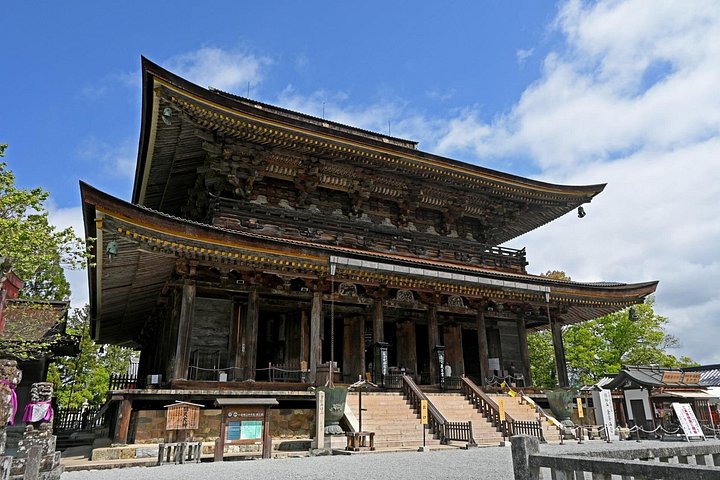
Muro-ji is a Buddhist temple in the mountains of eastern Nara Prefecture, hidden in a steep valley of giant cedars. It is associated with the early Shingon school of Buddhism and, unlike the great mountain monastery of Koya, it has long welcomed women as well as men, which earned it the affectionate nickname of the women's Koya. Its buildings are scattered along a mountain path and stone stairs, with moss-covered steps, small halls and shrines half hidden by the trees, and the whole complex has a feeling of deep calm. The temple's best-known sight is its five-storey pagoda, which at about sixteen metres is the smallest outdoor pagoda of its type in Japan. It stands in a clearing among the trees, and in late spring the surrounding slopes bloom with thousands of rhododendrons in pink and white. The pagoda was badly damaged by a typhoon in the late twentieth century and carefully rebuilt, and today it looks complete again, with its small roofs and bright upturned corners. Above it, a long stone stairway of several hundred steps climbs to the Okunoin, the inner hall, which holds the temple's most sacred image.
What to see
Walk from the entrance gate along the cedar path to the main halls and then to the pagoda, where the view of the small tower among the trees is the classic photograph. Beyond the pagoda, the long stone stairway climbs steeply through cedars to the inner hall, a climb that takes about fifteen to twenty minutes and is worth doing for the atmosphere, though it is demanding on the knees. The grounds are small, and you can see the main buildings in an hour if you skip the upper stairs.
How the guided option works
The booking link on this page is for a guided visit to the temple, which suits travellers who want the history of the temple and its place in the Shingon tradition explained, as well as help with the mountain bus connection. Check whether temple entry is paid separately, what is included, and where you meet. If you plan to go by yourself, the English signage on the grounds is limited, so a short read about the temple before you go will add a lot.
Planning the visit
Muro-ji is remote. From Nara, travel by train to Muroguchi-Ono Station on the Kintetsu Osaka Line, and then take a local bus up the valley, with services that can be infrequent, so check the timetable before you set out and plan for a longer day. The best time is late April to May for the rhododendrons, though the temple is atmospheric in every season, including snow in winter and misty mornings in autumn. Wear sturdy shoes with grip and carry water, since there are few shops.
Allow about half a day plus travel, and treat it as a rewarding, quieter alternative to Hase-dera, which lies nearby. It helps to bring a small flashlight or phone light for the darker corners of the inner halls, and a light waterproof layer, since weather in the valley can change quickly. Take your time on the stairs, rest at the landings and enjoy the smell of the cedars, which is one of the temple's quiet pleasures.
What to expect
The experience
A walk through a forested mountain temple with a small five-storey pagoda and a long stone stairway, on your own or with a guide.
Best time
Late April and May for the rhododendrons; weekday mornings in any season for the quietest visit.
How long
About two hours at the temple, plus a longer trip from Nara by train and bus.
Tips
Check the bus timetable before you leave, wear shoes with grip, carry water and cash, and allow a full half day.
Quick picks
- Best for
- Travellers who want a remote, atmospheric temple with very few visitors.
- Families
- Best for older children, because the stairway is steep and the bus connection takes planning.
- Couples
- Misty, mossy and deeply quiet, especially on a weekday morning.
- Pair with
- Hase-dera, or a night in Nara before an early train.
- Time needed
- Allow most of a day including travel.
Good questions
Why is Muro-ji called the women's Koya?+
It has long welcomed women pilgrims, unlike many mountain monasteries, and it follows the Shingon tradition, so people gave it the nickname.
How do I get to Muro-ji?+
Take a train on the Kintetsu Osaka Line to Muroguchi-Ono Station and then a local bus up the valley. Check the timetable first, because services can be infrequent.
When are the rhododendrons in bloom?+
They usually bloom in late April and May, depending on the weather. Check the temple's pages for the current season.
Is the stairway difficult?+
It is steep, with several hundred stone steps, but it is short enough to manage at a slow pace.
Is a guide necessary?+
No, but a guide helps with the bus connection and the temple's history.