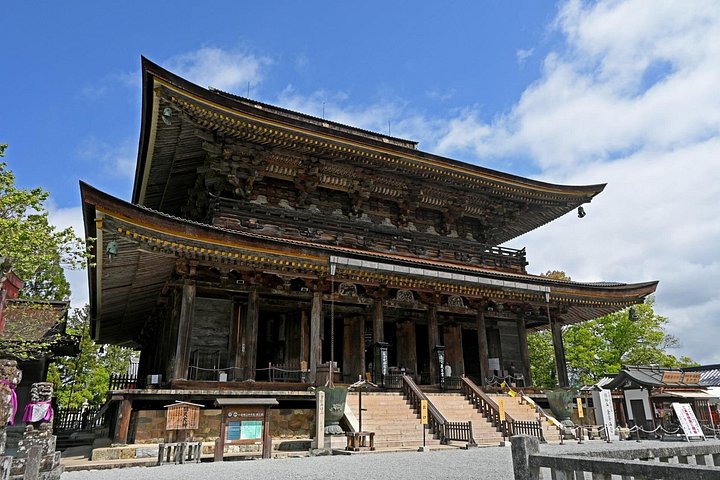
Most visitors to Nara never leave the eastern side of town, which is a pity, because two of its finest temples sit a few kilometres west of the stations in a calm, almost suburban setting. Yakushi-ji was founded in the late seventh century and moved to its present site when the capital relocated to Nara, and its East Pagoda, completed in the early eighth century, is the one building that has survived from that first era. From a distance it looks like a six-storey tower, but three of the roofs are small skirt roofs, so the pagoda is really a three-storey structure with a rhythm of large and small eaves that makes it unforgettable. The main hall holds a bronze Yakushi triad, a Buddha of healing flanked by two attendants, with the dark patina of more than a millennium on its surface. Nearby stands the Genjo Sanzo-in, a hall dedicated to the monk Xuanzang who carried Buddhist scriptures from India to China. A short walk north brings you to Toshodai-ji, founded in the middle of the eighth century by Ganjin, the Chinese monk who made several failed attempts to sail to Japan, lost his sight on the way and finally arrived to teach the monastic rules. Its Kondo, or Golden Hall, is regarded as one of the finest surviving examples of Tang-influenced temple architecture in Japan, with a row of heavy pillars along the front that swell slightly in the middle. Both temples belong to the Historic Monuments of Ancient Nara World Heritage listing.
What to see at each temple
At Yakushi-ji, give yourself time to circle the East Pagoda from different angles, then step into the Kondo and the lecture hall, and look at the gentle detail of the roof ornaments. The precinct also has a cluster of newer halls and a quiet garden. At Toshodai-ji, the main hall is the highlight, followed by the lecture hall, the treasure houses and a path through mossy grounds to the memorial of Ganjin.
Interior access to some halls is limited and conservation work comes and goes in both precincts, so expect some scaffolding or screens at times and check before you set your heart on a particular photograph.
How the guided option works
The booking link on this page is for a guided visit that is built around Yakushi-ji and offers either Toshodai-ji or a sutra-copying session as the second part. Sutra copying is a pleasant, meditative activity in which you trace characters with a brush, and it suits people who want something hands-on rather than another hall to admire.
Check what is included and whether temple entry is paid separately, and note the meeting point before you go. A guide is particularly helpful here because the signs are modest and the history of Ganjin and the pagoda is full of good stories.
Planning the visit
Both temples stand close to Nishinokyo Station on the Kintetsu Kashihara Line, a short train ride from Kintetsu Nara Station with a change or a direct service depending on the time of day. The two temples are about ten minutes apart on foot along a flat road, so you can see both comfortably in half a day.
Both close in the late afternoon and charge separate admission, mostly in cash. Combine them with a morning in Nara Park and an early lunch in the old town, or go first thing and be back in the centre by lunchtime.
The quiet is part of the appeal, so aim for a weekday if you can. A word on timing: the light on the pagoda is best in the morning and again late in the day, and both temples have gift shops with good stamps and small keepsakes if you collect temple seals. Take your time, because the charm of this part of town lies in the pauses between the buildings.
What to expect
The experience
A walk through two temple precincts on the western side of the city, with the option of a guided visit that adds either the second temple or a sutra-copying session.
Best time
Weekday mornings, when both precincts are very quiet; autumn and spring are especially pleasant on the tree-lined paths.
How long
About two to three hours for both temples at an easy pace.
Tips
Carry cash for the separate entry fees, wear shoes that are easy to remove, and check in advance for screens or scaffolding on any hall you most want to see.
Quick picks
- Best for
- Travellers who have seen the main park sights and want something quieter and older.
- Families
- Calm and spacious, though older children get more from it than toddlers; the sutra-copying option is a good hands-on break.
- Couples
- A peaceful, unhurried morning away from the crowds, with fine pagoda views.
- Pair with
- Horyu-ji later in the day, or Naramachi and Kofuku-ji back in the centre.
- Time needed
- Allow half a day including the train.
Good questions
Are the two temples close together?+
Yes, they are about ten minutes apart on foot along a flat road, so most visitors see both in one outing.
How do I get there from central Nara?+
Take the Kintetsu line from Kintetsu Nara Station toward Nishinokyo Station, which is the stop for both temples. The journey is short, and you can check the timetable at the station.
Do I need a guide?+
A guide is not essential, but the history of the pagoda and of Ganjin is much more vivid when explained. English signs cover the basics.
What is sutra copying?+
It is a quiet meditative practice in which you copy a short Buddhist text with a brush and ink. No skill is needed, and it is offered as an alternative second stop on the guided option.
Is it worth the trip if I only have one day?+
If you have only one day, focus on the park and the great temples first. With two days, western Nara is a rewarding and much calmer half-day.