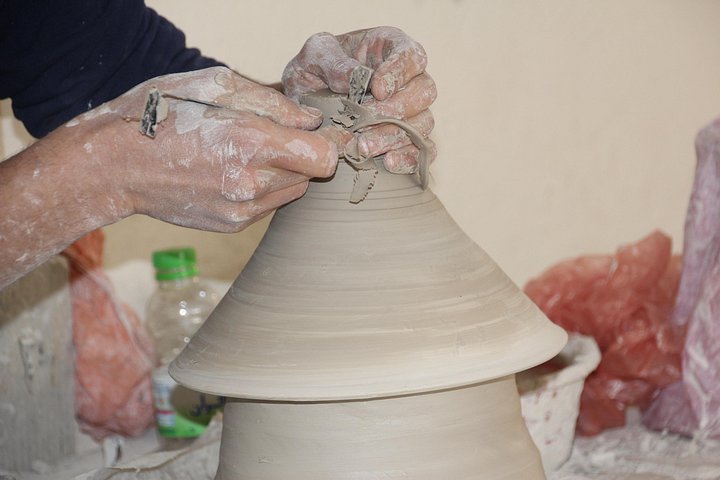
Fes has been a city of craftspeople for more than a thousand years, and the medina still works as a vast open workshop. Leatherworkers, coppersmiths, weavers, potters and plaster carvers practise skills passed down within families, and the best way to understand them is to try one yourself. A workshop turns a crowded souk into something you can read, because once you have shaped a pot or carved a pattern, you look at every finished piece differently.
Start with what interests you
If you love architecture, a plaster carving or calligraphy session explains the decoration you will see in Bou Inania and Al-Attarine. If you like colour and texture, wool dyeing and carpet weaving show how Moroccan textiles are made. If you want something tactile and forgiving, the pottery and zellige mosaic workshop is the most popular choice, because you finish with a piece you can carry home. Choose one or two rather than five, since a craft day is enjoyable when it has room for tea and conversation.
Pottery and zellige
Fes is renowned for its ceramics, and the zellige mosaic tradition, in which tiny glazed tiles are cut by hand and assembled into geometric patterns, is among the finest in the Islamic world. In a workshop you usually decorate or shape a piece, learn about glazes and see how tiles are chiselled from larger squares. It suits children and adults alike and takes around two hours.
Weaving and dyeing
A carpet weaving workshop puts you at a loom with a weaver who explains wool, patterns and knots, while a dyeing workshop explains plant and mineral colours. Together they make a good pair, because one follows the other from thread to textile. Both are indoors and seated or semi-active, so they suit hot or wet days.
Plaster and calligraphy
These are the quiet crafts, requiring patience and a steady hand. Plaster carving gives you a chisel and a small panel, and calligraphy gives you a reed pen and ink. Both link directly to the madrasas, so schedule your workshop before a madrasa visit and you will arrive with trained eyes. Children who can concentrate often enjoy them, but they are better suited to older children and adults.
Food as craft
Bread and pastry are crafts too. The baking workshop at a palace-riad cooking school shows the dough work behind every meal, and a savoury cooking class or a market-led class in a riad shows how a table is built from stall to plate. If you want a break from clay and wool, these are pleasant additions.
How to plan a craft day
Pair a morning workshop with a medina walk and an afternoon tea. Ask your guide to link visits so you do not spend half your time crossing the lanes. Fes is compact for a city of its fame, but its streets are slow, so allow extra time between activities. Wear clothes that can take dust, clay, dye or ink, and carry a small bag for your creations. Check how long a piece needs to dry and how to pack it, because plaster and ceramics are fragile.
Buying well
Workshops often end in a showroom, which is normal and fair, but you are never obliged to buy. If you do, ask about materials, whether pieces are handmade and how long they took, and compare more than one seller. Bargaining is expected, so start politely at a fraction of the first price and settle where both sides are comfortable. Avoid buying on your first day, so you have a sense of quality and value. For larger items such as rugs or ceramics, ask about shipping and packaging before you pay. Many shops can arrange it, but costs and timing vary.
Respect and etiquette
Artisans are happy to be photographed at work, but ask first and avoid pointing a camera at faces without permission. Tip your instructor if you enjoyed the session, and thank them in a simple phrase. If you are curious about the craft, ask questions, because many craftspeople are proud of their skills and happy to talk about their families and traditions.
Seasons and timing
Workshops run all year, but spring and autumn are the busiest seasons, so book ahead. In summer, indoor workshops are a welcome relief from the midday heat, and in winter they provide a warm, dry activity. During Ramadan, schedules shift, so check availability when you book.
Final tip
The best craft experiences are slow. Give yourself time to sit, ask and try, and you will leave Fes with more than souvenirs: you will understand what you are looking at in the lanes.