Most people come to Pamukkale for the white terraces, but the city on the plateau above them is the deeper story. Hierapolis was founded around 190 BC by the kings of Pergamon, took its name from the Greek words for sacred city, and grew rich on the same warm springs that build the travertines today. It passed to Rome, flourished as a spa and textile town, was shaken by repeated earthquakes, and became a Christian centre whose pilgrims came to honour the apostle Philip. This guide walks through that history in the order you can see it on the ground.
Greek and Roman beginnings
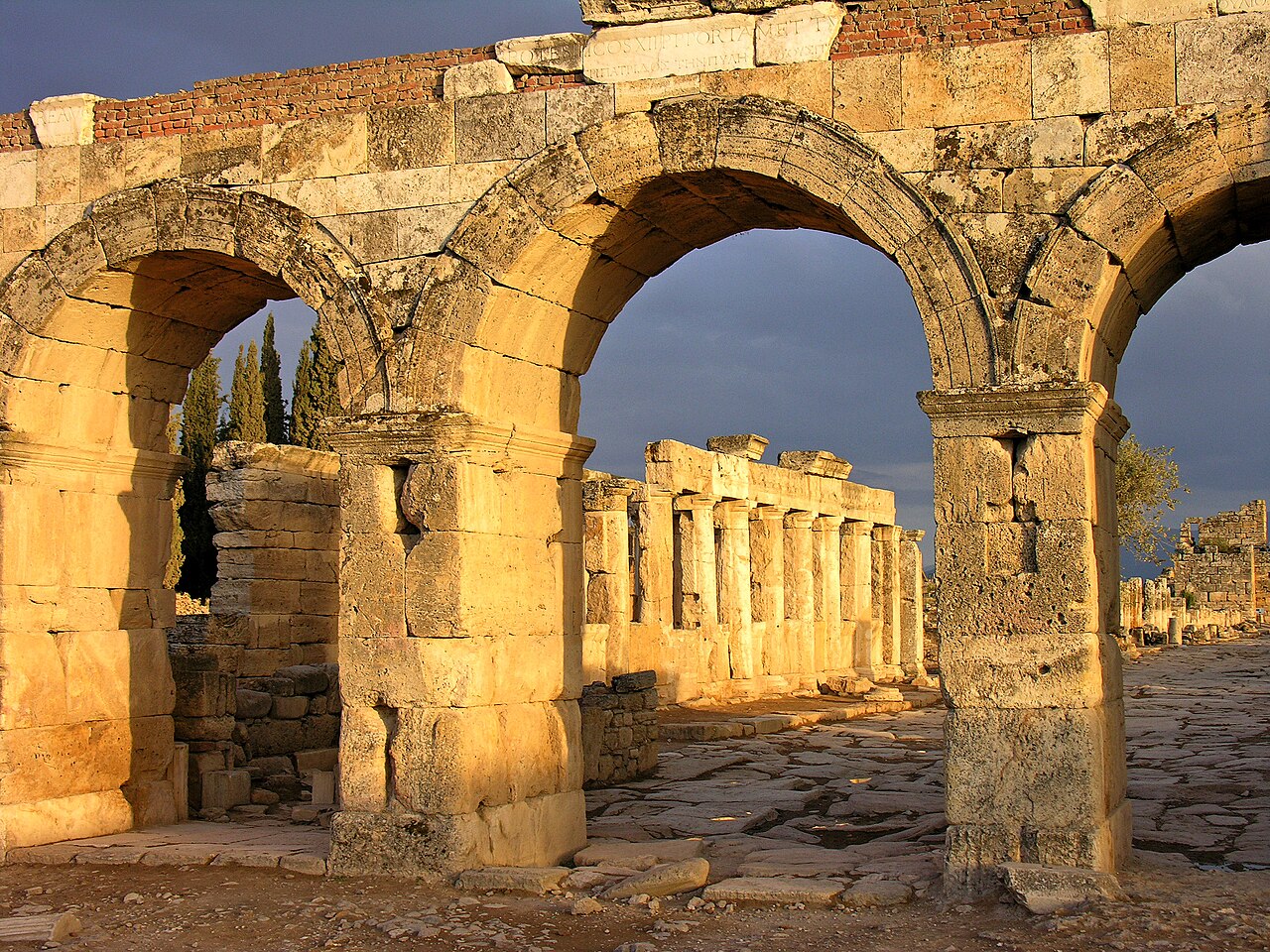
The earliest city was a modest settlement attached to the springs, but the Romans made it a showpiece. Much of what you see dates from the first to third centuries AD, when the city was rebuilt after a major earthquake and grew into a wealthy resort. Visitors came to bathe, to consult the oracle and to buy dyed wool and cloth, a trade that depended on the mineral-rich water. Start at the Frontinus Street gate and the Domitian Gate, where the colonnaded main street runs dead straight through the city. The paving, the shop fronts and the monumental gate give a clear picture of Roman urban planning.
The theatre and the civic centre
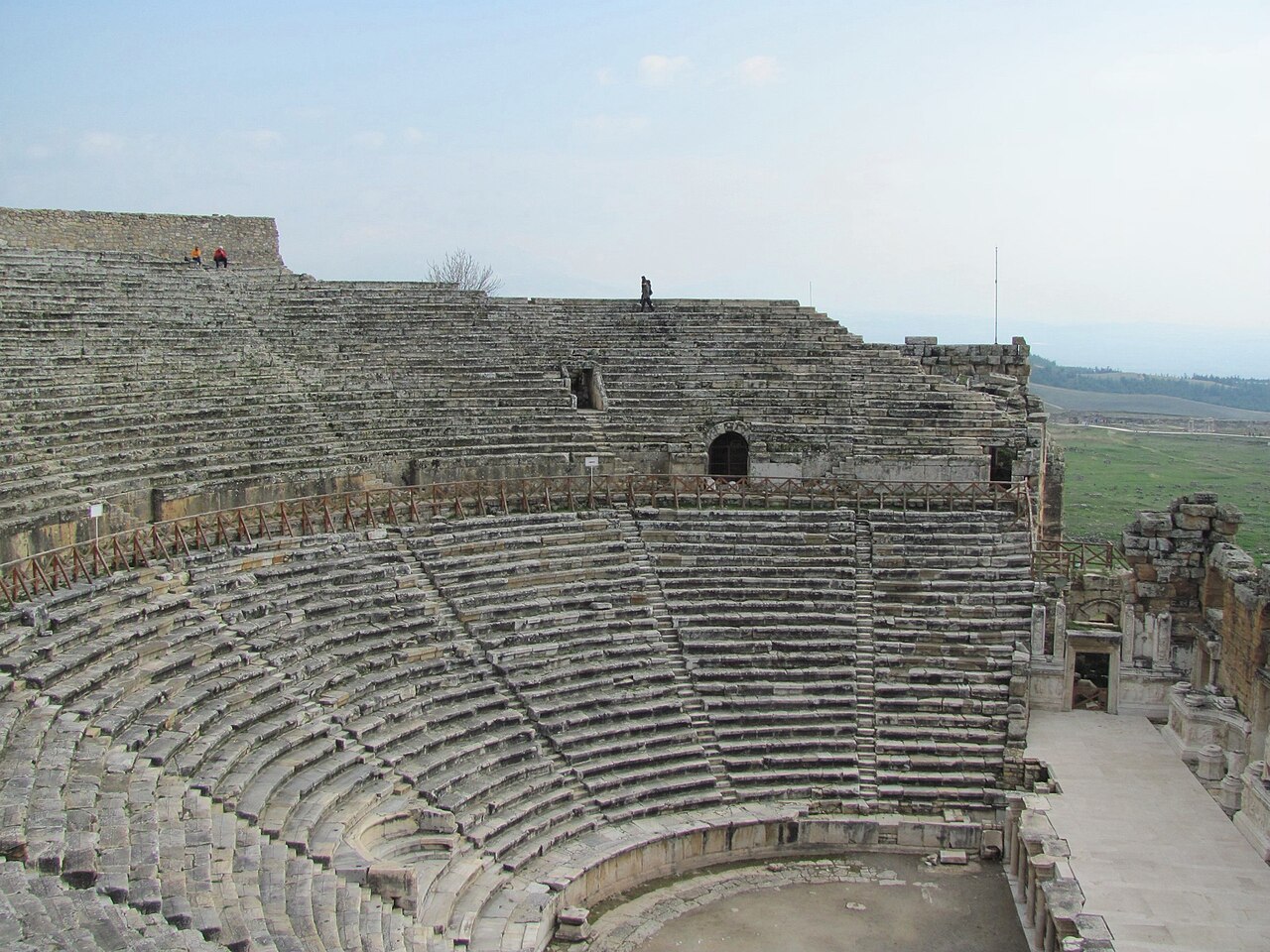
The Roman theatre sits high on the hillside and is among the best preserved in the region, with rows of seats and a richly carved stage building. It could hold thousands, and from the top rows you look out over the plain of Denizli. Near it, the ruins of the agora and the public buildings show where trade and politics took place. The theatre is the best single place to understand how the city worked as a place of entertainment and gathering, and it is worth sitting for a few minutes to take in the view.
The Temple of Apollo and the Plutonium
Hierapolis was famous across the ancient world for a cave said to be an entrance to the underworld. Poisonous gases still rise from the opening near the Temple of Apollo, and ancient writers described priests who could enter the chamber and survive while birds that flew in dropped dead. The cave is fenced off today and the temple foundations are partly preserved. It is one of the most atmospheric corners of the site, because the story, the stones and the spring come together in a few square metres.
The necropolis
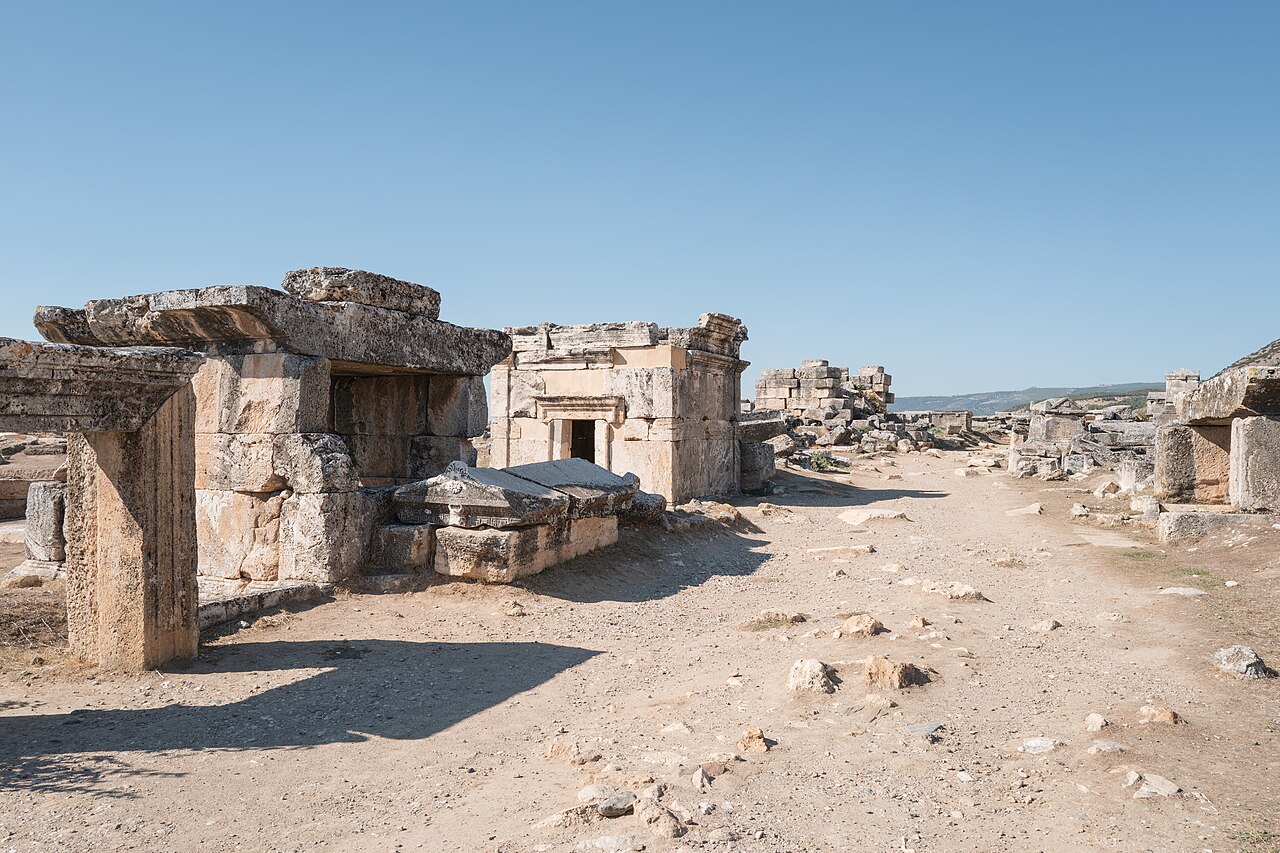
Outside the northern edge of the city lies one of the largest ancient cemeteries in Anatolia, with well over a thousand tombs. They range from simple sarcophagi to temple-like house tombs and mounds, and their inscriptions record trades, family names and curses against anyone who disturbs them. A walk among them tells you who lived here: merchants, cloth workers and wealthy families. Allow time for it, because it is quiet and often empty even when the main site is busy.
Christian Hierapolis and the martyrium
According to tradition the apostle Philip was martyred here, and the city became a place of pilgrimage. On a hilltop above the theatre stand the remains of an eight-sided church known as the Martyrium of Saint Philip, built to mark the spot. The climb is steep but rewarded with views, and the building shows how the city shifted from pagan spa to Christian centre. The Byzantine Gate at the northern edge belongs to the later city and marks the end of a walk downhill from the theatre.
The archaeology museum
Inside the old Roman baths, the museum displays sculpture, sarcophagi, jewellery and inscriptions from the excavations, and it puts faces and names to the ruins outside. It is small enough to see in under an hour and makes a cool break from the sun. If you do one indoor stop, make it this one.
A suggested route
Enter at the south gate, walk the terraces, then climb to the theatre. Continue to the Temple of Apollo and the Plutonium, visit the museum, and then walk along Frontinus Street to the northern end and the necropolis. If you still have energy, add the martyrium. A full circuit takes four to five hours at a relaxed pace, and a guide adds a great deal because few monuments carry signs.
Practical tips
Wear sturdy shoes for the ancient paving, carry water and sun protection, and bring a light layer outside summer. Check the opening hours for your season, since winter days are shorter. Early morning and late afternoon give the best light on the stones and the thinnest crowds, and the ruins are often almost empty in the cooler months.
Where to go next
If Hierapolis leaves you wanting more, the Roman city of Laodicea is a short drive away, and Aphrodisias, with its remarkable carved sculpture, makes an excellent day trip. Together they give a full picture of how Roman Asia Minor lived, traded and worshipped.